Trials of Fire
- Category:
- Release date:
- Game Genre:RPG, fantasy, turn-based, roguelike, tactical, card games, indie games
- Developer:Whatboy Games, Publisher: Whatboy Games
- Release:ElAmigos
- Platform:PC
- Languages (subtitles):English, French, Spanish, Polish, Russian, Korean, Simplified Chinese
- Crack:Codex
- Game size:1.38GB
Game Description
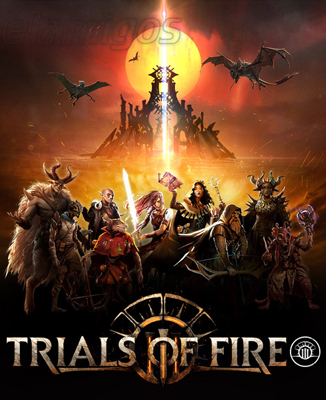
Trials of Fire PC is a single-player tactical deckbuilding roguelite from Whatboy Games, set in the ruined wastelands of Ashe. Steam and GOG continue to list it under the original name, with no verified rebrand or replacement edition. Its defining combination is a three-hero party, loot-linked card construction, overworld survival decisions, and hex-grid positional combat.
A tactical deckbuilder built around three heroes
Every expedition begins with a party of three heroes, each bringing an individual deck, role, and set of tactical priorities. Combat is not a conventional card duel. You issue commands by playing cards, moving units across a battlefield, exploiting cover, managing action resources, and deciding which hero should absorb pressure while the others create openings.
The three decks operate together, but they are not interchangeable. One hero may specialize in ranged attacks, another in close-quarters damage, and another in elemental abilities, support, or summons. The strongest turns usually come from combining these roles rather than maximizing one character's output. Positioning is critical because distance, line of attack, cover, and enemy reach can determine whether a powerful hand is useful or wasted.
Players who enjoy the card evaluation and route planning of procedural deckbuilding games such as Slay the Spire will recognize the appeal of adapting a build during a run, but Trials of Fire adds party management and spatial tactics to every encounter.
Cards, gear, and combat decisions
Cards represent more than attacks. They can provide movement, defense, buffs, debuffs, summons, utility effects, or resource manipulation. Because each hero redraws from a personal deck, a weak hand for one character does not necessarily end the turn. The wider tactical problem is deciding how to use the whole party when one deck produces the answer and another does not.
Loot-linked deckbuilding gives equipment an unusually direct role in progression. Weapons, armor, items, and other gear can add cards or modify the options available to a hero, so exploration changes the way a character plays rather than merely increasing numerical power. A piece of equipment may support a defensive build, improve a specific card interaction, or encourage a different approach to positioning.
Injuries and other weaknesses also matter. A difficult battle can leave lasting problems that dilute a deck or restrict future choices, creating a meaningful distinction between winning a fight and leaving it in good condition. The result is a combat loop built around mitigation, preparation, and knowing when a risky encounter is not worth the reward.
The overworld is part of the challenge
Outside combat, the party travels across an overworld map representing Ashe after the Cataclysm. Movement is tied to resource pressure, encounters, landmarks, quests, and opportunities to find better equipment. The route you choose affects how much danger you face and how prepared the party will be for the next major confrontation.
Trials of Fire uses an event-driven adventure structure rather than a traditional linear RPG campaign. Narrative encounters can offer rewards, complications, or difficult choices, while landmarks and hostile groups create reasons to deviate from the safest route. Exploration is therefore not a pause between battles. It is where you decide how much risk the party can accept before its next serious fight.
The game includes a substantial collection of playable heroes, skill cards, items, legendary items, narrative encounters, enemy types, bosses, and landmarks. These systems give repeated runs a different shape, but the replayability comes primarily from learning how the mechanics interact and making better strategic decisions rather than from a conventional level-based power climb.
Modes, progression, and commercial structure
The base game is a paid single-player release rather than a free-to-play service. Steam lists multiple game modes, a seasonal quest, lore quests, and a large collection of combat and exploration content. There is no verified gameplay season pass or recurring card-store model attached to the current storefront listing.
The available paid add-ons are the Trials of Fire Soundtrack and The Art of Ashe - Digital Artbook and Map. Steam also lists an Inferno Edition bundle containing the game and both bonus products. These extras are supplementary content rather than additional playable campaigns, so the standard purchase contains the core tactical adventure.
Progression operates at several levels. Heroes can improve through new abilities and equipment, individual decks become more specialized, and the player gradually learns which combinations work against different enemy formations. Because a run can be damaged by attrition before the decisive battle arrives, successful play depends on preserving options instead of chasing every reward.
Who is Trials of Fire for?
Trials of Fire is a strong fit for PC players who want turn-based tactics, deck construction, party composition, procedural exploration, and meaningful risk management in the same game. It rewards people who enjoy studying card interactions, planning several turns ahead, and rebuilding a strategy when a preferred hero or item combination is unavailable.
It is less suitable for players seeking real-time combat, online co-op, a purely narrative RPG, or a relaxed deckbuilder where every run quickly becomes overpowered. The overworld can punish inefficient routes, and tactical battles expect careful use of movement, cover, resources, and the distinct roles of all three heroes.
The presentation also has a specific identity. Ashe is presented as a fantasy world in ruin, while the interface and battlefield combine illustrated storybook framing with board-game-like units and cards. The style supports the game's systems-first design without turning it into an action-focused spectacle.
PC features, controls, and localization
The Steam edition is listed as single-player and includes Steam Achievements, Trading Cards, Steam Workshop, Steam Cloud, Steam Leaderboards, and Family Sharing. Steam Workshop support gives the PC version a community-content layer beyond the standard campaign, while the official game remains playable without requiring modifications.
Controller support is available, making gamepad play a practical option for players who prefer a living-room setup. Keyboard and mouse remain well suited to card selection, map navigation, and precise battlefield commands. GOG lists the game as DRM-free, with an optional offline installer that does not require GOG Galaxy.
The storefront language listings include English, Simplified Chinese, Russian, Polish, Latin American Spanish, French, Korean, and German interface and subtitle support. Full voice audio is not listed as a separate feature, so players should treat Trials of Fire primarily as a text-localized strategy RPG.
Similar games on PC
Trials of Fire occupies a narrower space than a standard roguelike deckbuilder because every fight combines cards with party tactics and a battlefield grid. Players who want another multi-character card combat system can compare it with dark tactical deckbuilders like Banners of Ruin, although that game uses animal warriors, row-based formations, and a different progression structure.
The Banner Saga is a closer comparison for players interested in harsh fantasy travel and difficult party decisions, but its focus is on authored narrative consequences and caravan management rather than loot-driven deck construction. Trials of Fire is the better fit for players who want to refine combat builds through equipment and card synergies across repeated adventures.
These comparisons also clarify what makes the game distinctive. It is not simply Slay the Spire with more characters, nor is it a conventional tactical RPG with cards added on top. Its identity comes from making deck quality, equipment, positioning, overworld routing, and party survival affect one another.
Trials of Fire FAQ
Is Trials of Fire still the current PC name?
Yes. Steam and GOG continue to list the game as Trials of Fire. No verified rebrand, definitive replacement edition, or new storefront title was found during the current check. The Inferno Edition is a bundle that adds the soundtrack and digital artbook and map, not a renamed game.
What type of game is Trials of Fire?
It is a single-player tactical deckbuilding roguelite with overworld exploration, party management, procedural encounters, loot-based customization, and turn-based positional combat on a hex-style battlefield.
Does Trials of Fire have multiplayer or co-op?
No. The current PC storefront listings identify it as single-player. Steam Remote Play or other platform features do not turn the campaign into online co-op or split-screen multiplayer.
How does the deckbuilding work?
Each of the three heroes uses an individual deck. Skills, weapons, armor, items, and other equipment influence the cards and tactical options available to that character. The goal is to build a party whose decks support one another rather than treating every hero as an isolated damage dealer.
What is included in the standard PC purchase?
The standard purchase includes the complete playable game, its heroes, modes, quests, encounters, items, enemies, bosses, and overworld content. The separately listed add-ons are the soundtrack and The Art of Ashe - Digital Artbook and Map. There is no verified gameplay expansion pass attached to the current listing.
Does the PC version support controllers and offline play?
Yes. Controller support is listed for the PC versions, and the GOG edition is DRM-free with optional offline installation without requiring GOG Galaxy. Steam also provides Workshop, Cloud, achievements, leaderboards, and other platform features.
System Requirements
Minimum: |
Processor: Intel Core i5 2.8 GHz Graphics: 2 GB GeForce GTX 660 / Radeon HD 7870 Memory: 4 GB RAM Disk space: 3 GB HDD Operating system: Windows 7/8/10 64-bit |
Screenshots


Trailer/Gameplay
Download
Trials of Fire (2021), 1.38GB
ElAmigos release, game is already cracked after installation (crack by Codex).

Updated to version 1.055 (05.01.2022).

1. Extract files.
2. Burn or mount the image.
3. Install the game.
4. ElAmigos release, game is already cracked after installation.
5. Play the game. If you like this game, BUY IT!
Trials of Fire Download
🔒 Premium access required
To see and use the download links, you must be logged in and have an active PREMIUM account.
* Unlock downloads via Torrent and TeraBox.
Torrent Download
The best torrent download speeds are with qBittorrent!