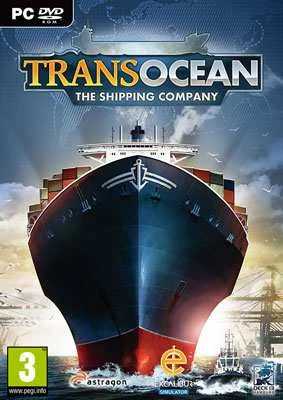
TransOcean: The Shipping Company
- Category:
- Release date:
- Game Genre:Strategy, Economic, transport, ships
- Developer:Deck13 Interactive Publisher: astragon Entertainment
- Release:ElAmigos
- Platform:PC
- Languages (subtitles):English, French, Italian, German, Spanish, Polish, Russian, Czech, Hungarian, Chinese Traditional
- Dubbing/Audio:English
- Crack:Reloaded
- Game size:3.86GB
Game Description
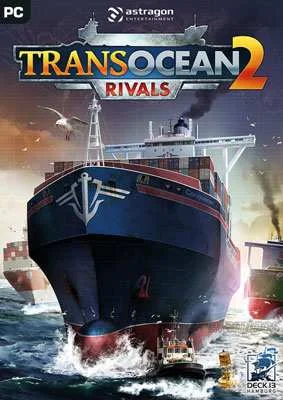
TransOcean: The Shipping Company is a PC shipping tycoon and logistics simulation from Deck13 Hamburg and astragon Entertainment. The game remains listed under its original name on Steam, with no verified rebrand or replacement edition. Its focus is clear: buy merchant ships, accept freight contracts, plan profitable routes, maintain a growing fleet, and build a reputation across a worldwide network of ports.
Run routes, contracts, and a growing fleet
The main loop combines route planning, contract management, and long-term fleet expansion. You begin by choosing a home harbor and purchasing a vessel, then compare available cargo assignments by destination, payment, capacity, weight, fuel needs, and delivery deadlines. Every contract affects your next decision because ships cannot accept unlimited freight, and late deliveries can damage both finances and reputation.
Ships travel between ports on a world map while time advances at adjustable speeds. You can pause the simulation, accelerate the clock, and redirect vessels as new opportunities appear. The strategic challenge is not simply finding the highest-paying job. It is balancing fuel costs, ship condition, port access, cargo capacity, and the risk of accepting a deadline that leaves no room for delays.
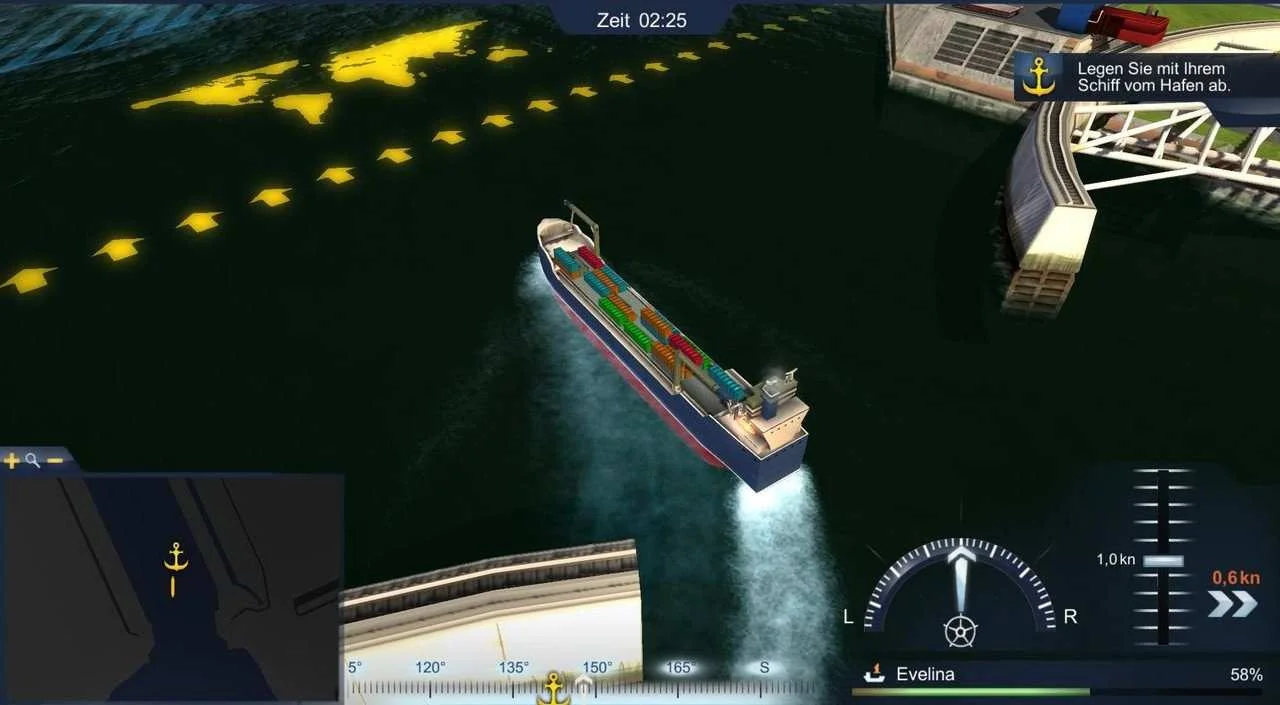
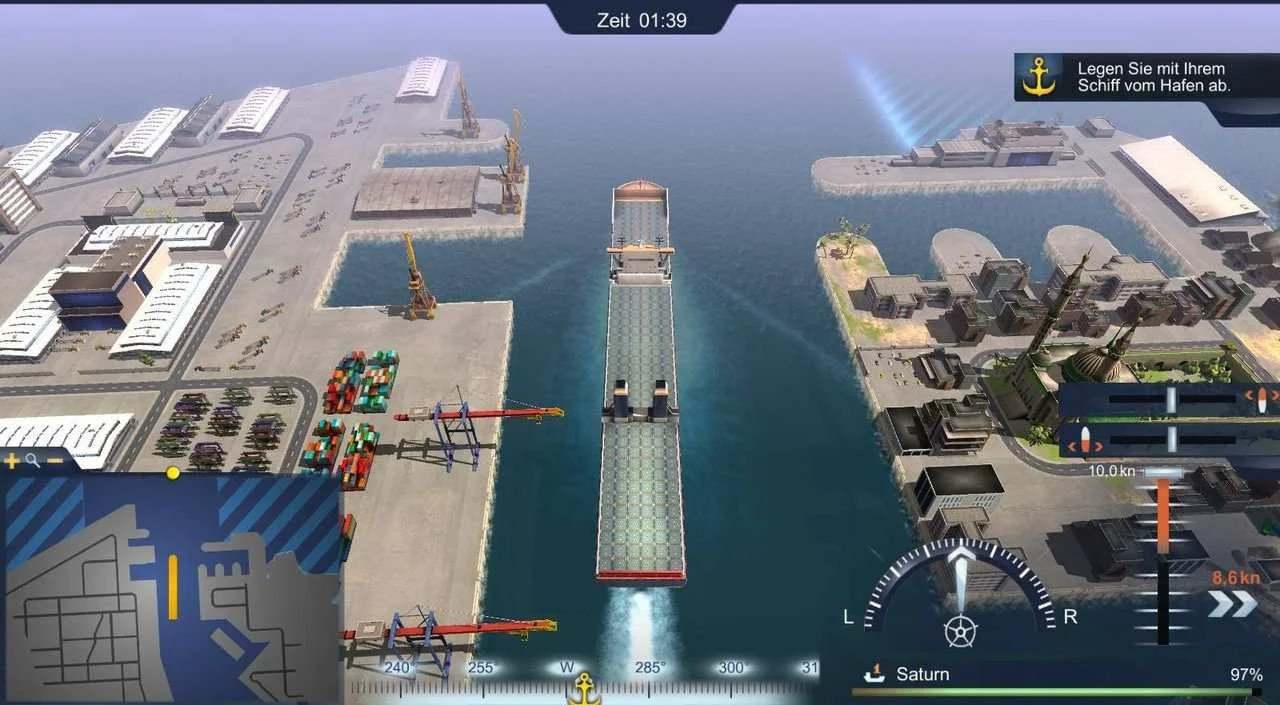
Harbor operations add a small hands-on layer to the management formula. Players can use assisted procedures or take control during manual mooring and casting off. The harbor view uses keyboard and mouse controls for thrust, rudder movement, camera panning, and additional bow or stern thrusters on larger vessels.
Ports, ship classes, and commercial risk
The game includes 55 detailed harbors, with 20 featuring recognizable landmarks, and each location has different practical advantages. Some ports offer better contracts or fuel prices, while others restrict access to smaller ships. Delivering freight also unlocks destinations, so the map gradually becomes more useful as your company establishes dependable routes.
There are 20 ship classes to evaluate, and vessel selection is tied to geography as much as cargo capacity. Feeder ships can reach smaller ports, while Panamax, Post-Panamax, New Panamax, and ultra-large vessels open different possibilities and restrictions. A ship that looks profitable on a long route may be a poor purchase if it cannot enter the destination port or requires an expensive detour around a canal.
Operational costs remain important after a purchase. Ships require fuel management, repairs, and attention to condition. Maintenance downtime creates docking costs and removes vessels from active service, while running a neglected fleet can reduce your company reputation. The game also tracks quarterly financial performance, making a large fleet a liability when its routes are poorly planned.
Dynamic prices, reputation, and events
TransOcean uses a trade system built around 22 types of goods and changing market conditions. Cargo prices vary between ports, so profitable routes depend on current demand rather than a permanently optimal circuit. Fuel prices also differ by location, which can make a short detour worthwhile when a vessel needs to refuel.
Reputation is a central progression system rather than a cosmetic rating. Completing contracts, meeting deadlines, maintaining ships, and reporting strong financial results can improve the offers available to your company. Late deliveries, customs problems, poor maintenance, and weak finances work in the opposite direction.
Random incidents and global events can disrupt an otherwise safe plan. Storms, piracy threats, port capacity, customs checks, and cargo restrictions force you to judge whether a lucrative assignment is worth the exposure. The option to carry questionable freight introduces another calculated risk: short-term profit may be outweighed by fines and reputational damage.
Campaign structure and content model
The game is designed around management progression rather than character development or a traditional action campaign. You build from a small operation, unlock more ports through successful deliveries, purchase larger ships, and improve the quality of contracts offered by the market. The mastery loop comes from learning how to combine vessel classes, port limitations, deadlines, fuel prices, and reputation.
The commercial model is straightforward. Steam lists the base game as a paid product, and the current store page does not present a separate DLC catalog or season pass for this title. It is also sold in bundles with other games in the wider TransOcean and business-simulation lineup, but those bundles do not change the content of the standalone game.
Players looking for a deep port-construction simulator should set expectations carefully. TransOcean concentrates on fleet ownership and freight contracts, not on building sprawling industrial districts, designing container terminals, or controlling a full supply chain from extraction to production.
Who should play TransOcean?
This is a good fit for players who enjoy economic games where the satisfaction comes from improving margins and reducing wasted time. The strongest audience is made up of fans of merchant fleet management, spreadsheet-style planning, trading simulations, and transport games that let small operational decisions shape a larger company.
It is less suitable for players expecting direct ship piloting to dominate the experience. Manual harbor maneuvers are present, but most of the game is spent selecting contracts, arranging routes, monitoring vessels, buying ships, and protecting the company balance sheet. The world is maritime, yet the core experience is business administration rather than nautical adventure.
Players comparing it with road-based logistics management may also find a useful point of reference in transport tycoon games such as TransRoad: USA. The two games share a focus on contracts, vehicle fleets, route efficiency, and company growth, although TransOcean replaces highways and trucks with ports, canals, cargo ships, and international trade.
PC features, controls, and online pricing
The Steam version includes single-player support, Steam Cloud, Steam Achievements, Steam Trading Cards, and Family Sharing. The store lists Steam as the required platform and DRM layer, and the game requires agreement to a third-party EULA. No separate launcher or anti-cheat system is listed for the title.
Interface localization is available in English, French, Italian, German, Spanish from Spain, Hungarian, Czech, Polish, Russian, and Traditional Chinese. The storefront lists interface text rather than full voice acting, which suits a management game built around menus, maps, contract data, and financial information.
The game also includes an online price mode within its free-game structure. Other players' shipping activity can influence commodity prices, causing heavily used routes and goods to become less attractive while neglected markets become more valuable. Steam presents the product primarily as single-player, so this feature should not be confused with a modern co-op campaign or a shared company-management mode.
Similar games and the strategic niche
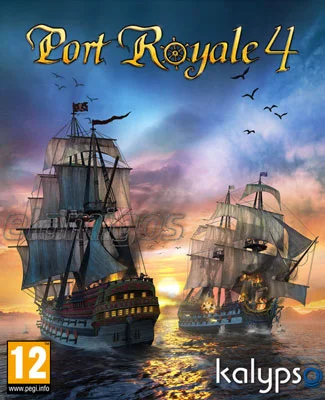
TransOcean occupies a narrower niche than broad economic sandboxes. It is closer to a focused maritime logistics game than to a city builder or naval combat title. Port Royale 4 offers more production-chain construction and historical Caribbean trading, while Railroad Corporation emphasizes infrastructure, industrial supply lines, and rail network expansion.
That narrower design is also its clearest selling point. The game gives shipping itself the spotlight: choosing a home port, matching vessel classes to destinations, managing cargo deadlines, watching fuel expenditure, and deciding when a larger ship is genuinely profitable. Players who want a compact freight-management loop may appreciate that focus more than a larger sandbox filled with unrelated systems.
TransOcean: The Shipping Company FAQ
Is TransOcean: The Shipping Company still available under its original name?
Yes. The current Steam listing uses TransOcean: The Shipping Company. No verified storefront rebrand, renamed definitive edition, or replacement title was found during the storefront check.
Is TransOcean: The Shipping Company multiplayer?
Steam lists the game as single-player. Its online option affects commodity prices according to player activity, but it is not presented as direct co-op, split-screen, or a competitive company-management mode.
What do you manage in TransOcean?
You manage merchant ships, freight contracts, routes, fuel, repairs, port access, deadlines, loans, reputation, and quarterly finances. The game includes 55 harbors, 20 ship classes, and 22 trade goods.
Can you control the ships directly?
You can manually handle harbor departure and docking using thrust, rudder, camera, and thruster controls. Long-distance travel is primarily a route-management activity on the world map rather than continuous open-water piloting.
Does the game support controllers?
The verified manual documents mouse and keyboard controls for the world map and harbor maneuvers. An official full-controller support feature is not listed on the current Steam storefront, so PC players should expect the game to be designed primarily around mouse-and-keyboard input.
What languages are supported?
The interface supports English, French, Italian, German, Spanish from Spain, Hungarian, Czech, Polish, Russian, and Traditional Chinese. The storefront does not list full audio localization.
System Requirements
Minimum: |
Processor: Core 2 Duo 2.66 GHz Graphics: 512 MB VRAM Memory: 4 GB RAM Disk space: 4 GB HDD Operating system: Windows Vista/7/8 |
Screenshots


Trailer/Gameplay
Download
TransOcean The Shipping Company (2014), 3.86GB
ElAmigos release, game is already cracked after installation (crack by Reloaded).

1. Extract files.
2. Burn or mount the image.
3. Install the game.
4. ElAmigos release, game is already cracked after installation.
5. Play the game. If you like this game, BUY IT!
TransOcean The Shipping Company Download
🔒 Premium access required
To see and use the download links, you must be logged in and have an active PREMIUM account.
* Unlock downloads via Torrent and TeraBox.
Torrent Download
The best torrent download speeds are with qBittorrent!