Phantom Doctrine
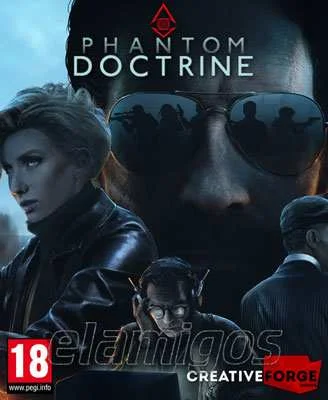
- Category:
- Release date:
- Game Genre:Strategy, turn-based, cold war, tactical, spyware, Polish, indie games, 80s
- Developer:
- Release:ElAmigos
- Platform:PC
- Languages (subtitles):English, French, Italian, German, Spanish, Russian, Polish, Chinese Simplified
- Dubbing/Audio:English
- Crack:Codex
- Game size:8.23GB
Game Description
Phantom Doctrine is a PC turn-based tactical strategy game built around Cold War espionage, counterintelligence, and stealth operations. The game remains listed under the same name on current Steam and GOG storefronts, with no verified rebrand or replacement edition. You lead The Cabal, recruit agents, connect clues, and decide whether each operation ends with a silent extraction or an open firefight.
Espionage Before the Shooting Starts
Phantom Doctrine is played from an isometric perspective, but its structure goes beyond squad combat. The campaign alternates between tactical missions, a global espionage network, base management, and the Investigation Board. Each layer feeds the others, so a clue discovered in one operation can expose a new location, recruit, resource, or technological lead.
The central campaign follows a secret organization attempting to uncover a conspiracy that manipulates governments and intelligence agencies. You can begin from the perspective of a former KGB counterintelligence operative or a renegade CIA operative. These viewpoints give the campaign different narrative framing, while a further protagonist becomes available through the Extended Playthrough after completing the main campaign.
Between missions, agents move through an espionage network in which enemy activity, informants, and operational risk constantly compete for attention. The world map is not a passive menu. It is where you decide which leads deserve resources, which agents should investigate, and when your organization needs to change its position.
How Tactical Missions Work
Tactical missions are divided into Infiltration and Combat states. Infiltration is the preferred starting point: operatives enter concealed, use disguises, avoid cameras and guards, and attempt to complete objectives without exposing the team. Combat begins when the operation turns into a firefight, bringing heavier risks and a more direct use of weapons and abilities.
Every agent normally has Action Points for movement and physical actions alongside a separate Fire Point economy for attacks. This split creates a different rhythm from many familiar turn-based squad games. Movement, reloading, abilities, equipment, breaching, and extraction all compete for carefully limited actions.
Awareness is one of the key combat systems. It affects an agent's ability to avoid or reduce incoming damage and supports powerful actions such as takedowns and headshots. Enemy awareness matters just as much, so lowering it can be more important than simply finding a better firing angle.
Stealth tools include muffled weapons, silent takedowns, disguises, and period-appropriate intelligence technology. If concealment fails, Phantom Doctrine supports open assaults with variable Overwatch modes, the Breach ability, reinforcements, heavy weapons, and air support. The game therefore allows both approaches, but its systems generally make remaining undetected the more controlled choice.
The Investigation Board and Counterintelligence Loop
The Investigation Board is the game's most distinctive non-combat interface. You connect cases, people, locations, and intelligence fragments to determine which information is relevant. This is not simply a lore archive. Solving files can reveal missions, technologies, resources, and contacts that shape the next stage of the campaign.
Recruitment is similarly broad. The Cabal can draw operatives from KGB and CIA backgrounds, criminal circles, and secret government experiments. Agents can be assigned new identities through custom character creation, with changes to appearance, forged documents, training, and equipment helping them operate under different covers.
Phantom Doctrine also includes morally severe counterintelligence systems. Interrogation, brainwashing, body engineering, and chemical enhancement can be used to extract information or improve an operative. These mechanics reinforce the game's paranoia: agents are valuable assets, but loyalty and identity are never treated as permanently secure.
The campaign is modular rather than completely fixed. Character names and backgrounds, intelligence snippets, and the composition of adapted tactical locations can vary between playthroughs. The main story remains authored, while the surrounding information and mission structure create room for different operational routes.
Content Model and PC Editions
The standard PC purchase contains the complete core game and its single-player campaign. The storefront catalog also lists a Deluxe Edition upgrade, which adds a digital artbook and the original soundtrack rather than a separate campaign or major gameplay expansion.
A free Halloween Scare Tactics add-on is listed alongside the paid Deluxe upgrade. The commercial model is therefore straightforward: Phantom Doctrine is a premium game with optional digital extras, not a free-to-play service built around recurring purchases.
Steam lists single-player, online player-versus-player matches, achievements, trading cards, cloud saves, and Family Sharing. Multiplayer is focused on competitive 1v1 skirmishes, not campaign co-op or split-screen squad management.
Who Should Play Phantom Doctrine?
Phantom Doctrine suits players who enjoy strategy games where information is as important as firepower. It is a strong fit for anyone looking for Cold War espionage, stealth-first tactics, agent management, conspiracy investigations, and a campaign that alternates between a strategic map and grid-based missions.
Players coming from XCOM should adjust their expectations. Phantom Doctrine begins missions from a concealed state and places greater emphasis on avoiding detection, managing identities, and controlling awareness. The combat system is less about maximizing damage every turn and more about preventing an operation from escalating.
It is less suitable for players who want a purely combat-focused tactics game, a fully cooperative campaign, or a fast and frictionless progression loop. The investigation systems and counterintelligence menus demand attention, while procedurally adapted side content can feel more repetitive than the authored story missions.
For a different take on turn-based stealth, turn-based cyberpunk infiltration games such as Invisible, Inc. offer a more procedural, survival-focused structure, while Phantom Doctrine gives greater weight to narrative conspiracy and organizational management.
PC Features, Controls, and Localization
Phantom Doctrine is available for Windows PC through Steam and GOG. Steam provides Steam Cloud, achievements, trading cards, Family Sharing, and online PvP. GOG offers a DRM-free version that can be installed and played offline for single-player, while its store documentation identifies GOG GALAXY as required for multiplayer access.
Controller support is present on GOG's feature listing, while Steam's metadata identifies it as partial rather than full controller support. The interface and investigation-heavy design are therefore best approached with a mouse and keyboard, with controller use treated as a supported alternative rather than the primary control method.
Steam lists English full audio and text, with Polish, French, German, Russian, Simplified Chinese, Italian, and Spanish subtitles and interface support. GOG lists the same broad text-language coverage, but English is the only language identified with full audio on the Steam listing.
There is no verified official mod-support feature to present as a core PC selling point. The confirmed platform features are the storefront integrations, online PvP, cloud functionality, controller availability, achievements, and language options.
Similar Tactical Espionage Games
Phantom Doctrine occupies a narrow space between squad tactics, stealth, and management strategy. Its closest comparisons are useful mainly for separating what you want from the formula.
For a more traditional turn-based command structure with base development and a larger emphasis on direct firefights, squad strategy campaigns in the style of XCOM 2 are the obvious comparison. Phantom Doctrine differs through concealment, disguises, awareness, and counterintelligence.
For real-time stealth puzzles with specialist agents, historical tactical stealth sandboxes such as Shadow Tactics: Blades of the Shogun provide a useful contrast. Shadow Tactics focuses on coordinated real-time abilities and patrol manipulation, while Phantom Doctrine gives each turn more weight through action economies, intelligence, and escalation management.
The result is a game for players who want their spy fantasy expressed through systems rather than only story presentation. You are not simply choosing where to shoot. You are deciding whom to trust, which identity to expose, and how much attention a successful mission is worth.
Phantom Doctrine FAQ
Is Phantom Doctrine still called Phantom Doctrine on PC?
Yes. Current Steam and GOG listings use Phantom Doctrine, and no verified official rebrand, renamed edition, or replacement storefront title was found.
Is Phantom Doctrine a single-player game?
Yes. The main experience is a single-player espionage campaign involving tactical missions, agent recruitment, investigation, base operations, and a global intelligence network.
Does Phantom Doctrine have multiplayer or co-op?
It has online competitive multiplayer through 1v1 PvP skirmishes. There is no verified campaign co-op or split-screen mode listed for the PC version.
What is included in the Deluxe Edition?
The Deluxe Edition adds the game's digital artbook and original soundtrack. The standard edition contains the main game, while the storefront catalog also lists the free Halloween Scare Tactics add-on separately.
Does Phantom Doctrine support controllers on PC?
Controller support is listed on GOG, while Steam identifies controller support as partial. Mouse and keyboard remain the safer choice for the investigation interface and detailed tactical commands.
What languages are supported?
Supported text and interface languages include English, Polish, French, German, Russian, Simplified Chinese, Italian, and Spanish. English has full audio on the Steam listing; the other listed languages are presented as text localization.
How does a Phantom Doctrine campaign progress?
Progress comes from connecting intelligence on the Investigation Board, selecting global operations, recruiting and preparing agents, completing infiltration or combat missions, and unlocking technologies and resources. The campaign is structured around operational decisions and mastery of its systems rather than a conventional level-based action game.
System Requirements
Minimum: | Recomended: |
| Processor: Intel Core i3-2100 3.1 GHz / AMD Phenom II X4 965 3.4 GHz Graphics: 1 GB GeForce GTX 550 Ti / Radeon HD 5770 Memory: 6 GB RAM Disk space: 10 GB HDD Operating system: Windows 7/8/8.1/10 64-bit | Processor: Intel Core i5-4670K 3.4 GHz / AMD FX-8320 3.5 GHz Graphics: 4 GB GeForce GTX 960 / Radeon R9 290X Memory: 16 GB RAM Disk space: 10 GB HDD Operating system: Windows 10 64-bit |
Screenshots


Trailer/Gameplay
Download
Phantom Doctrine (2018), 8.23GB
ElAmigos release, game is already cracked after installation (crack by Codex).

Updated to version 1.1.0 (14.02.2019)

Included bonus content: Soundtrack (mp3), Artbook.

1. Extract files.
2. Burn or mount the image.
3. Install the game.
4. ElAmigos release, game is already cracked after installation.
5. Play the game. If you like this game, BUY IT!
Phantom Doctrine Download
🔒 Premium access required
To see and use the download links, you must be logged in and have an active PREMIUM account.
* Unlock downloads via Torrent and TeraBox.
DLC: Halloween Scare Tactics, Alienware Jackets & Shirt.
Torrent Download
The best torrent download speeds are with qBittorrent!