Factorio
Edit date: 24-06-2026, 00:35
Reason: + update 2.0.66 - 2.0.77 (23.06.2026)
- Category:
- Release date:
- Game Genre:Strategy, science fiction, Economic, 2D, multiplayer, indie games, co-op, Find Your Next Game
- Developer:
- Release:ElAmigos
- Platform:PC
- Languages (subtitles):English, French, Italian, German, Spanish, Polish, Czech, Slovak, Russian, Hungarian, Danish, Dutch, Portuguese, Portuguese-Brazil, Finnish, Swedish, Norwegian, Turkish, Romanian, Catalan, Greek, Japanese, Korean, Chinese Simplified, Chinese Traditional (+ few more, 41 total)
- Crack:Codex/Rune
- Game size:3.96GB
Game Description
Factorio on PC is a 2D automation and construction-management sandbox from Wube Software, built around one demanding question: how far can you scale a factory before its own complexity becomes the problem? The current storefront identity remains Factorio; there is no verified rebrand or replacement edition. Factorio: Space Age is a separate paid expansion, while the major 2.0 improvements are part of the base game.
From handcrafting to full automation
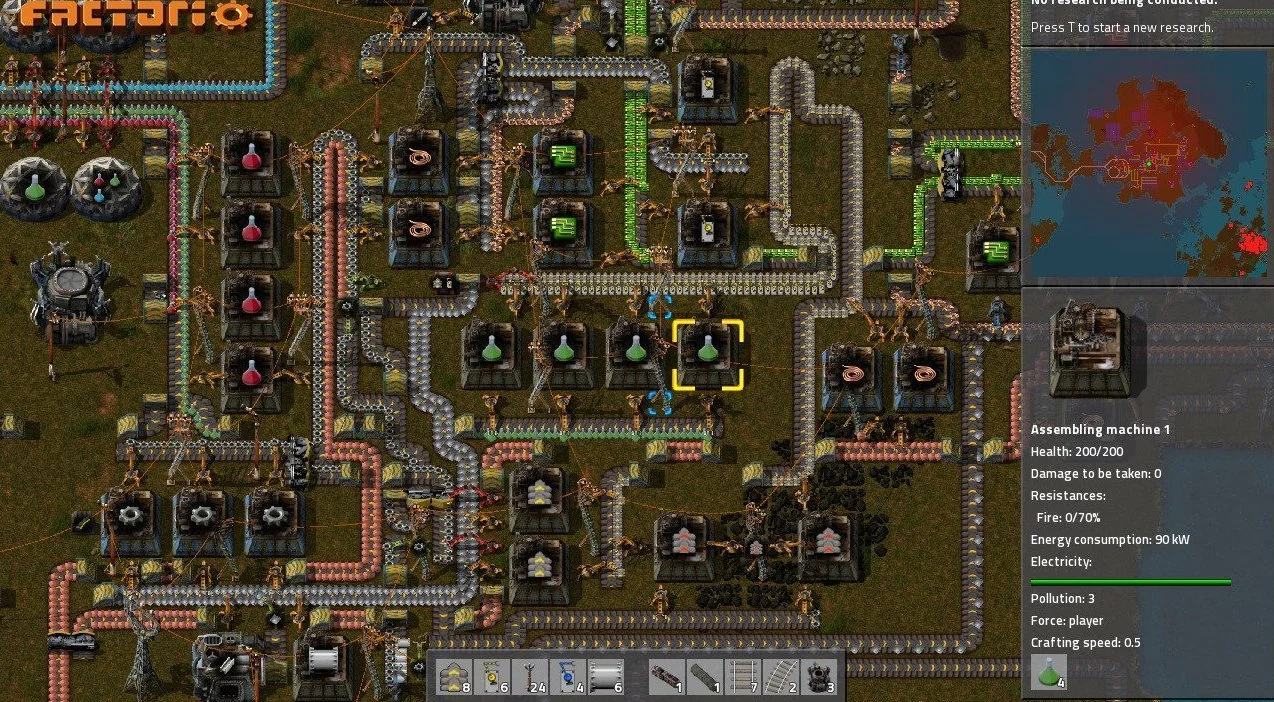
Factorio begins with a small crash-landed engineer gathering wood, mining ore, and crafting basic machines by hand. That stage is temporary. The real game starts when you replace manual work with assemblers, inserters, electric power, and transport belts that move materials without constant supervision.
The central loop is straightforward but deep: extract resources, process them into intermediate products, research new technologies, and redesign the factory whenever demand outgrows the current layout. Iron plates become gears, circuits, engines, science packs, and eventually the components needed to leave the planet. Every new production chain creates another logistics problem.
Factorio uses a top-down perspective in a procedurally generated 2D world. The map is effectively open-ended, so expansion is limited more by planning and performance than by a fixed campaign boundary. Players can build compact starter bases, sprawling megafactories, dedicated rail networks, or highly organized city-block layouts.
Logistics, power, pollution, and defense
Belts are only the beginning. Trains move bulk resources across long distances, while construction robots place planned structures and logistic robots move items through storage networks. Pipes handle fluids such as crude oil and petroleum products, and the circuit network lets players connect machines, switches, pumps, trains, and combinators into programmable control systems.
Power management becomes increasingly important as the factory grows. Steam engines provide an early solution, followed by solar fields, accumulators, and nuclear power. These systems are not just visual upgrades. They change how much space, fuel, water, and maintenance the factory requires.
Industrial expansion also creates pollution, which attracts hostile native creatures commonly known as biters. Combat is not the main focus, but defense is part of the factory loop in standard freeplay. Walls, turrets, ammunition, military research, and automated repair systems allow the base to survive while production continues. Peaceful settings and other world-generation options can reduce or remove that pressure for players who want a purer logistics sandbox.
Research, blueprints, and the mastery loop
Research is organized through science packs. Each color represents a different production challenge, encouraging the player to extend existing chains rather than simply spend a conventional experience bar. Research unlocks faster machines, new weapons, trains, robots, power systems, modules, and production methods.
The most important long-term tool is the blueprint system. Players can save factory sections, rail intersections, defenses, and complete production blocks for reuse. Blueprints turn successful designs into repeatable infrastructure, but they also expose weak planning: a blueprint that works for one line may create shortages when copied across a much larger base.
Factorio is not structured like a short story campaign with a fixed sequence of missions. Its main freeplay objective gives the factory a clear direction, while the deeper progression comes from optimization, automation, throughput, expansion, and increasingly ambitious personal projects. Players who enjoy measuring ratios and removing bottlenecks will find more structure here than the open-ended presentation initially suggests.
Space Age and the current content model
The base game is a paid standalone product with a free demo and no free-to-play economy. Its core content includes freeplay, scenarios, multiplayer, mod support, achievements, and the in-game map editor. The storefront also lists the game’s soundtrack separately.
Factorio: Space Age is a paid expansion rather than a renamed edition of Factorio. It builds on the 2.0 version of the base game with interplanetary progression, space platforms, new technologies, and four additional worlds: Vulcanus, Fulgora, Gleba, and Aquilo. Each planet introduces different resources, production constraints, and environmental problems.
Space Age also adds the Quality system, Elevated Rails, and the Recycler. These features make the expansion more than a simple post-game area. They alter production planning, rail construction, item efficiency, and the way factories are distributed between planetary surfaces and orbital platforms. Players can still run the base game without using the expansion content.
Who Factorio suits best
Factorio is a strong fit for players who enjoy automation, production ratios, logistics puzzles, rail planning, and systems that continue operating after the player stops directly interacting with them. It is particularly rewarding for people who like solving one bottleneck and immediately discovering two more.
The game is less suitable if you want a relaxed city builder, a heavily scripted story, or a factory that stays manageable without regular rebuilding. Even the early hours can require careful attention to power, storage, transport, and defensive range. The interface explains the rules, but it does not remove the need to think through consequences.
Players who want a more traditional settlement layer may prefer the resource networks and worker logistics of isometric factory city builders such as Factory Town. Factorio is more industrial and combat-focused, with far greater emphasis on autonomous machinery and throughput.
PC features, multiplayer, and mod support
On PC, Factorio supports single-player, online cooperative play, LAN co-op, and cross-platform multiplayer. Friends can divide responsibilities, with one player handling mining and power while another manages rail lines, science, defenses, or construction. Multiplayer remains cooperative at its core, although the game’s force and scenario systems provide room for custom rule sets.
The PC version includes full controller support alongside its traditional keyboard-and-mouse controls, although the interface is still particularly well suited to mouse precision and keyboard shortcuts. Steam features include achievements, cloud saves, the map editor, Family Sharing, and Remote Play on Tablet.
Modding is one of Factorio’s defining PC features. The official Mod Portal is integrated into the game, and the mod ecosystem ranges from interface improvements and small balance changes to large-scale overhauls. Mods can add technologies, enemies, planets, production chains, scenarios, vehicles, and entirely different progression structures. The official website also provides DRM-free downloads for owners who prefer not to rely on a launcher.
Steam lists a broad interface localization selection, including English, French, German, Spanish, Italian, Polish, Portuguese, Russian, Japanese, Chinese, Korean, Turkish, Ukrainian, and other languages. Full voice acting is not the focus; the game communicates primarily through interface text, item descriptions, tutorials, and research information.
Similar factory and production games
For a more compact engineering format, players may also enjoy open-ended automation puzzles like Opus Magnum. Both games reward designing production systems and improving them, but Opus Magnum presents discrete puzzle boards while Factorio turns logistics into a continuous world-scale operation.
Another useful comparison is specialized manufacturing management in Production Line: Car Factory Simulation. It focuses on arranging a commercial car plant and balancing vehicle production, whereas Factorio gives players a broader industrial toolkit with mining, combat, trains, power grids, programmable circuits, and planetary expansion.
Factorio FAQ
These answers address the practical questions that most affect how the PC version should be approached.
Has Factorio been renamed on PC?
No verified storefront rebrand replaces the original game. Current PC listings continue to use Factorio. Factorio: Space Age is the name of the paid expansion, not a new title that supersedes the base game.
Is Space Age included with Factorio?
No. The base game and Space Age are separate purchases. The 2.0 update is part of the base game, while Space Age adds planetary production, space platforms, Quality, Elevated Rails, the Recycler, and its expanded progression.
Does Factorio have multiplayer co-op?
Yes. The PC version supports online co-op, LAN co-op, and cross-platform multiplayer. Cooperative factories can assign different players to logistics, construction, research, combat, rail planning, or resource management.
Is Factorio good with a controller?
Controller support exists on PC, but keyboard and mouse remain the most natural input method for large factories, blueprint placement, circuit work, and rapid inventory management. A controller is practical for players who prefer it, while mouse precision is usually faster for complex construction.
Does Factorio support mods on PC?
Yes. The integrated Mod Portal supports a large range of compatible mods, from quality-of-life tools to total conversion-style overhauls. Modded multiplayer requires players to use matching game versions and mod configurations.
What is the real endgame in Factorio?
The base game gives players a clear technological objective, but the lasting endgame is factory mastery: higher throughput, cleaner layouts, automated construction, rail megabases, circuit-controlled systems, achievement hunting, scenarios, and large modded projects. Space Age extends that loop across multiple planets and orbital factories.
System Requirements
Minimum: | Recomended: |
| Processor: Quad Core 3.0 GHz Graphics: 2 GB GeForce GTX 750 Ti / Radeon R7 360 Memory: 8 GB RAM Disk space: 3 GB HDD Operating system: Windows 7/8/10 64-bit | Processor: Dual Core 3.0 GHz Graphics: 896 MB GeForce GTX 260 / 512 MB Radeon HD 4850 Memory: 4 GB RAM Disk space: 3 GB HDD Operating system: Windows Vista/7/8/10 64-bit |
Screenshots

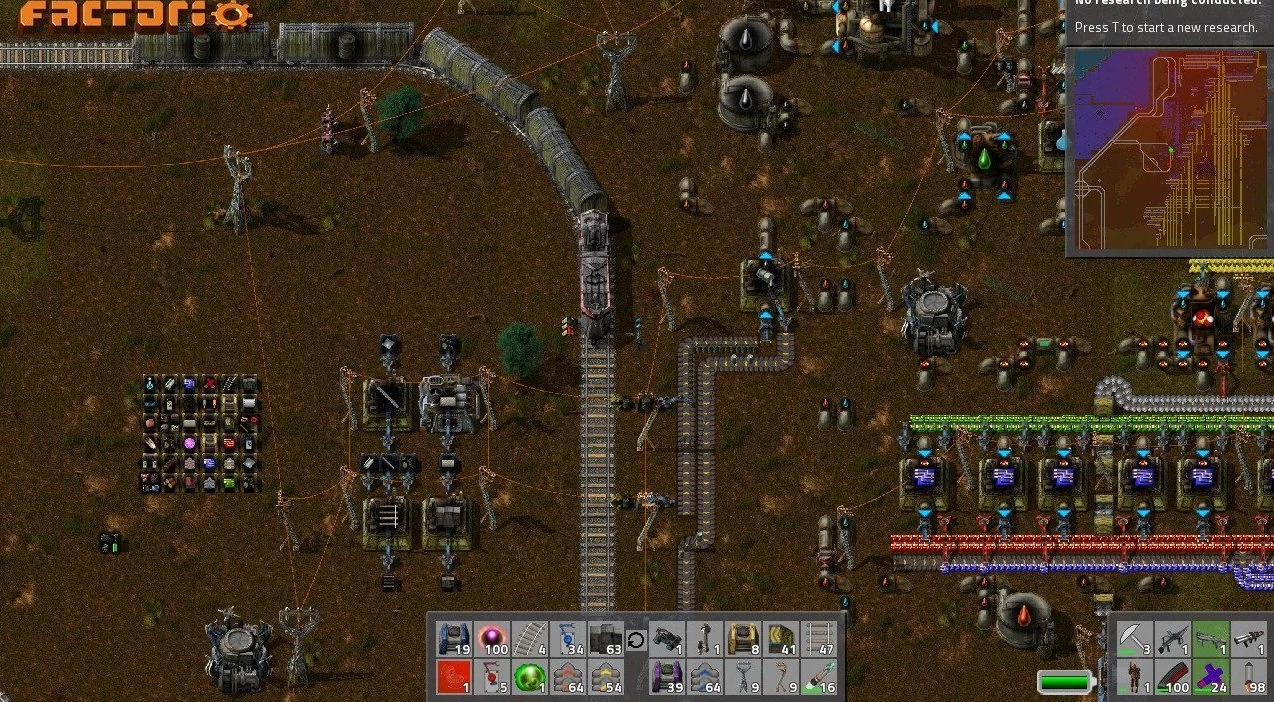

Trailer/Gameplay
Download
Factorio (2020), 3.96GB
ElAmigos release, game is already cracked after installation (crack by Codex/Rune).

Updated to version 2.0.66 (05.09.2025).

1. Extract files.
2. Burn or mount the image.
3. Install the game.
4. ElAmigos release, game is already cracked after installation.
5. Play the game. If you like this game, BUY IT!
Factorio Download
🔒 Premium access required
To see and use the download links, you must be logged in and have an active PREMIUM account.
* Unlock downloads via Torrent and TeraBox.
+ update 2.0.66 - 2.0.77 (23.06.2026) & crack (by Codex/Rune), 38MB
🔒 Premium access required
To see and use the download links, you must be logged in and have an active PREMIUM account.
* Unlock downloads via Torrent and TeraBox.
DLC: Space Age, Soundtrack.
Torrent Download
The best torrent download speeds are with qBittorrent!