Opus Magnum
Edit date: 6-01-2023, 14:38
Reason: Updated till 17.01.2022

- Category:
- Release date:
- Game Genre:Logic, 2D, indie games
- Developer:
- Release:ElAmigos
- Platform:PC
- Languages (subtitles):English, French, German, Spanish, Russian, Portuguese, Turkish, Czech, Ukrainian, Japanese, Korean, Chinese Simplified
- Dubbing/Audio:English
- Crack:Codex
- Game size:0.27GB
Game Description
Opus Magnum on PC is an open-ended programming and automation puzzle game from Zachtronics. Current storefronts continue to list the base game under the original name, with no verified PC rebrand or replacement edition. You design alchemical machines, solve production problems, and then refine each solution for efficiency, speed, cost, or compactness.
Build the Machine, Then Improve It
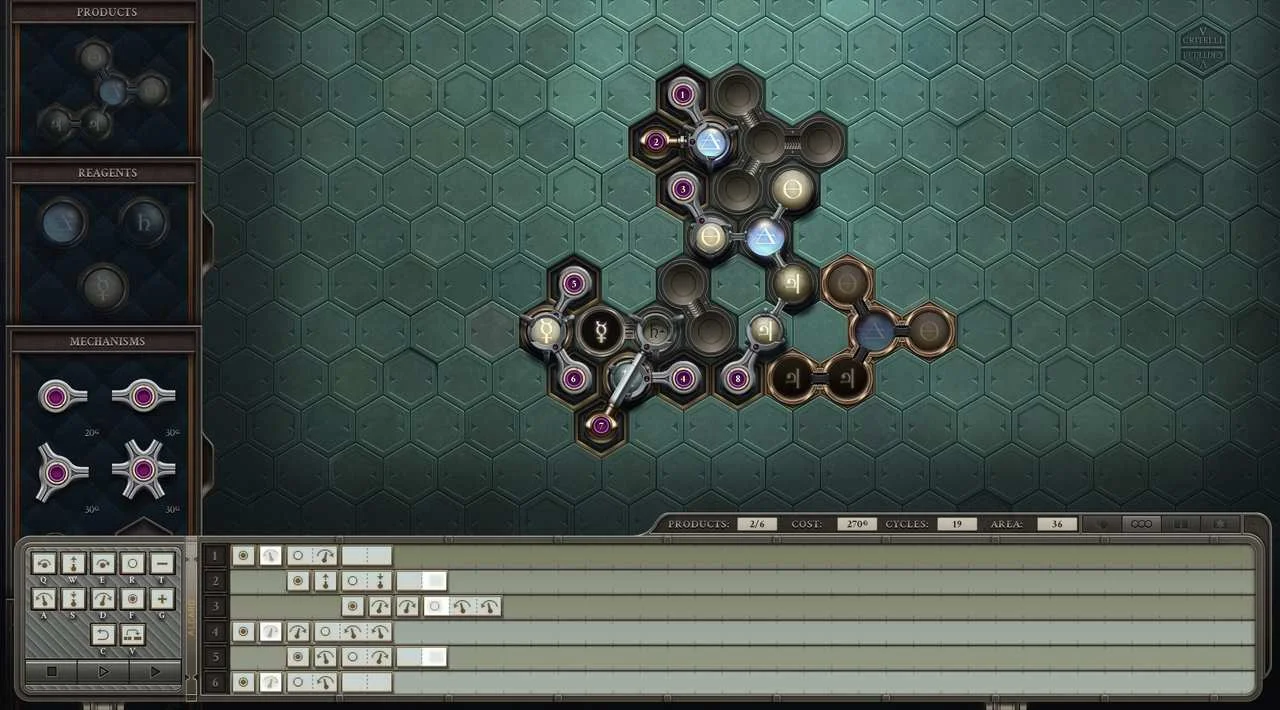
Each challenge presents a target compound and a collection of reagents. Your job is to arrange mechanical components on a hexagonal workspace so the machine can grab, transform, rotate, bond, separate, and deliver materials in the correct sequence.
The central system is the transmutation engine. Programmable arms move parts around the board, while customizable tracks guide them between operations. The result is not a conventional factory where you simply unlock better equipment. You create the entire production process yourself, then watch it execute cycle by cycle.
A valid solution is only the starting point. Opus Magnum evaluates your design through competing performance goals, including cost, cycles, and area. A machine with fewer components may be cheaper, while a larger design may finish faster. Compact solutions can also require more careful routing and timing.
Programming Through Physical Systems
Opus Magnum uses a symbol-based programming system that is easier to read than a traditional code editor but still creates genuine programming problems. You define how arms move, when they grab or release objects, and how repeated actions synchronize across the machine.
The component list expands beyond basic manipulators. Programmable arms, tracks, grabbers, inputs, outputs, and specialized glyphs combine into machines that feel closer to clockwork programs than ordinary puzzle props. Advanced tools such as Van Berlo's wheel and the Glyph of Animismus change how materials move and transform.
Because the puzzles are open-ended, there is rarely one intended layout. You can solve a problem with a sprawling design that is easy to understand, then rebuild it into a dense machine with carefully synchronized cycles. That freedom is the game's main appeal and its main source of difficulty.
A Campaign With a Real Engineering Context
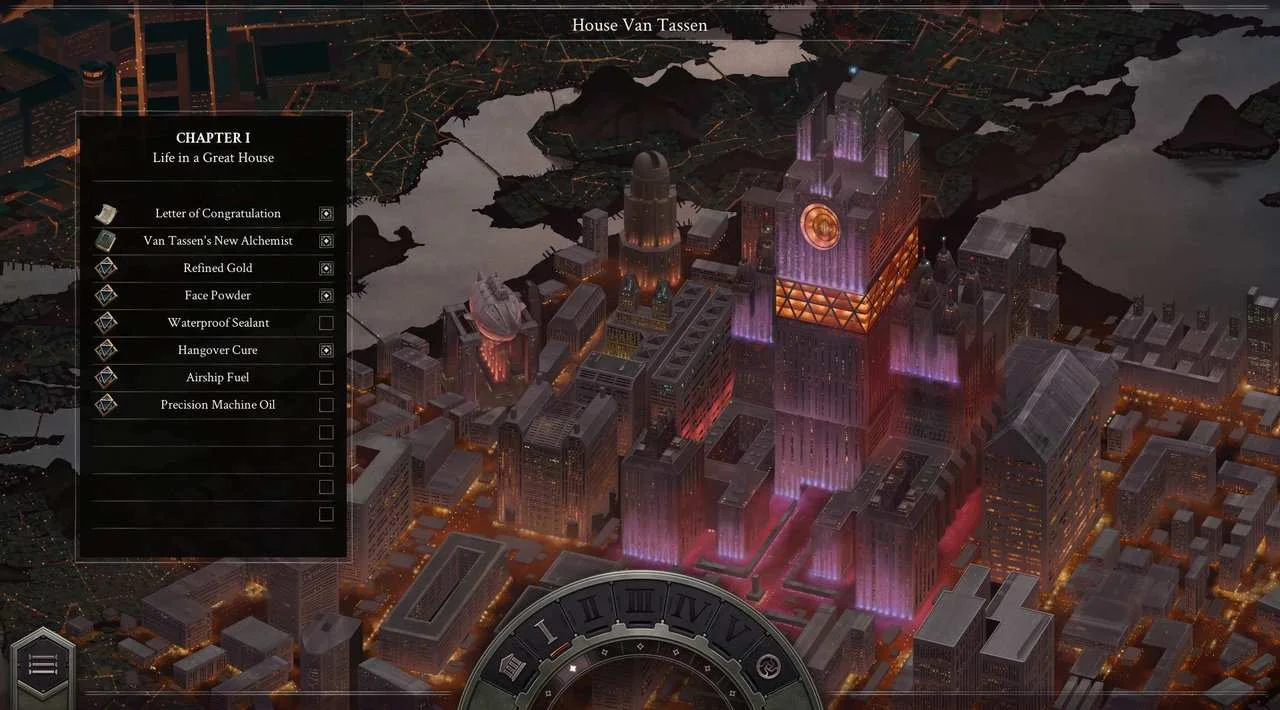
The story follows Anataeus Vaya, an alchemist who accepts a position as Head Alchemist for House Van Tassen. The fantasy setting gives each engineering task a purpose, while conversations and character portraits connect the puzzles to rival houses, dangerous discoveries, and political intrigue.
The narrative is not a replacement for the puzzle systems. It acts as a framework that introduces new mechanics and gives the increasingly complex assignments a reason to exist. Players who prefer pure optimization can focus on the machines, while players interested in the setting receive a complete story thread around the work.
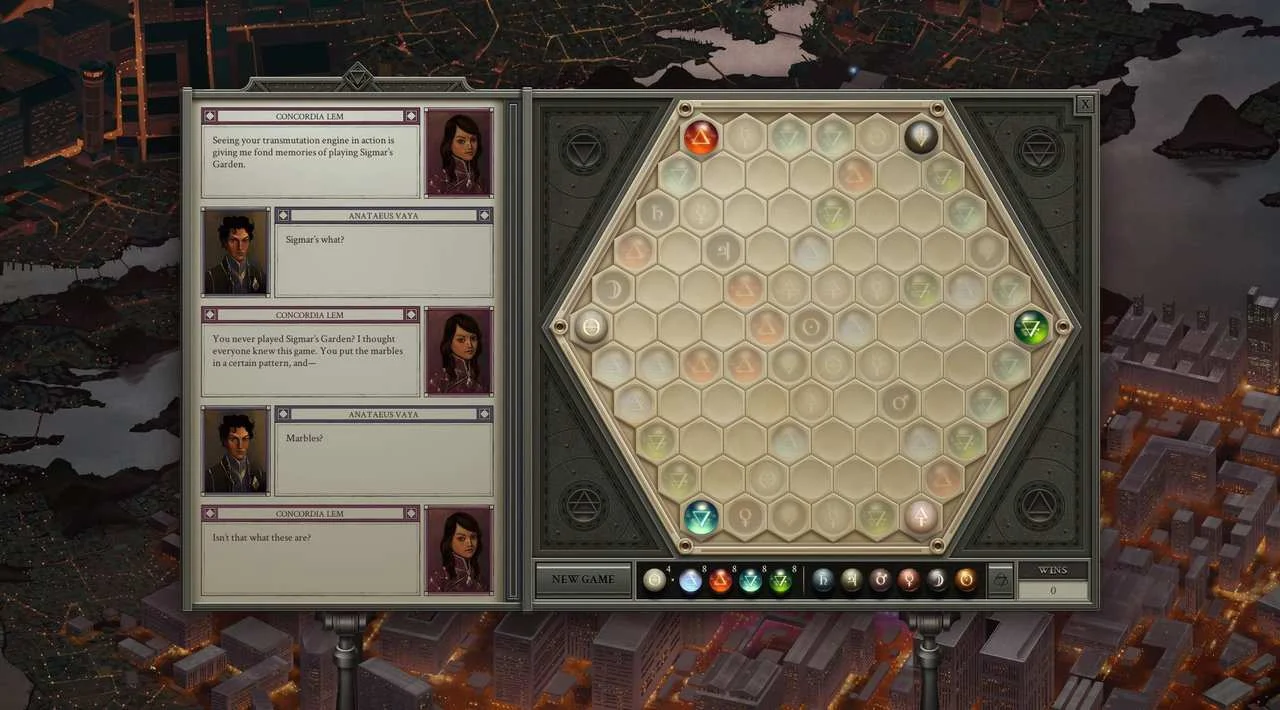
Outside the main puzzles, Sigmar's Garden provides an alchemy-themed solitaire game. It is a separate mental exercise rather than another factory mode, offering a slower change of pace between engineering problems.
Content, Workshop, and Additional Campaign
The paid base game includes its main story, the built-in solitaire diversion, Steam achievements, leaderboards, cloud support, and a level editor. There is no free-to-play structure or recurring content model attached to the base game.
Steam Workshop extends the puzzle library with user-created challenges. The in-game editor lets players design and share their own problems, while the Journal of Alchemical Engineering presents selected community puzzles curated for play inside the game.
The current Opus Magnum ecosystem also includes Opus Magnum: De Re Metallica, a separate paid downloadable expansion that requires the base game. It adds an independent mini-campaign, three new chapters, three new glyphs, additional story and music, and a House Colvan variant of Sigmar's Garden. It is an expansion rather than a renamed version of the original game.
Who Should Play Opus Magnum?
Opus Magnum suits players who enjoy automation puzzles, visual programming, factory logic, and optimization loops. It rewards patience more than reflexes. You can pause, inspect every arm, change one instruction, and rerun the machine until the behavior makes sense.
The game is particularly strong for players who enjoy comparing solutions. Leaderboards turn each puzzle into a series of personal targets: first make it work, then reduce the cost, shorten the cycle count, or create a more elegant layout.
It is a poor fit if you want action, direct character control, cooperative play, or a puzzle game with one obvious answer. Opus Magnum is single-player, and its challenge comes from understanding systems rather than reacting quickly.
PC Features and Storefront Details
The PC version is primarily designed for mouse and keyboard control. The interface depends on placing components, drawing tracks, and editing symbolic instructions, so a traditional controller is not a central feature. Steam functionality includes Steam Workshop, Steam Cloud, Steam Leaderboards, achievements, and the level editor.
Steam lists interface support for English, French, German, Japanese, Russian, Simplified Chinese, Latin American Spanish, Korean, Turkish, Ukrainian, Portuguese, Czech, and Polish. Full voice acting is not advertised as a separate feature, making the game suitable for players who prefer text-led story presentation.
The Steam edition uses the Steam client and its associated community services. No competitive multiplayer mode or anti-cheat system is listed. The core experience remains offline-style single-player engineering, with online features focused on sharing puzzles, cloud saves, and comparing results.
Similar Engineering Puzzle Games
Players who enjoy experimenting with physical components and chain reactions may also like physics-based machine puzzles such as Crazy Machines 3. The two games share a hands-on construction mindset, but Crazy Machines 3 emphasizes simulated objects and cause-and-effect experiments, while Opus Magnum focuses on deterministic programming and alchemical production.
For a broader automation sandbox with resource flow and factory planning, large-scale production systems like Factorio offer a useful comparison. Factorio is built around expanding networks and industrial logistics, whereas Opus Magnum compresses its engineering problems into discrete puzzle boards with tightly measured outputs.
Those comparisons also explain why Opus Magnum feels distinctive. It is not a conventional factory builder, physics toy, or coding exercise. Its identity comes from combining programmable machines, tangible motion, score-based optimization, and a story-driven puzzle structure.
Opus Magnum FAQ
Is Opus Magnum still sold under its original name?
Yes. The current PC storefront listing remains Opus Magnum. De Re Metallica is a separate downloadable expansion and not a rebrand of the base game.
Is Opus Magnum single-player?
Yes. The game is designed for single-player puzzle solving. You can compare results through leaderboards and share user-made puzzles, but it does not provide co-op, split-screen, or direct competitive multiplayer.
What does the base game include?
The base game includes its story campaign, open-ended alchemy puzzles, Sigmar's Garden, achievements, leaderboards, cloud support, a level editor, and Steam Workshop integration.
What is Opus Magnum: De Re Metallica?
It is a separate paid expansion that requires the base game. It adds a short independent campaign, new glyphs, new story content, additional music, and a new variant of Sigmar's Garden.
Does Opus Magnum support custom puzzles?
Yes. The built-in editor supports custom puzzle creation, and Steam Workshop lets players share and browse user-made challenges. This gives the game a longer tail beyond the main campaign.
Does Opus Magnum work well with a controller?
The PC interface is built around mouse and keyboard input. Storefront information emphasizes those controls rather than official gamepad support, so mouse-driven play is the safer expectation.
Is Opus Magnum about finishing a campaign once?
Not primarily. Completing a puzzle unlocks the engineering problem, but the deeper loop is solution optimization. Players often revisit completed designs to reduce cost, shorten cycle counts, shrink the footprint, or produce a cleaner machine.
System Requirements
Minimum: | Recomended: |
| Processor: Intel Pentium 4 2 GHz Graphics: 512 MB GeForce 8800 Memory: 4 GB RAM Disk space: 300 MB HDD Operating system: Windows Vista/7/8/10 | Processor: Intel Core i3 2 GHz Graphics: 1 GB GeForce GTX 460 Memory: 4 GB RAM Disk space: 300 MB HDD Operating system: Windows Vista/7/8/10 |
Screenshots

Trailer/Gameplay
Download
Opus Magnum (2017), 0.27GB
ElAmigos release, game is already cracked after installation (crack by Codex).

Updated till 17.01.2022.
Change language in game options.

1. Extract files.
2. Burn or mount the image.
3. Install the game.
4. Play the game. If you like this game, BUY IT!
Opus Magnum Download
🔒 Premium access required
To see and use the download links, you must be logged in and have an active PREMIUM account.
* Unlock downloads via Torrent and TeraBox.
Torrent Download
The best torrent download speeds are with qBittorrent!