Potionomics
Edit date: 12-11-2024, 02:24
Reason: Updated till 22.10.2024
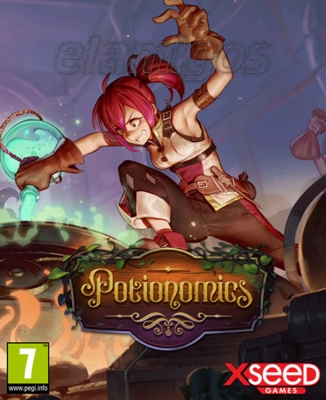
- Category:
- Release date:
- Game Genre:Strategy, fantasy, Economic, RPG elements, indie games, crafting, simulation elements
- Developer:
- Release:ElAmigos
- Platform:PC
- Languages (subtitles):English, German, Japanese, Korean, Chinese Simplified, Chinese Traditional
- Dubbing/Audio:English
- Crack:Codex/Rune
- Game size:3.38GB
Game Description
Potionomics PC is a narrative-driven potion shop simulator that combines resource management, crafting, relationship building, time management, and deck-based negotiation. The current Steam version remains listed as Potionomics rather than Potionomics: Masterwork Edition. Masterwork Edition is the console branding, while PC received the expanded feature set through an update to the standard game.
Developed by Voracious Games and published by XSEED Games and Marvelous USA, Potionomics follows Sylvia, a penniless witch who inherits a struggling shop and a substantial debt. Her route to solvency involves brewing better potions, sourcing rare ingredients, improving the store, and convincing demanding customers to pay more.
Running a potion shop under pressure
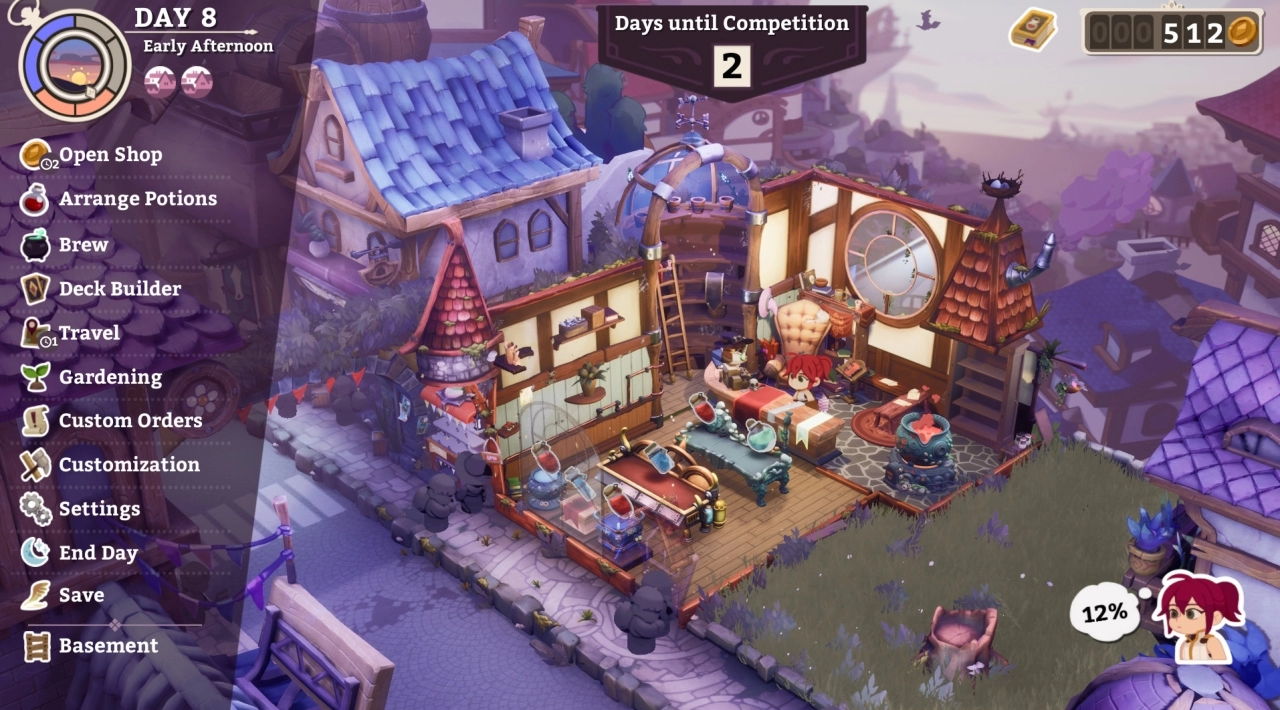
The central loop is built around a limited daily schedule. Sylvia decides whether to brew, open the shop, visit vendors, strengthen relationships, send heroes on expeditions, buy ingredients, or improve the store. Every choice consumes part of the day, so efficient planning matters as much as the quality of the potion itself.
Brewing begins with selecting ingredients and managing the resulting potion traits. Ingredients influence a potion's potency, value, taste, aroma, and possible negative properties. Better results require experimentation and a reliable supply chain, which makes ingredient gathering and recipe discovery important parts of the business rather than simple menu interactions.
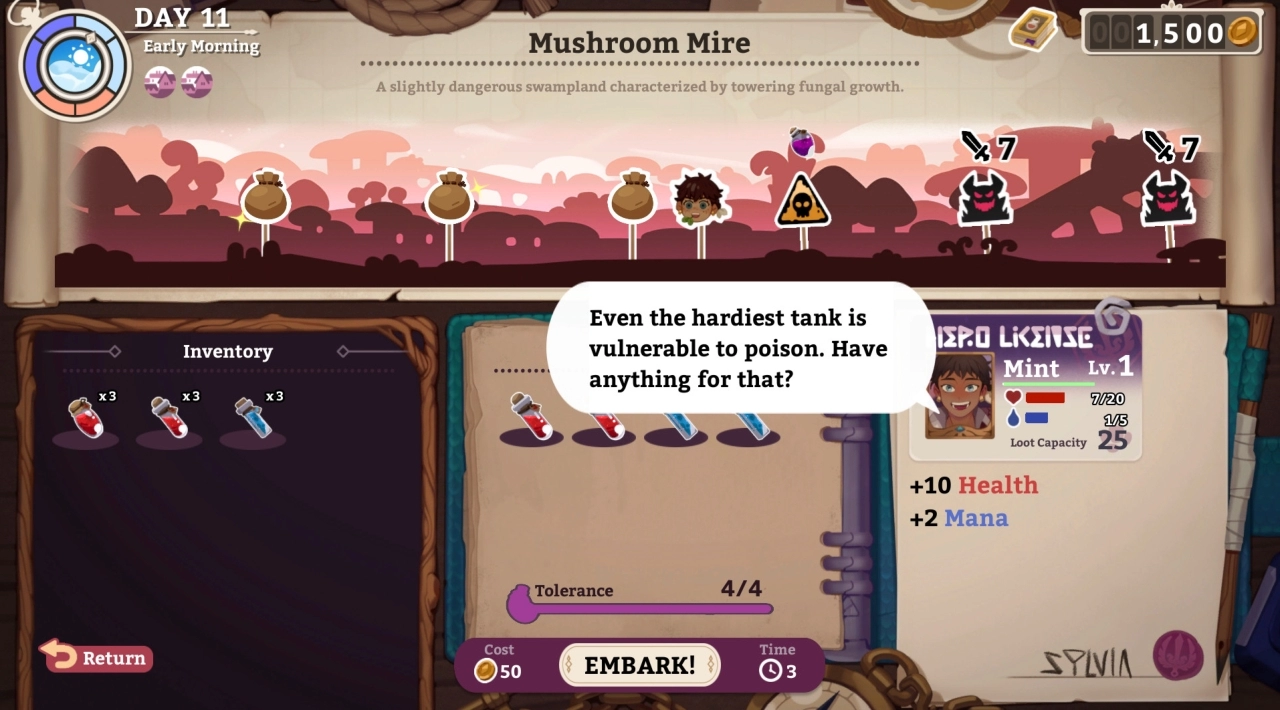
Heroes can be recruited to explore dangerous areas and return with ingredients. Their expeditions help Sylvia access materials that may be expensive or unavailable through ordinary shopping, but the results are not always perfectly predictable. This creates a practical trade-off between spending money immediately and sending an adventurer to search for better resources.
Haggling as a card game
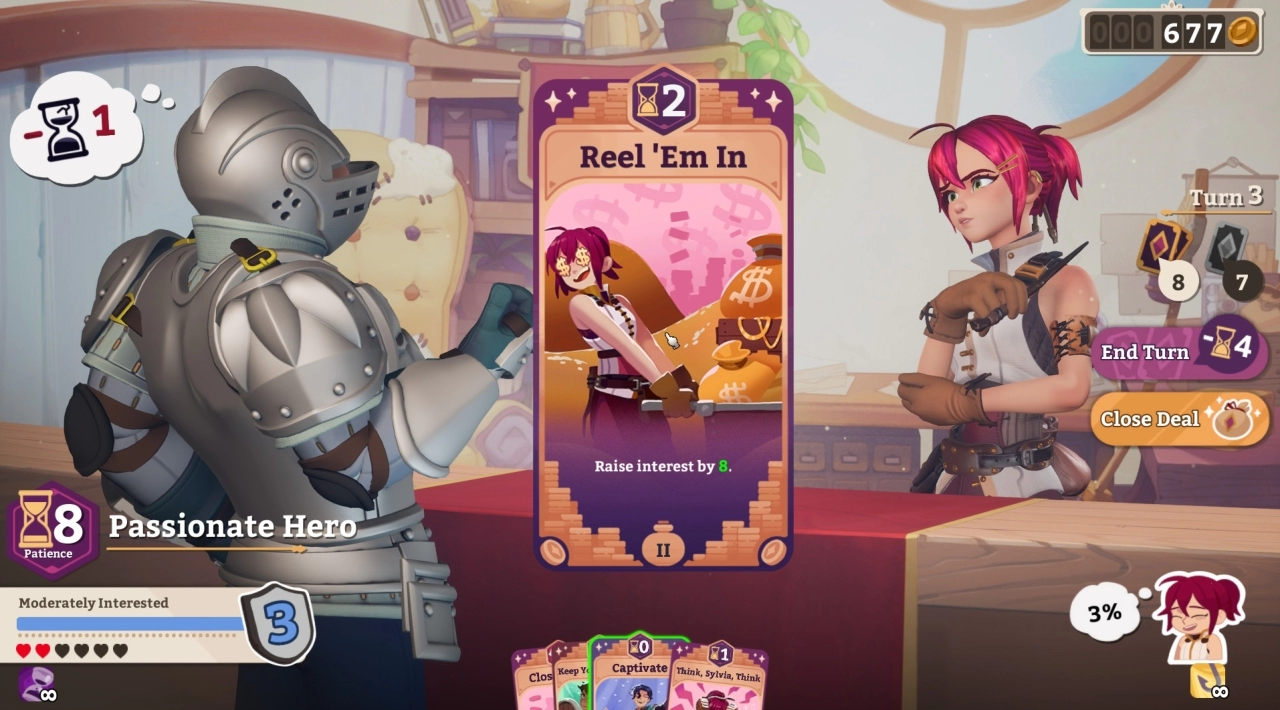
Customers do not simply buy whatever is placed on the shelf. Each sale becomes a tactical negotiation in which Sylvia plays haggling cards to increase interest and raise the final price. The customer has limited patience, while Sylvia must also manage stress and avoid allowing the negotiation to collapse.
The deck is assembled from cards learned through relationships with vendors and adventurers. Some cards increase interest, others reduce stress, extend patience, create discounts on card costs, or improve the value of later plays. The best decks are not necessarily the largest ones; they are built around a dependable sequence that reaches a strong price before the customer loses patience.
Competition stages make the economic pressure more direct. Sylvia must prepare potions that meet the contest requirements while preserving enough time and ingredients for the rest of the schedule. These contests test the entire management loop: brewing, shopping, shop upgrades, relationship progression, and negotiation all feed into the same result.
Relationships, upgrades, and shop customization
Rafta's merchants and adventurers are more than vendors. Spending time with them develops relationships, unlocks story scenes, and grants access to new negotiation strategies. Several relationships also support romance, giving the social system a meaningful mechanical purpose instead of treating it as a separate visual-novel layer.
Shop improvements affect more than appearance. Decorative choices can influence prices, potion quality, or brewing efficiency, allowing players to shape the store around a preferred strategy. A player focused on rapid production may prioritize one set of improvements, while a negotiation-heavy approach can benefit from a different arrangement.
The result is a progression system based on business knowledge rather than conventional character levels. Sylvia becomes more capable through stronger recipes, improved equipment, better shop decoration, expanded card options, and a deeper understanding of how each customer and ingredient behaves.
Players who enjoy potion-focused life simulation can also compare its social crafting structure with cozy alchemy and relationship management in Potion Permit, although Potionomics places far more emphasis on shop economics and negotiation cards.
Current PC edition and content model
The current PC package is a paid single-player game rather than a free-to-play product. The main game includes the shop campaign, potion brewing, expeditions, competitions, relationship paths, shop customization, and the card-based haggling system.
The PC update associated with Masterwork Edition added Endless Mode, new difficulty options, additional post-game relationship scenes, voice acting for story scenes, controller support, and extra language options. These features are available through the PC version listed as Potionomics, not through a separately named Masterwork Edition storefront product.
Paid add-on content is limited in scope. The Steam catalog lists the Boss Finn Content Pack as gameplay-related additional content, while the original soundtrack and artbook are separate non-core extras. There is no season pass or recurring card-store model attached to the base game.
Who should play Potionomics?
Potionomics suits players who like management games where every action has an opportunity cost. It is especially relevant to fans of crafting economies, visual-novel relationships, card-based strategy, and games that turn routine shop tasks into a sequence of optimization problems.
The game is less suitable for anyone expecting a traditional action RPG, free exploration, or combat-focused potion gathering. Heroes may go on expeditions, but Sylvia does not directly fight through dungeons. The main challenges are planning, brewing, negotiation, and meeting competition requirements before the schedule moves on.
The original campaign has a structured, deadline-driven rhythm. Players who prefer a relaxed sandbox can use Cozy difficulty and Endless Mode for a less restrictive experience, while players seeking stronger economic pressure can choose the more demanding settings. This flexibility makes the updated PC version more approachable than the original structure alone suggests.
PC features and controls
The PC version is distributed through Steam and includes Steam Cloud, achievements, trading cards, and Family Sharing. It is a single-player title with no online multiplayer, co-op, or split-screen mode.
Controller support was added to the PC version through the Masterwork feature update and has continued to receive input and navigation improvements. Mouse and keyboard remain natural choices for browsing recipes, selecting ingredients, and arranging cards, while a controller is useful for players who prefer a couch or handheld setup.
Steam lists interface and subtitle support for English, German, Japanese, Korean, Simplified Chinese, and Traditional Chinese. English is also listed with full audio. The added voice acting applies to story scenes rather than turning the game into a fully voiced simulation of every shop interaction.
The storefront does not identify a separate launcher beyond Steam. Its listed platform features focus on Steam services, and the game is presented as a standalone PC release rather than an online service.
Games with related shop and strategy systems
Potionomics has a rare combination of systems, so comparisons depend on which part of the design appeals most. Players looking for a stronger action-and-commerce split may prefer fantasy shopkeeping and dungeon runs in Moonlighter, where retail decisions fund real-time expeditions rather than card-based negotiations.
For the haggling deck itself, the closest structural reference is turn-based deckbuilding and tactical card synergies in Slay the Spire. The goals are different, however: Potionomics uses cards to maximize a sale and manage customer patience, while Slay the Spire uses them for combat and run-based survival.
These comparisons also explain why Potionomics is difficult to classify with one genre label. It is part shop simulator, part crafting game, part relationship-focused life sim, and part economic card strategy game. Its strongest identity comes from making all four systems depend on the same daily schedule.
Potionomics FAQ
Is Potionomics: Masterwork Edition the current PC name?
No. The current PC storefront listing remains Potionomics. Potionomics: Masterwork Edition is the console edition name, while the PC version received the associated gameplay and presentation updates through its existing listing.
Does the PC version include Endless Mode?
Yes. Endless Mode was added to PC alongside the broader Masterwork feature update. It provides a post-campaign structure for players who want to continue brewing, selling, improving relationships, and managing the shop without treating the original competition progression as the only endpoint.
Does Potionomics have multiplayer or co-op?
No. Potionomics is a single-player game. There is no online co-op, local co-op, split-screen mode, or competitive multiplayer campaign.
Can you romance characters in Potionomics?
Yes. Sylvia can build relationships with several merchants and adventurers, and romance is part of the relationship system. These connections also unlock dialogue, story scenes, and new haggling cards, so social progression affects the shop's strategic options.
How does Potionomics make money?
Sylvia earns money by brewing potions, displaying them in the shop, and negotiating with customers. The final value depends on the potion's quality, shop improvements, customer demand, and the cards played during the haggle. Ingredient costs, brewing time, and daily scheduling determine whether a sale is actually profitable.
Does Potionomics support controllers on PC?
Yes. Controller support was added in the PC update associated with Masterwork Edition, with later patches improving navigation in areas such as adventuring, vendor menus, inventory, and gardening. Mouse and keyboard remain fully relevant for the game's menu-heavy brewing and card-selection systems.
System Requirements
Minimum: | Recomended: |
| Processor: Intel Core 2 DUO 2.4 GHz / AMD Athlon X2 2.7 GHz Graphics: Nvidia GTX 650 Ti or AMD HD 7850 Memory: 8 GB RAM Disk space: 7 GB available space Operating system: Windows 7 | Processor: Quad Core Processor Graphics: GeForce GTX 1060 6GB or Radeon RX 470 Memory: 16 GB RAM Disk space: 7 GB available space Operating system: Windows 10 |
Screenshots
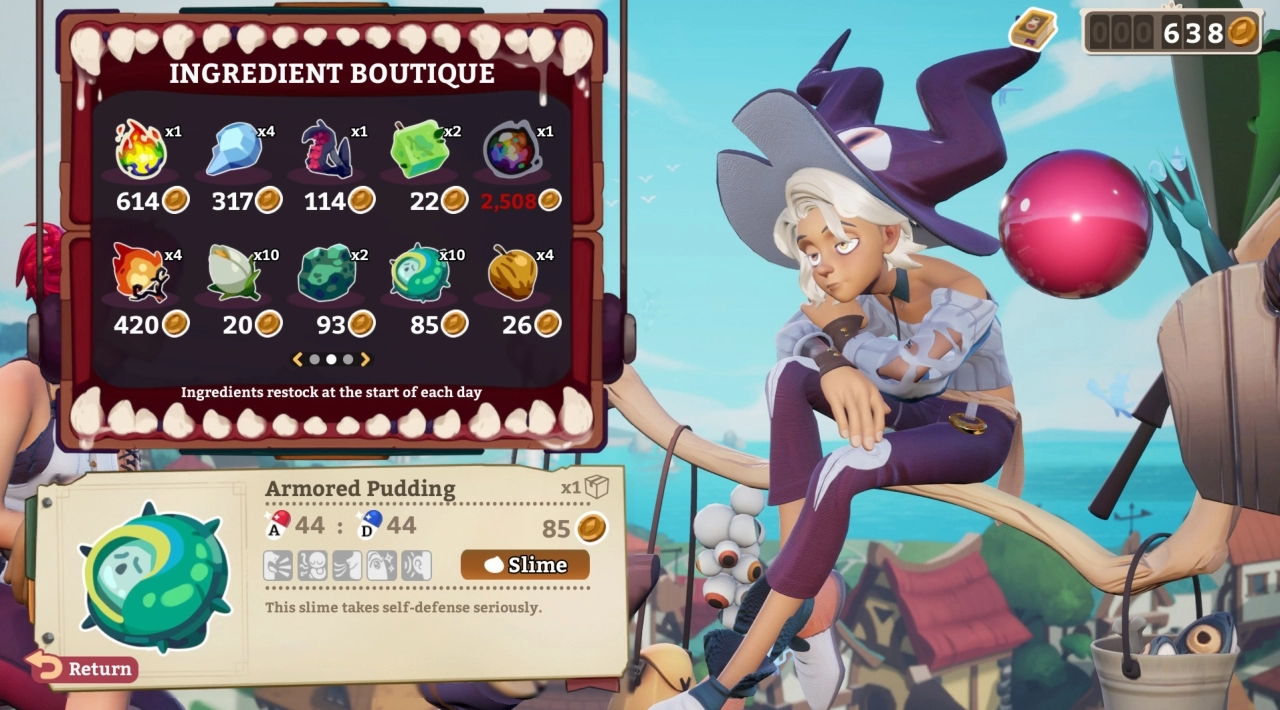
Trailer/Gameplay
Download
Potionomics (2022), 3.38GB
ElAmigos release, game is already cracked after installation (crack by Codex/Rune).

Updated till 22.10.2024.

1. Extract files.
2. Burn or mount the image.
3. Install the game.
4. ElAmigos release, game is already cracked after installation.
5. Play the game. If you like this game, BUY IT!
Potionomics Download
🔒 Premium access required
To see and use the download links, you must be logged in and have an active PREMIUM account.
* Unlock downloads via Torrent and TeraBox.
DLC: Boss Finn Content Pack, Soundtrack, Artbook.
Torrent Download
The best torrent download speeds are with qBittorrent!