Pistol Whip VR
Edit date: 13-11-2023, 15:38
Reason: Updated to version 1.5.65.184 (08.11.2023)
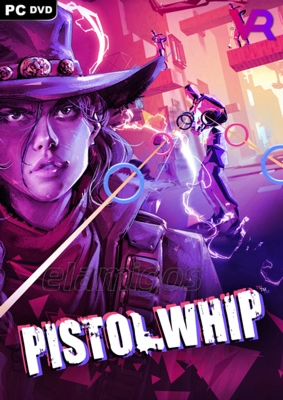
- Release date:
- Game Genre:Action, FPP, FPS, rhythm, Oculus Rift/Quest, shooters, PlayStation VR, SteamVR, virtual reality
- Developer:
- Release:ElAmigos
- Platform:PC
- Languages (subtitles):English, French, Italian, German, Spanish, Portuguese-Brazil, Japanese, Korean
- Dubbing/Audio:English
- Crack:Codex/Rune, FLT
- Game size:1.39GB
Game Description
Pistol Whip VR is the common search name for Pistol Whip, the current PC storefront title from Cloudhead Games Ltd. This first-person VR action-rhythm shooter combines tracked-controller gunplay, beat-driven movement, cinematic scenes, score chasing, and physical dodging. It is built for players who want a replayable arcade challenge rather than a conventional campaign shooter.
The PC version is a VR-only game distributed through SteamVR. It requires tracked motion controllers and a compatible headset, with no standard keyboard, mouse, or gamepad substitute for aiming, firing, ducking, and dodging. The storefront lists Steam Cloud, achievements, statistics, leaderboards, Family Sharing, and tracked-controller support.
How the action-rhythm loop works
Each Scene places the player on a guided route through a stylized combat environment. Enemies appear along the path, bullets cross the play space, and targets are arranged around the musical structure. The player shoots, avoids incoming fire, and uses physical movement to stay alive while building a high score.
The shooting is not governed by rhythm alone. A well-timed shot can improve the score, but survival also depends on reading enemy positions, anticipating projectile paths, and moving the head and body out of danger. The result is a hybrid of rhythm shooting, on-rails action, and bullet-dodging that rewards both timing and spatial awareness.
Scenes are designed for repeated attempts. A first run may be about learning the route, while later runs focus on cleaner shots, better movement, higher accuracy, and leaderboard placement. Some players will chase musical flow; others will prefer a more aggressive style built around rapid target clearing and close-range melee strikes.
That structure makes the game easy to understand but difficult to exhaust. There is no traditional character-level grind to carry a weak run. Improvement comes from learning patterns, refining controller movement, and selecting a Style that matches the way you want to play.
Styles, weapons, and difficulty control
The Styles System is one of the game’s most important additions. It lets players combine weapons and gameplay modifiers instead of treating every Scene as a fixed challenge. Preset Styles provide ready-made rule combinations, while custom configurations allow players to tune the experience for precision, accessibility, fitness, or higher difficulty.
Modifiers can change how scoring, ammunition, targets, enemy attacks, and rhythm interact. Options such as Deadeye, Bullet Hell, Rhythmic, and No Beat create meaningfully different versions of the same Scene. A player who dislikes strict timing can emphasize accuracy, while an experienced player can stack modifiers that increase pressure and reduce room for mistakes.
Weapon selection and customization add another layer of ownership. The available arsenal includes different firing styles and visual options, while dual-wielding can turn a run into a faster, more demanding test of coordination. The game’s physical design also makes body positioning important: ducking under attacks and leaning away from projectiles are part of the core skill set.
The system is useful for more than hardcore score hunters. Easier configurations can reduce physical intensity or simplify the timing demands, making the game more approachable for new VR players. The tradeoff is that players looking for a traditional military shooter with free movement, cover, and inventory management may find the guided structure restrictive.
Scenes, campaigns, and long-term content
The current game includes over 40 Scenes across its arcade-focused catalog, along with cinematic campaigns and rotating Contracts. Arcade play is the main score-chasing mode: choose a Scene, select the difficulty and Style, then replay it to improve performance.
The two named cinematic campaigns, 2089 and Smoke & Thunder, give the game more narrative structure without replacing its arcade foundation. 2089 uses a futuristic setting and cybernetic enemies, while Smoke & Thunder moves the action into a stylized western scenario. Both campaigns still revolve around shooting, dodging, and mastering linked Scenes.
Contracts provide recurring challenges built around selected Scenes and modifiers. Daily, weekly, and longer rotating challenges give returning players a reason to revisit content without manually constructing every rule set. Scores, rankings, and contract progress create a metagame based on consistency rather than equipment upgrades.
The PC version also includes community-created content through the Pistol Mix ecosystem and the in-game Remixes area. This is a significant distinction from the original fixed arcade format: players can access additional community Scenes alongside the official catalog, although the quality and style of those creations can vary.
Commercially, the base game is a paid purchase rather than a free-to-play service. Cloudhead Games has expanded the gameplay catalog through free content updates and collections, while the Steam storefront separately lists optional soundtrack add-ons. The current PC store page does not present paid gameplay expansion packs as the main content model.
Party play and player fit
Party Mode is a local mode designed for shared play with friends and family. It is not a conventional online co-op campaign. Instead, players can create personalized challenges and take turns in the same local setting, making it useful for demonstrations, gatherings, and friendly score competition.
The strongest audience is made up of players who enjoy short, repeatable VR sessions with a clear mastery loop. It suits fans of action games, arcade shooters, music-driven challenges, and physical VR experiences. Players who like experimenting with modifiers will also find more depth here than the simple premise suggests.
Players seeking a broader tactical shooter should set expectations carefully. The guided route, score-based structure, and limited narrative interaction mean that Pistol Whip is closer to an interactive action sequence than a room-scale campaign shooter. For a more conventional VR firearms experience with movement and weapon handling, military-style VR shooters such as Zero Caliber VR are a different fit.
PC features, localization, and mod support
On PC, SteamVR support is central to the experience. The Steam listing identifies the game as VR-only and supports tracked controllers, Steam Cloud, achievements, statistics, and global leaderboards. These platform features reinforce the game’s focus on repeat attempts and measurable improvement.
The control scheme is intentionally physical. Players aim by moving their tracked hands, fire with controller inputs, reload according to the selected Style, and physically duck or lean to evade danger. A clear play area is important because successful runs involve real arm movement and body repositioning rather than only thumbstick inputs.
Steam lists interface and subtitle support for English, French, Italian, German, Spanish from Spain, Japanese, Korean, and Portuguese from Brazil. English is the listed full-audio language. The game is not dialogue-heavy, so localization primarily affects menus, instructions, campaign text, and interface presentation.
Mod support is more structured than simply dropping unrelated files into a folder. The official Pistol Mix tool and in-game Remixes tab connect community-made Scenes to the PC experience. This gives the Steam version an evolving user-created content layer while preserving the official Arcade, Campaign, Contracts, and Party Mode menus.
Similar PC VR games
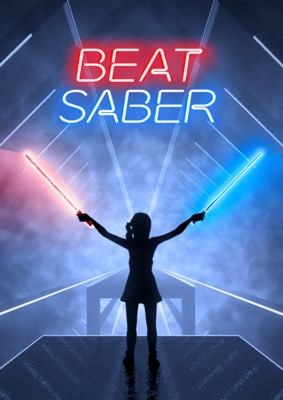
The closest comparison is a rhythm game with equally direct physical input, but the action differs. VR rhythm games built around tracked saber swings like Beat Saber emphasize directional note cutting and obstacle reading, whereas Pistol Whip asks the player to aim at enemies, dodge attacks, and shape a run through cinematic gunplay.
The two games share a strong score-chasing loop, physical movement, escalating difficulty, and repeated practice. Pistol Whip is the better match for players who want targets, projectiles, and action-film staging; Beat Saber is more focused on musical note patterns and precise swing direction.
Beyond those comparisons, the game occupies a fairly specific niche. It is not a full campaign shooter, not a conventional rhythm chart system, and not an online multiplayer platform. Its identity comes from combining guided movement, reactive gunplay, soundtrack-led pacing, and adjustable challenge rules.
Pistol Whip FAQ
Is Pistol Whip VR the official PC name?
No. Pistol Whip is the current Steam title. “Pistol Whip VR” is a useful search phrase that describes the game’s platform and format, but it is not a separate PC edition or confirmed storefront rebrand.
Is Pistol Whip a traditional first-person shooter?
It uses a first-person VR perspective and gunplay, but its structure is closer to a guided action-rhythm arcade game. Players move through Scenes along designed routes instead of freely exploring large maps, managing inventories, or taking cover through a conventional campaign.
Does Pistol Whip have online multiplayer?
The main PC experience is single-player with global leaderboards. Party Mode provides local shared play and pass-the-headset competition, but it is not a full online co-op campaign.
What content is included with the PC version?
The base game includes the official Scene catalog, the 2089 and Smoke & Thunder cinematic campaigns, Contracts, Styles, Party Mode, Training, leaderboard features, and community Remixes. The Steam storefront also lists optional soundtrack add-ons, while Cloudhead Games has delivered gameplay content through free updates and collections.
Can PC players create or play custom Scenes?
Yes. PC players can use the Pistol Mix modding ecosystem and access community-created Scenes through the in-game Remixes tab. This extends the replay value beyond the official arcade and campaign content.
What kind of VR controller does Pistol Whip require?
The PC version is built around tracked VR motion controllers. A headset and tracked hand controllers are required for aiming, shooting, weapon handling, and physical evasion; standard keyboard, mouse, or gamepad controls do not replace the intended input system.
System Requirements
Minimum: | Recomended: |
| Processor: Intel Core i5-4590 or equivalent Graphics: Geforce GTX 970 or equivalent Memory: 8 GB RAM Disk space: 800 MB available space Operating system: Windows 10 (64-bit) | Processor: Intel Core i7 Graphics: GeForce GTX 1070 or greater Memory: 8 GB RAM Disk space: 800 MB available space Operating system: Windows 10 (64-bit) |
Screenshots


Trailer/Gameplay
Download
Pistol Whip VR (2019), 1.39GB
ElAmigos release, game is already cracked after installation (crack by Codex/Rune or FLT).

Updated to version 1.5.65.184 (08.11.2023).

1. Extract files.
2. Burn or mount the image.
3. Install the game.
4. ElAmigos release, game is already cracked after installation.
5. Play the game. If you like this game, BUY IT!
Pistol Whip VR Download
🔒 Premium access required
To see and use the download links, you must be logged in and have an active PREMIUM account.
* Unlock downloads via Torrent and TeraBox.
Torrent Download
The best torrent download speeds are with qBittorrent!