Jon Shafer's At the Gates
Edit date: 8-12-2022, 16:08
Reason: Updated to version 1.1.0 (31.05.2019)

- Category:
- Release date:
- Game Genre:Strategy, Economic, turn-based, sandbox, Ancient history, 2D, crowdfunding
- Developer:
- Release:ElAmigos
- Platform:PC
- Languages (subtitles):English
- Dubbing/Audio:English
- Crack:Codex
- Game size:0.10GB
Game Description
Jon Shafer's At the Gates is a PC 4X grand strategy game about building a barbarian kingdom in the shadow of the declining Roman Empire. The current Steam listing and the publisher's own website still use this exact name, with no verified rebrand or replacement edition. Its appeal comes from a compact but demanding structure built around clan management, seasonal survival, mobile settlement planning, and highly variable single-player campaigns.
Developed and published by Conifer Games, the game was designed by Jon Shafer, known for his work on Civilization V. It is not a conventional empire builder where you establish a network of cities and steadily follow a predictable technology ladder. Instead, At the Gates asks you to keep a fragile society moving, fed, trained, and politically stable while larger powers already dominate the map.
A 4X game built around one settlement
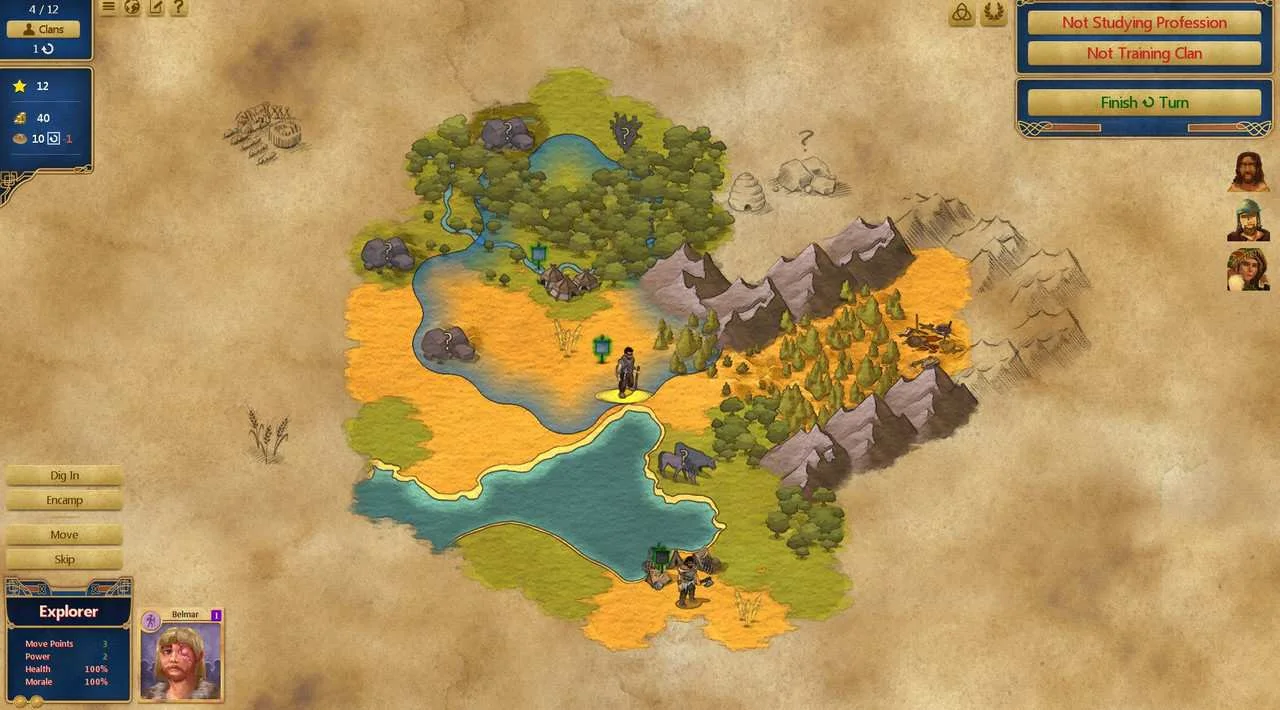
At the Gates uses an overhead, map-focused presentation with turn-based decisions and a strong emphasis on exploration. Each playable faction begins with one mobile Settlement, roughly filling the role that a city occupies in other 4X games. You do not manage a sprawling chain of permanent urban centers. Your single economic hub must support exploration, production, military preparation, and future expansion.
That limitation gives every production decision more weight. New clans arrive at the Settlement, and you train them into professions such as Explorers, Gatherers, Blacksmiths, or Weaponsmiths. Since the Settlement can only train one profession at a time, choosing between food production, resource discovery, tools, and military capacity is often the central decision of a turn.
Expansion is deliberately temporary during the early game. You move the Settlement toward useful resources, establish structures within its borders, and relocate when deposits become exhausted or the surrounding area stops supporting your plans. Later, you can found a kingdom and transition toward more permanent stone structures, creating a meaningful change from survival-driven mobility to established regional power.
Players who enjoy the slower, planning-heavy side of historical 4X games may also appreciate turn-based empire builders such as Oriental Empires, although At the Gates operates on a much smaller and more mobile economic foundation.
Clans are characters, workers, and liabilities
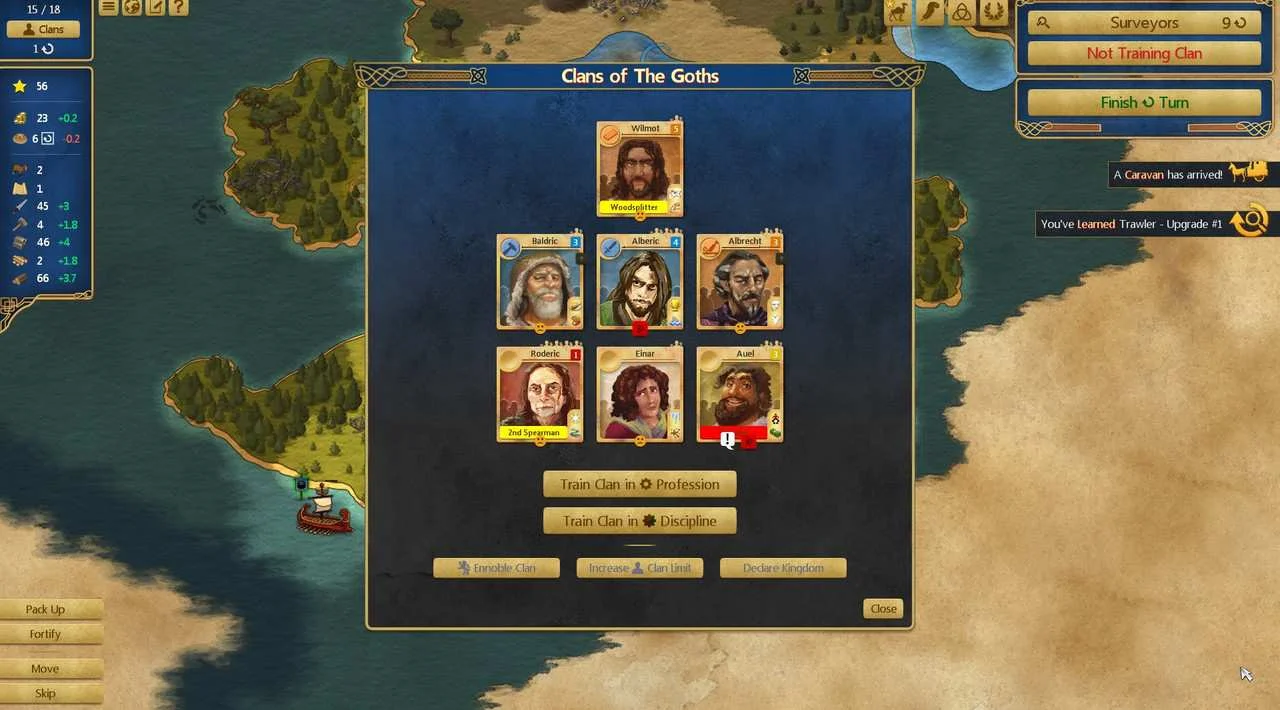
The defining system is the population itself. Clans are not anonymous workers that can be assigned without consequence. Each clan has two traits, personal desires, and a mood that can affect economic and military performance. A useful specialist may also be difficult to manage if their personality conflicts with the conditions of your settlement.
Professions belong to six disciplines: agriculture, livestock, metalworking, crafting, discovery, and honor. Clans gain experience within their current discipline, making it easier to switch between related professions. Moving someone into another discipline resets that progress, so long-term workforce planning matters more than simply filling whichever job is currently open.
Clan unhappiness creates practical problems rather than merely cosmetic complaints. Restless groups suffer performance penalties, feuds can force you to choose sides, and criminal behavior can damage the mood of other clans on the same tile. You may need to separate troublesome people from the main settlement, accept a permanent penalty, or sacrifice a useful profession to prevent a wider breakdown.
This character-management layer gives the game a different texture from standard Civilization-style population screens. A clan can be economically valuable, militarily important, socially disruptive, or all three at once. The best solution is rarely the one that produces the most resources immediately.
Seasons reshape the strategic map
The map is procedurally generated and combines terrain, climate, rivers, mountains, forests, deserts, swamps, and resource deposits into changing starting situations. Exploration is not just a matter of revealing territory. Many resources must first be identified before you know whether they are worth harvesting, which makes sending the right profession into the field an important investment.
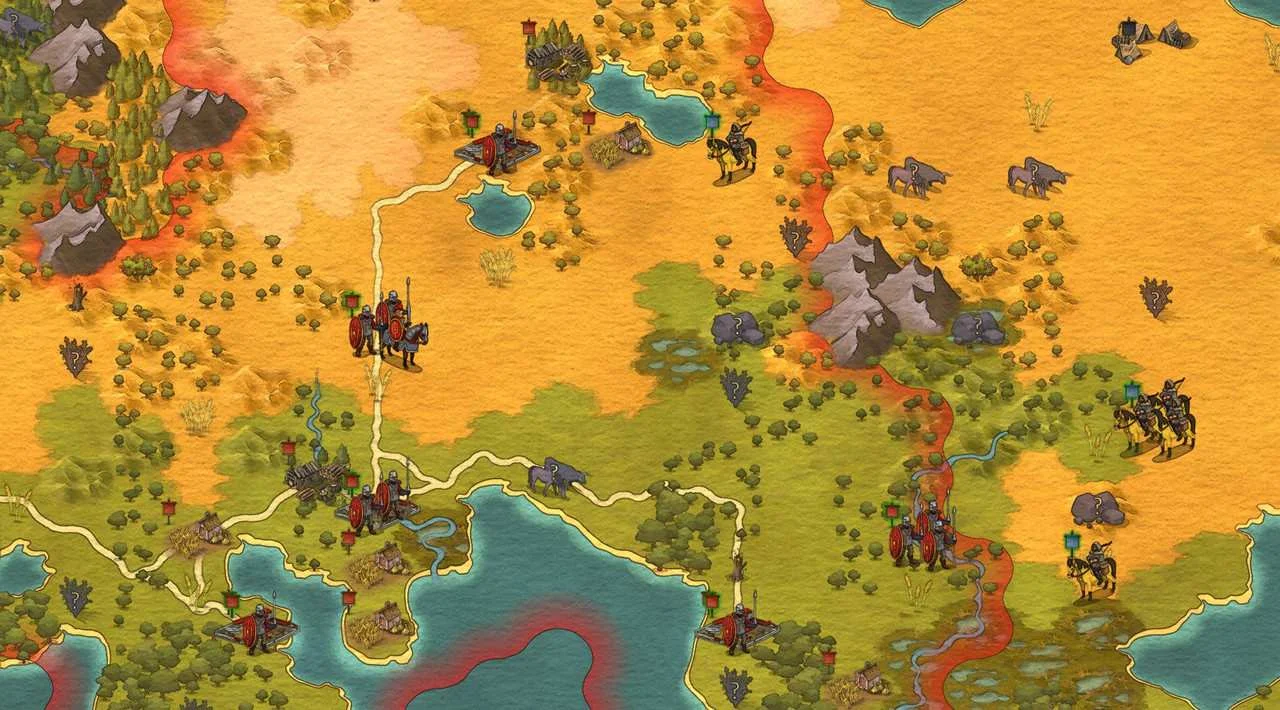
A complete seasonal cycle lasts 24 turns. Summer supports food production and military movement, while winter reduces supplies and can make northern regions especially dangerous. The change is not a simple penalty phase. Frozen rivers may remove major terrain barriers, allowing armies to cross routes that were previously impassable.
That seasonal rhythm affects both economics and warfare. Armies can lose their supply, food production can shut down, and a campaign planned in summer may become impossible once the landscape freezes. Conversely, an opponent that feels protected by a large river may become vulnerable when winter turns it into a crossing.
The result is a game of seasonal logistics rather than a static map puzzle. You must prepare food, time military operations, watch the climate, and decide whether a short-term opportunity is worth the risk of entering a region that may become hostile a few turns later.
Resources, caravans, and the path to a kingdom
Food is the first major pressure. Early clans rely on flexible foraging professions, but these produce less than developed timber and stone structures. Because resource deposits can run out, a strong opening economy is not enough by itself. You need a plan for replacing exhausted supplies and moving toward more reliable production.
The caravan system gives you another way to compensate for an imperfect start. Caravans arrive three times per year and allow you to trade available resources for materials you lack. They do not visit during winter, so autumn preparation is essential. Upgrading the caravan can improve the quality of these exchanges, making trade an important part of survival rather than a decorative side system.
Tools and weapons support much of the early development loop. Training a Blacksmith or Weaponsmith can strengthen your economy or military, but the correct choice depends on what the map provides. A shortage of iron does not end a campaign, but it forces you to rely more heavily on trade, alternate professions, or a different expansion route.
Once your economy is stable, Founding a Kingdom fixes the Settlement in place, expands your borders, and provides a major Fame boost. It is a commitment as much as a reward: you gain permanence and stronger infrastructure, but lose the freedom to keep migrating toward every new opportunity.
Factions, Romanization, and victory
At the Gates uses asymmetric factions rather than presenting every civilization as a balanced variation of the same formula. The roster includes groups such as the Goths, Vandals, Huns, and Alemanni, with notable leaders including Attila and Cerdic. Some factions support the standard settlement-and-structure approach, while others change the assumptions of the entire campaign.
New factions can be unlocked by conquering their capital or forming an alliance with them. This gives progression a gameplay purpose: unlocking a faction requires you to engage with the world rather than simply complete an unrelated menu challenge.
Your relationship with Rome is also more flexible than a simple permanent war. You can pursue Romanization Traits through diplomacy or by capturing Roman cities, gaining bonuses that reflect the influence and resources of the empire you are trying to replace.
There are two primary victory routes. A military victory comes from conquering the capital of either the Eastern or Western Roman Empire. An economic victory requires sending five fully equipped clans to Rome as new Roman Legions, allowing you to replace the emperor peacefully and take control of the army.
The game is not structured as a conventional race in which every faction independently rushes toward victory. Powerful neighbors may begin far stronger than you, and the challenge is often navigating around them while developing a viable long-term plan. This makes diplomacy, positioning, and timing as important as direct conquest.
Who should play it on PC?
At the Gates is best suited to players who enjoy single-player 4X strategy with scarcity, uneven openings, and meaningful adaptation. It rewards people who like studying a map, interpreting imperfect information, and building a plan around the clans and resources they receive rather than executing the same opening every time.
It is less suitable for players looking for multiplayer, split-screen, or a large city network with dozens of production queues. The official design intentionally focuses on asymmetric solo play, and the current Steam feature list identifies the game as single-player only.
The game can also be demanding in a way that has little to do with interface complexity. Its systems are interconnected, so a bad food decision can become a winter crisis, an unhappy clan can weaken production, and a premature military push can exhaust the economy that supports it.
Players seeking a broader modern 4X framework may prefer large-scale turn-based civilization games such as Sid Meier's Civilization VII. At the Gates is the more specialized choice, built around pressure, mobility, and asymmetric survival instead of a broad catalogue of empires and victory systems.
PC storefront, controls, and content model
The active PC storefront listing is on Steam under the unchanged title Jon Shafer's At the Gates. The publisher also offers a direct DRM-free version and provides a Steam key with that purchase. The official storefront information lists Conifer Games as both developer and publisher.
The game is designed around map selection, information panels, profession assignment, and nested explanations, making keyboard and mouse the practical control setup. Steam does not list full controller support, gamepad support, or multiplayer features, so players should not expect a controller-first interface or online campaign functionality.
Steam lists English interface text and no full audio track. No broader localization is confirmed on the current storefront listing. The game is sold as a paid base product, and the available storefront information does not present a season pass or a large DLC catalogue as part of its current content model.
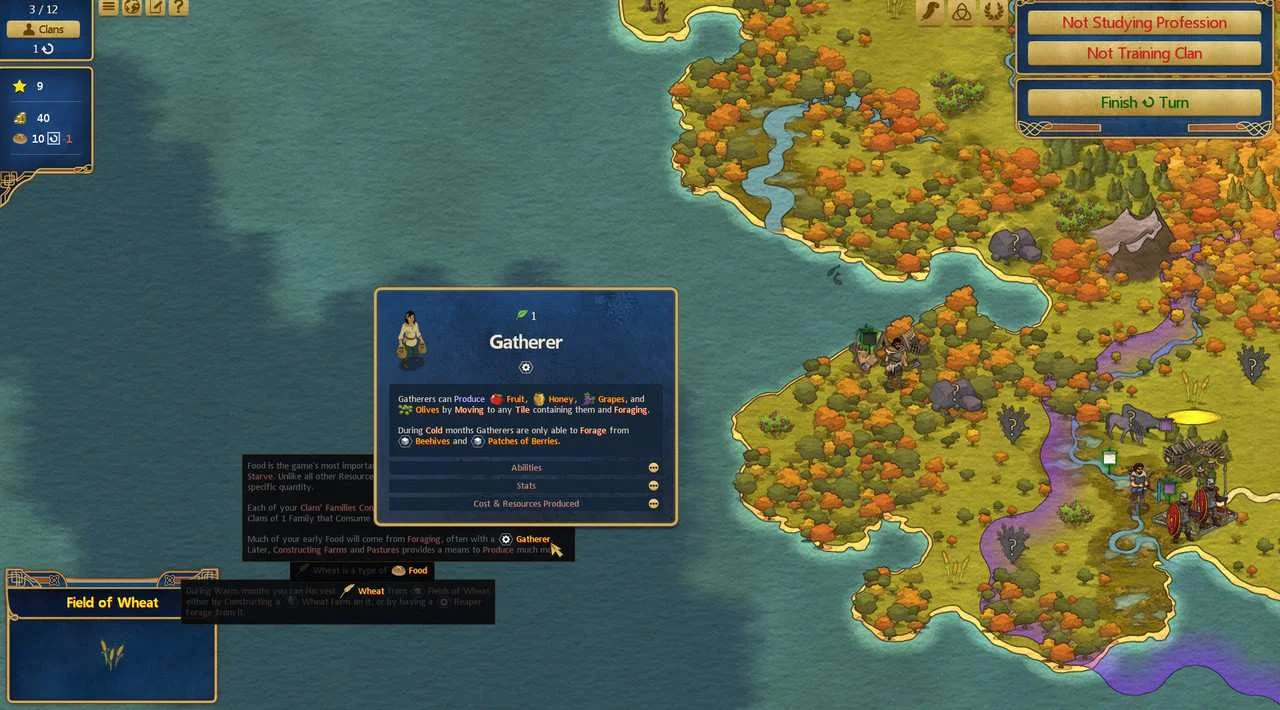
One of its most distinctive PC conveniences is the tooltips-in-tooltips interface. Hovering over highlighted terms can open more explanations without forcing you to leave the current screen, which is especially useful when learning how professions, resources, disciplines, and faction bonuses interact.
Jon Shafer's At the Gates FAQ
Is Jon Shafer's At the Gates still the current name?
Yes. The current Steam listing and the publisher's website use Jon Shafer's At the Gates. No verified official rebrand, definitive edition, or replacement storefront name was found.
Is At the Gates multiplayer?
No. It is a single-player-only strategy game. There is no confirmed online multiplayer, co-op, or split-screen mode.
How does the Settlement work?
You begin with one mobile Settlement that serves as your central economic hub. It trains clans into professions, supports your early structures, and can relocate as resources are exhausted. Founding a Kingdom later makes the Settlement permanent.
What makes the clans different from normal workers?
Clans have traits, desires, moods, professions, and discipline experience. Their behavior can create feuds, crimes, performance penalties, and difficult personnel choices, so population management is one of the game's main strategic systems.
How do you win?
You can conquer the capital of the Eastern or Western Roman Empire, or pursue the economic route by sending five fully equipped clans to Rome as Roman Legions and replacing the emperor peacefully.
Does the game support controllers?
Controller support is not listed in the current Steam feature information. The game's map, tooltips, and management panels are best approached with keyboard and mouse.
System Requirements
Minimum: |
Processor: Dual Core 1.6 GHz Graphics: 256 MB GeForce 7900 GT / Radeon X1950 Pro Memory: 2 GB RAM Disk space: 2 GB HDD Operating system: Windows XP/Vista/7 |
Screenshots
Trailer/Gameplay
Download
Jon Shafer’s At the Gates (2019), 0.10GB
ElAmigos release, game is already cracked after installation (crack by Codex).

Updated to version 1.1.0 (31.05.2019).

1. Extract files.
2. Burn or mount the image.
3. Install the game.
4. ElAmigos release, game is already cracked after installation.
5. Play the game. If you like this game, BUY IT!
Jon Shafer's At the Gates Download
🔒 Premium access required
To see and use the download links, you must be logged in and have an active PREMIUM account.
* Unlock downloads via Torrent and TeraBox.
Torrent Download
The best torrent download speeds are with qBittorrent!