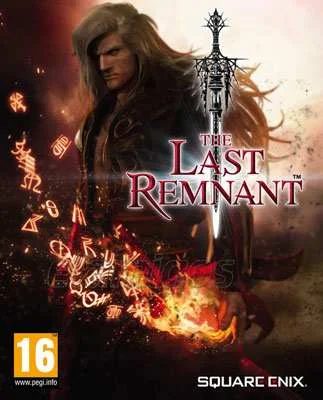
The Last Remnant
- Category:
- Release date:
- Game Genre:RPG, TPP, fantasy, turn-based, tactical, elements of strategy, jRPG
- Developer:
- Release:ElAmigos
- Platform:PC
- Languages (subtitles):English, French, Italian, German, Spanish, Japanese
- Dubbing/Audio:English, Japanese
- Crack:Reloaded
- Game size:4.90GB
Game Description
The Last Remnant PC is a fantasy JRPG built around large-scale, turn-based command battles rather than traditional one-character party control. The current Steam listing still uses the original name and notes that the game is unlisted at the publisher's request. It should not be confused with The Last Remnant Remastered, the later console and mobile edition; the PC version remains the reference point for its expanded union system and PC-specific battle options.
Commanding unions instead of individual characters
The Last Remnant replaces conventional party micromanagement with union-based combat. Each union combines several leaders and soldiers into one battlefield formation with shared health, shared action resources, and a unified command structure. You choose broad orders such as attacking, defending, healing, using combat arts, or casting mystic arts, while the individual members carry out those instructions according to their abilities.
This structure makes the game feel closer to a tactical army simulator than a standard menu-driven JRPG. You are not selecting every sword swing or spell manually. Instead, you shape the conditions that determine which actions become available, which units support one another, and how safely a union can survive a difficult engagement.
Exploration uses a third-person field perspective across cities, roads, ruins, and dungeons. Enemy formations are visible in the environment, allowing you to decide whether to engage, reposition, or link encounters together. The result is a deliberate loop of exploring, recruiting, reorganizing unions, and testing new formations against increasingly complex enemy groups.
Why formations, morale, and deadlocks matter
Formation selection is one of the game's most important preparation tools. Different formations alter union-wide attributes and can favor physical attacks, mystic arts, defense, speed, or particular kinds of enemies. A formation that works for ordinary monsters may be a poor choice against a boss capable of locking several unions into combat at once.
Once battles begin, positioning and engagement order become central. A direct clash is called a Deadlock, while additional unions attacking from the side or rear can create stronger assault conditions. These attacks are not cosmetic bonuses; they influence damage, pressure, and the amount of control you have over the battlefield.
The morale system adds another layer to every major fight. The battle's morale balance can shift when unions fall, reinforcements arrive, special arts are used, or advantageous attacks succeed. A strong morale position can make a difficult encounter manageable, while losing control of the flow can leave even a well-built army struggling to recover.
Characters develop through the actions they perform rather than through a simple class-and-stat template. Leaders and soldiers can learn different arts, request equipment components, and move toward different combat roles. Because the game does not expose every rule clearly, party building rewards experimentation and careful observation more than following a single universal setup.
PC edition improvements and battle controls
The Windows version is more than a direct conversion of the original console release. Its most visible addition is Turbo Mode, which plays battles at twice the normal speed. This is particularly useful during routine encounters, while difficult boss fights can still be viewed at the standard pace when timing and battlefield reading matter more.
The PC edition also removes the previous restriction on leader units, giving you more freedom when constructing unions. Soldiers can be assigned as leaders, and unions can be built around a wider selection of named characters. This change substantially affects how you distribute unique arts, healing roles, weapon styles, and command options across the active army.
A second practical improvement is the equipment preview. When shopping for weapons or shields, you can compare statistical information and inspect how equipment appears in battle before committing resources. Components and consumables are also easier to distinguish in the PC interface, reducing some of the friction involved in managing a large roster.
The PC version supports both English and Japanese voice acting. The current storefront lists English, French, Italian, German, Spanish from Spain, and Japanese interface or subtitle support, with no multiplayer feature advertised. This is a single-player RPG designed around long-term party planning rather than cooperative progression.
Story, recruitment, and world structure
The setting contains four principal races: Mitra, yama, qsiti, and sovani. Their societies are shaped by Remnants, mysterious artifacts from an ancient era whose power has influenced civilization, politics, and the balance between rulers and those under their control.
You play as Rush Sykes, a young man drawn into a wider conflict after his sister is taken. The campaign moves through multiple cities and regions, combining a central storyline with side quests, guild activities, recruitment opportunities, and optional battles. The world is not built around a single narrow party; it encourages you to assemble a broad roster and decide which personalities and combat roles belong in each union.
Recruitment is therefore part of the strategy, not merely a way to fill empty slots. Named leaders can bring distinctive arts and command tendencies, while generic soldiers help you tune weapon types, healing access, and formation requirements. The best roster is not always the one with the highest individual statistics; it is the one that gives your unions reliable answers to different battle conditions.
Content model and who should play it
The current PC listing presents The Last Remnant as a standalone, single-player RPG distributed through Steam. It does not advertise a free-to-play structure, online multiplayer, a season pass, or a separate expansion catalog. The PC package is notable because the Windows version's added systems are part of the edition itself rather than being presented as optional storefront purchases.
This is a strong fit for players who enjoy deep party construction, opaque progression systems, unusual turn-based mechanics, and battles where preparation matters as much as the command selected during a turn. It also suits JRPG players who prefer managing a large army to controlling a compact four-person party.
It is a weaker match for anyone who wants immediate tactical clarity, transparent character builds, or precise control over every individual action. The game deliberately asks you to interpret broad commands, union composition, morale, and formation bonuses. Some of its appeal comes from gradually understanding systems that are initially difficult to read.
PC platform details and storefront status
The Last Remnant's current PC storefront identity is straightforward: Steam still labels it The Last Remnant, not The Last Remnant Remastered. However, the listing is marked unlisted at the publisher's request, so it may not appear through normal Steam search results. The page identifies Square Enix as both developer and publisher.
The storefront lists full controller support for the Xbox 360 Controller for Windows, alongside the expected keyboard-and-mouse interface for menus and field navigation. It identifies Steam as the distribution platform, lists single-player and Family Sharing features, and does not list a separate launcher or anti-cheat service.
There is no modern PC remaster listed under the remastered name. That distinction matters when searching for information, because guides covering the console remaster generally describe the PC-expanded rule set, while the available PC storefront entry remains the older Windows edition.
Similar turn-based RPGs on PC
Players who want a more conventional party-based JRPG after The Last Remnant may prefer story-rich turn-based adventures like Like a Dragon: Infinite Wealth, which offers clearer individual character roles and more direct battlefield positioning.
For a traditional fantasy journey with familiar command battles, classic turn-based JRPG exploration in DRAGON QUEST VII Reimagined provides a more accessible contrast. The two games share party progression and fantasy adventure foundations, but The Last Remnant is significantly more focused on union architecture, battlefield morale, and large-scale engagements.
The comparison is useful because The Last Remnant does not fit neatly into one genre box. It has the character recruitment and world travel of a JRPG, the preparation demands of a tactical RPG, and a command system that sits between direct party control and army-level strategy.
The Last Remnant FAQ
The following answers focus on the questions most relevant to PC players deciding whether this unusual Square Enix RPG fits their library.
Is The Last Remnant still the current PC storefront name?
Yes. The current Steam listing uses The Last Remnant. The Last Remnant Remastered is the name associated with later console and mobile versions, not a replacement PC storefront listing.
Is The Last Remnant a traditional turn-based RPG?
It is turn-based, but it does not use standard one-character command selection. You issue broad tactical orders to unions, and the individual members execute actions based on their skills, equipment, position, and available resources.
How many characters can be placed in a union?
Unions are multi-member battlefield groups whose size expands as the campaign unlocks additional capacity. Their effectiveness depends on more than member count: formation bonuses, leaders, arts, equipment, and healing coverage all influence the final result.
Does the PC version have Turbo Mode?
Yes. Turbo Mode doubles battle speed, making routine fights faster while leaving you free to use normal speed when learning an encounter or managing a difficult boss battle.
Does The Last Remnant support multiplayer or co-op?
No multiplayer or co-op mode is listed. The PC edition is presented as a single-player RPG, with its strategy centered on building and commanding your own unions.
Which languages and voices are available on PC?
The storefront lists English, French, Italian, German, Spanish from Spain, and Japanese interface or subtitle support. Voice acting can be switched between English and Japanese.
Is the PC version different from the original console edition?
Yes. The Windows edition adds Turbo Mode, removes the former leader-unit restriction, includes equipment preview functionality, and incorporates other changes made for the PC version. Those differences are why PC guides should not automatically treat the original console rules as equivalent.
System Requirements
Minimum: |
Processor: Core 2 Duo 2.4 GHz Graphics: 512 MB VRAM Memory: 2 GB RAM Disk space: 5 GB HDD Operating system: Windows XP SP2/Vista SP1 |
Screenshots


Trailer/Gameplay
[media=https://www.youtube.com/watch?v=JwNaFByOf54]
Download
The Last Remnant (2009), 4.90GB
ElAmigos release, game is already cracked after installation (crack by Reloaded).

Updated to version 1.0.515.0.

1. Extract files.
2. Burn or mount the image.
3. Install the game.
4. ElAmigos release, game is already cracked after installation.
5. Play the game. If you like this game, BUY IT!
The Last Remnant Download
 Download from TeraBox
Torrent Download
The best torrent download speeds are with qBittorrent!