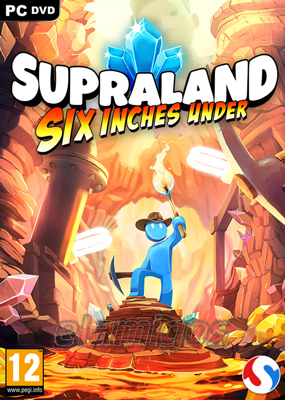
Supraland
Edit date: 6-01-2023, 12:02
Reason: Updated to version 1.23.6 (08.11.2021)
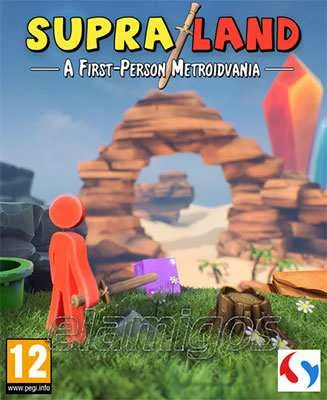
- Category:
- Release date:
- Game Genre:Action, FPP, RPG elements, logical elements, indie games, action adventure
- Developer:
- Release:ElAmigos
- Platform:PC
- Languages (subtitles):English, French, Italian, German, Spanish, Polish, Russian, Hungarian, Portuguese, Finnish, Turkish, Serbian, Japanese, Chinese Simplified, Chinese Traditional
- Dubbing/Audio:English
- Crack:Codex
- Game size:4.05GB
Game Description
Supraland on PC is a first-person Metroidvania puzzle adventure from Supra Games, built around exploration, inventive environmental challenges, platforming, secrets, and light shooter combat. The current Steam storefront still lists the game under its original name, with no verified rebrand or replacement edition. It remains a single-player experience with a separate paid expansion, Supraland Crash.
The game is best understood as a toy-box world designed for players who enjoy discovering how systems interact. Its colorful presentation looks accessible, but the puzzles and optional secrets expect observation, experimentation, and a willingness to explore without constant objective markers.
Exploration, progression, and first-person movement
Supraland uses an interconnected world rather than a sequence of isolated puzzle rooms. Early paths are blocked by environmental obstacles, inaccessible ledges, locked mechanisms, or traversal gaps. Progress comes from finding new abilities that open routes in previously visited areas and reveal optional rewards.
The perspective is fully first-person, which makes ordinary platforming more deliberate. Looking around is part of the puzzle language: a seemingly decorative surface may be a climbable route, a distant platform may be reachable with the right tool, and a suspicious gap may conceal a secret rather than a dead end.
Exploration is reinforced by hidden chests, currency, upgrades, and deliberately placed shortcuts. The game does not treat every collectible as mandatory busywork. Many rewards sit behind optional movement challenges or environmental deductions, giving completionists a reason to revisit familiar regions after gaining more abilities.
Players who enjoy first-person puzzle exploration with a more abstract visual language may also appreciate experimental spatial puzzlers such as Antichamber, although Supraland adds combat, upgrades, and a broader Metroidvania structure.
Puzzles built around versatile abilities
The central design idea is that abilities are useful in more than one context. A tool introduced for a straightforward obstacle can later become a platforming aid, a physics device, a combat option, or part of a larger chain involving several systems. Ability combinations are more important than simply collecting a larger list of powers.
Puzzles use physical objects, switches, jump pads, color interactions, electricity, water, projectiles, and spatial positioning. The challenge often lies in recognizing what the environment is communicating rather than executing a long sequence of precise inputs. Once the underlying idea becomes clear, the solution is usually intended to feel immediate.
This structure creates a strong mastery loop. You first learn what an ability does, then test its limits, and eventually notice that an old location supports a new application. That rhythm makes backtracking productive instead of merely administrative.
The game also rewards unconventional thinking. Some paths appear to lead outside the intended route, but the level design frequently places a chest, upgrade, or alternate solution near those apparent boundaries. Environmental experimentation is therefore part of normal progression, not an exploit reserved for speedrunners.
Combat and challenge balance
Combat is present, but it is not the primary reason to play Supraland. The game draws on fast old-school shooters such as Unreal, Doom, and Quake, using strafing, jumping, ranged attacks, and groups of charging enemies rather than slow cover-based encounters.
Your weapons are also puzzle tools. The gun can interact with switches and environmental setups, so combat equipment remains relevant outside enemy encounters. That overlap helps connect the action systems to the larger sandbox instead of treating them as a completely separate mode.
Fast movement matters during fights, especially when enemies pressure you from several directions. However, the experience is weighted toward exploration and puzzle solving. Players seeking a deep first-person combat game may find the fighting comparatively simple, while players who prefer combat as a change of pace will find it functional and appropriately secondary.
Difficulty comes more from interpretation than punishment. The game expects players to notice visual clues, test possibilities, and remember where an ability could apply. It offers less hand-holding than a conventional guided adventure, which is a strength for independent explorers and a potential frustration for anyone who wants constant waypoint guidance.
Story, tone, and content structure
Supraland presents a minimal story with an overarching objective rather than a heavily scripted campaign. You play in a miniature world of colored toy figures, where the contrast between the childlike setting and the more demanding puzzles creates much of the game's identity.
The tone is playful and self-aware, but the design does not reduce the puzzles to a casual experience. The visual style may suggest a family-friendly platformer, while the actual progression targets players comfortable with spatial reasoning, optional exploration, and delayed solutions.
The base game is a paid single-player title on Steam and includes a playable demo whose progress carries into the full version. The storefront also lists Supraland Crash as separate paid downloadable content, while the Complete Edition bundles the base game and Crash together.
Crash expands the Supraland formula rather than changing its identity. It is useful for players who finish the main adventure and want more first-person puzzles, ability interactions, secrets, and combat within the same broader design tradition.
Who should play Supraland?
Supraland is a strong match for PC players who want first-person Metroidvania progression without a conventional fantasy setting. It suits people who enjoy unlocking a tool, testing its boundaries, and returning to earlier spaces with a different understanding of what is possible.
It is also a good choice for puzzle fans who want more movement and exploration than a room-by-room logic game provides. If the idea of discovering a hidden route or solving a physical setup is more appealing than following a checklist, the open-ended structure is likely to work well.
It is less suitable for players who need a heavily narrated campaign, fully guided objectives, or combat that carries the same depth as a dedicated shooter. The lack of multiplayer is equally important: the Steam listing identifies Supraland as single-player only, with no co-op or split-screen mode.
For a closer comparison with a more structured first-person puzzle adventure, players who enjoy physics-focused PC puzzlers like Lightmatter may recognize the emphasis on observation, though Supraland offers more traversal, secrets, and progression systems.
PC features, controls, and storefront details
The PC version is distributed through Steam and supports full controller support, making it suitable for players who prefer a gamepad for platforming and movement. Keyboard and mouse remain a natural fit for first-person aiming and looking, while controller support gives the game flexibility across different PC setups.
Steam features include Steam Cloud, Steam Achievements, Steam Trading Cards, and Family Sharing. The current listing does not advertise a separate publisher launcher or an anti-cheat system. It also requires agreement to a third-party EULA, so players should treat Steam as the relevant storefront and account ecosystem.
Localization is broader than English-only indie releases. The Steam page lists interface and subtitle support for 16 languages, including English, French, Italian, German, Portuguese, Finnish, Russian, Japanese, Traditional Chinese, Simplified Chinese, Spanish, Turkish, Hungarian, Polish, and Korean.
There is no verified official rebranding to a new name such as Supraland Classic or Supraland Definitive Edition. The original title remains the current storefront identity, while Supraland Crash is presented as downloadable content and the Complete Edition as a bundle containing both products.
Similar first-person puzzle games on PC
Supraland occupies an unusual space between Metroidvania exploration, environmental puzzle design, platforming, and shooter movement. Its closest comparisons depend on which part of the experience matters most to you.
- Portal 2 is the clearer match for players who prioritize physics puzzles, spatial reasoning, and first-person interaction, but its structure is more campaign-focused and its cooperative content is separate from Supraland's solo design.
- Antichamber is a better comparison for nonlinear exploration and learning unfamiliar spatial rules, although it does not share Supraland's combat and upgrade loop.
- Lightmatter suits players looking for a more concentrated first-person puzzle experience built around environmental hazards and logical observation.
These games share puzzle-oriented first-person design, but Supraland stands apart through its interconnected sandbox, collectible upgrades, movement abilities, and willingness to combine combat with environmental problem solving.
Supraland FAQ
Is Supraland still called Supraland on PC?
Yes. The current Steam storefront lists the game as Supraland. No verified rebrand or replacement name has been identified. Supraland Crash is separate downloadable content, not a new title for the original game.
Is Supraland a full Metroidvania?
It is a first-person Metroidvania puzzle game built around an interconnected world, ability-gated routes, backtracking, secrets, and upgrades. Its emphasis is on environmental puzzles and exploration rather than traditional combat progression.
Does Supraland have multiplayer or co-op?
No. The PC storefront lists Supraland as a single-player game. There is no advertised online co-op, local co-op, or split-screen mode for the original title.
What is included in Supraland Crash?
Supraland Crash is paid downloadable content that extends the game's puzzle-platforming formula with more exploration, abilities, secrets, and combat. The Steam Complete Edition bundles the base game with Crash.
Does Supraland support controllers on PC?
Yes. Steam metadata lists full controller support. The game also supports the standard Steam ecosystem features associated with its PC release, including cloud saves, achievements, trading cards, and Family Sharing.
Is Supraland mainly a shooter?
No. Combat uses fast movement, strafing, jumping, and ranged weapons, but the dominant experience is exploration and puzzle solving. The gun and other abilities can also function as environmental tools, so action and puzzle systems overlap.
System Requirements
Minimum: | Recomended: |
| Processor: Intel Core 2 Duo 2.66 GHz Graphics: 3 GB GeForce GTX 780 Memory: 4 GB RAM Disk space: 3 GB HDD Operating system: Windows 7 | Processor: Quad Core Graphics: 4 GB GeForce GTX 1050 Ti Memory: 4 GB RAM Disk space: 3 GB HDD Operating system: Windows 10 |
Screenshots


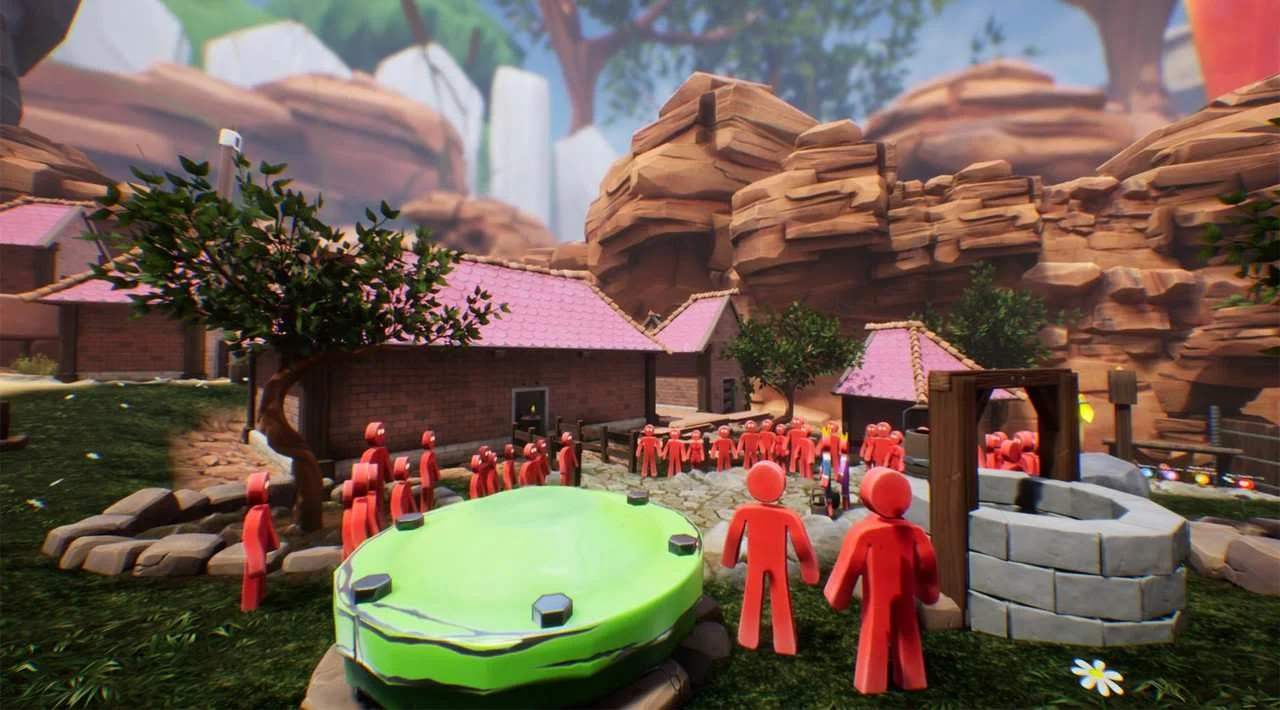
Trailer/Gameplay
[media=https://www.youtube.com/watch?v=eANmV-Z-oXo]
Download
Supraland (2019), 4.05GB
ElAmigos release, game is already cracked after installation (crack by Codex).

Updated to version 1.23.6 (08.11.2021)

1. Extract files.
2. Burn or mount the image.
3. Install the game.
4. ElAmigos release, game is already cracked after installation.
5. Play the game. If you like this game, BUY IT!
Supraland Download
🔒 Premium access required
To see and use the download links, you must be logged in and have an active PREMIUM account.
* Unlock downloads via Torrent and TeraBox.
DLC: Crash.
Torrent Download
The best torrent download speeds are with qBittorrent!