Medieval Engineers

- Category:
- Release date:
- Game Genre:Simulation, the middle ages, sandbox, indie games, crafting
- Developer:
- Release:ElAmigos
- Platform:PC
- Languages (subtitles):English, French, Italian, German, Spanish, Polish, Russian, Czech, Slovak, Portuguese-Brazil, Dutch, Croatian
- Dubbing/Audio:N/A
- Crack:Codex
- Game size:2.80GB
Game Description
Medieval Engineers PC is a first-person medieval engineering sandbox focused on construction, destruction, resource gathering, and mechanical experimentation. The Steam storefront still lists the game as Medieval Engineers; Community Edition is an opt-in branch of the original game rather than a renamed standalone edition. Keen Software House no longer leads regular development, while community volunteers continue work with Keen in a support role.
This status matters before you buy. The game remains a paid Steam title with single-player, online co-op, online PvP, Steam Workshop support, and an included dedicated-server application. It is best understood as a physics-heavy construction sandbox with survival elements, not as a conventional story-driven medieval RPG.
Build, test, collapse, rebuild
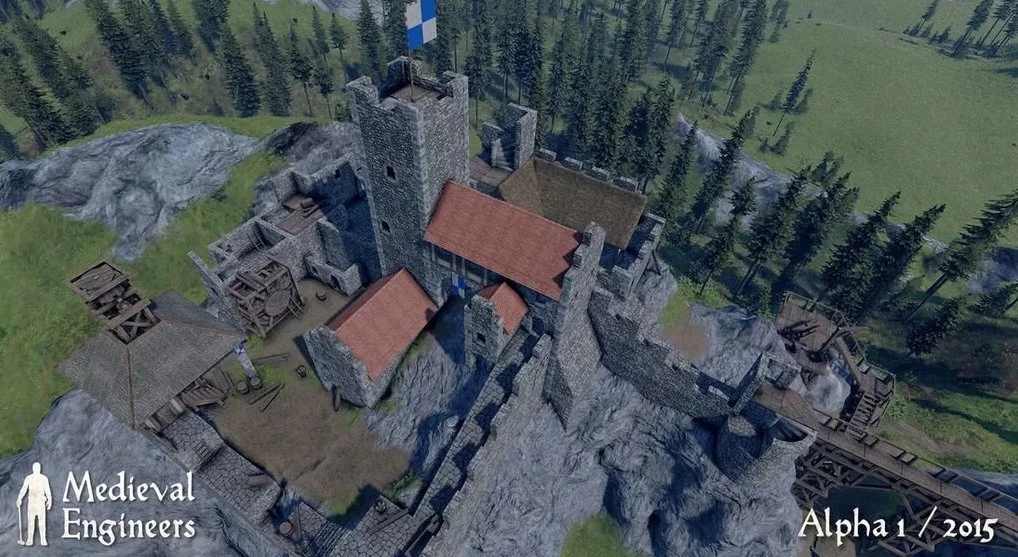
The central loop begins with gathering materials, choosing a building site, and placing blocks to create a functional structure. You can make houses, castles, fortifications, wagons, farming equipment, and siege machines. The emphasis is not simply on decoration; every ambitious project becomes an engineering problem.
Structural integrity is the defining system. Buildings rely on support from blocks beneath and beside them, while material weight and strength influence how a design behaves. A tall stone wall may survive where a wooden structure fails, but the heavier material also creates different construction demands.
The Structural Integrity View helps identify vulnerable areas during construction. It is particularly useful in Creative Mode, where you can prototype a castle or machine before attempting to reproduce it under Survival Mode restrictions.
When supports are damaged or removed, the result is not a simple health-bar exchange. Sections can become dynamic fractures and collapse through real-time destruction. That makes testing part of the gameplay: a gatehouse, bridge, or siege tower is only successful if it works under physical stress.
Creative and survival play
Creative Mode is the clearest expression of Medieval Engineers as a design tool. Unlimited construction resources let you concentrate on proportions, stability, moving parts, and visual detail without spending time mining every ingredient.
Survival Mode adds the logistical layer. You gather timber, stone, ores, plants, food, and other materials, then process them into tools, weapons, building components, and production equipment. The mode gives construction a stronger sense of purpose, but it remains a sandbox rather than a linear campaign.
The research and quest system provides some direction for new players. Quests act as small guided activities that introduce features while unlocking knowledge, blocks, and crafting recipes. They are useful onboarding tools, although the long-term objective still comes from the world and the projects you choose to pursue.
For players who prefer medieval settlement management over direct construction, first-person medieval survival sandboxes such as Medieval Dynasty offer a more character-focused progression model. Medieval Engineers instead puts the structure itself at the center of attention.
Materials, machines, and terrain
Resource progression covers copper, tin, iron, silver, and gold, along with alloys such as bronze and steel. Material choice affects tool and weapon efficiency, durability, and the kinds of construction you can attempt.
Voxel terraforming allows players to dig, mine, and reshape the ground. The terrain is not merely a backdrop for buildings: it can provide defensive advantages, expose resources, create underground spaces, or make a planned settlement easier to protect.
The world includes seven biomes, with differences in vegetation and terrain. Forests, grasslands, frozen regions, desert-like areas, and other environments change the visual character of a settlement while influencing where you gather materials and establish a base.
Mechanical Blocks extend construction into automation. Windmills, shafts, joints, and related systems can help process crops and materials, reducing the need to perform every production step manually. The appeal comes from designing a working chain rather than merely unlocking a faster menu option.
Farming supports plowing, planting, harvesting, and food production. With the relevant research, players can build mechanical farming equipment such as plows, seeders, and harvesters. This gives Survival Mode a practical reason to develop beyond a basic shelter and workshop.
Multiplayer and server tools
Medieval Engineers supports online co-op and online PvP. Friends can collaborate on castles, towns, machines, and defensive projects, or compete for territory and resources. Both Creative and Survival play are available in multiplayer.
Combat is part of the sandbox rather than the sole focus. Barbarian invaders, rival players, fortifications, and siege equipment create situations where construction directly affects defense. A wall is valuable because it controls movement, protects production, and survives pressure.
Area ownership lets players claim land for a house or faction. Ownership can control who is allowed to build, mine, travel, respawn, and access structures. That system is more relevant on persistent multiplayer worlds than in a private creative session.
The game includes dedicated server support without requiring an additional Steam account for the server software. Dedicated instances can run independently of a player-hosted session, making them suitable for communities that want a persistent world and administrative control.
Players who want a medieval village-management comparison can also look at medieval city builders like Life is Feudal: Forest Village. That game emphasizes population needs and settlement administration, whereas Medieval Engineers is more concerned with block placement, physics, machines, and player-built defenses.
Workshop and Community Edition
Steam Workshop is a major part of the PC ecosystem. Community content can include saved worlds, planets, models, textures, skins, shaders, banner patterns, and scripted behaviors. The official feature set also describes an API that lets modders extend in-game objects with C# scripting.
Custom banners and flags give multiplayer houses a recognizable identity. Research quests can also be modified or replaced, allowing experienced communities to create their own progression paths instead of relying only on the built-in activities.
The Community Edition is accessed through the Steam library by opening the game's Properties menu, selecting the Betas area, and choosing the Community Edition branch. It is community-led and Keen-supported, so players should treat it as an ongoing volunteer project rather than a fully publisher-directed sequel or remaster.
That distinction closes an important information gap found in many short catalog descriptions. Medieval Engineers has not been rebranded as a new commercial edition, and Community Edition does not turn it into a free-to-play game or introduce a separate monetization model.
PC features and accessibility
The game requires a Steam account to play, according to the official FAQ. Steam Workshop integration and the dedicated-server tools are therefore central to the PC experience rather than optional extras.
Xbox controller support was added through an official game update, while keyboard and mouse remain natural choices for precise construction, inventory management, and block placement. The current Steam listing identifies English and German interface support.
There is no official indication of a separate launcher, subscription, or paid expansion catalog attached to the game. The commercial model is a paid base game with community content delivered through Steam Workshop and the optional Community Edition branch.
The game is also unusually dependent on player-made goals. It does not present a conventional campaign structure with a fixed ending; the meaningful progression comes from learning construction systems, completing research activities, expanding a settlement, testing machines, and surviving or dominating a multiplayer world.
Who should play Medieval Engineers?
Medieval Engineers suits players who enjoy physics-based building, large-scale castle construction, voxel terrain, automation, and the satisfaction of solving design problems through repeated testing.
It is especially appealing if you want a medieval setting without giving up creative control. You can approach the game as an architect, survival crafter, mechanical designer, server administrator, or siege planner.
The game is a weaker fit for players seeking a polished narrative adventure, deep character progression, cinematic combat, or a heavily curated single-player campaign. Survival provides structure, but the sandbox remains the main attraction.
It is also worth approaching with realistic expectations about support. The original development direction has ended, and the current Community Edition depends on volunteer priorities. That makes the Workshop ecosystem valuable, but it also means future changes are not guaranteed to follow a conventional commercial roadmap.
Medieval Engineers FAQ
Is Medieval Engineers now called Community Edition?
No. The commercial game remains listed as Medieval Engineers. Community Edition is an optional Steam branch of the original title, maintained by community volunteers with support from Keen Software House.
Does Medieval Engineers have Creative and Survival Mode?
Yes. Creative Mode provides unrestricted building and is useful for testing designs, while Survival Mode adds resource gathering, crafting, research, farming, exploration, and threats.
Can you play Medieval Engineers with friends?
Yes. The game supports online co-op and online PvP. Multiplayer includes both Creative and Survival play, along with faction-style land ownership and defensive or offensive castle building.
Does Medieval Engineers support dedicated servers?
Yes. A dedicated-server application is included with the game and is also available as a separate Steam tool. It can host persistent worlds independently from a player-hosted session.
Does Medieval Engineers support mods?
Yes. Steam Workshop supports community worlds, planets, models, textures, skins, shaders, banner content, research quests, and scripted extensions through the modding API.
Is Medieval Engineers a story game?
No. It is primarily a construction and engineering sandbox. Research quests provide guided activities, but the main progression comes from building, resource management, machine design, survival, and multiplayer objectives.
System Requirements
Minimum: | Recomended: |
| Processor: Intel Core i5 3.0 GHz Graphics: 2 GB GeForce GTX 750 / Radeon R9 270X Memory: 8 GB RAM Disk space: 10 GB HDD Operating system: Windows 10 64-bit | Processor: Intel Quad Core i7 4.5 GHz Graphics: 8 GB GeForce GTX 1070 / Radeon RX Vega 56 Memory: 16 GB RAM Disk space: 10 GB HDD Operating system: Windows 10 64-bit |
Screenshots


Trailer/Gameplay
Download
Medieval Engineers (2020), 2.80GB
ElAmigos release, game is already cracked after installation (crack by Codex).

Updated to version 0.7.2 (17.03.2020).
Change language in game options.

1. Extract files.
2. Burn or mount the image.
3. Install the game.
4. ElAmigos release, game is already cracked after installation.
5. Play the game. If you like this game, BUY IT!
Medieval Engineers Download
🔒 Premium access required
To see and use the download links, you must be logged in and have an active PREMIUM account.
* Unlock downloads via Torrent and TeraBox.
Torrent Download
The best torrent download speeds are with qBittorrent!