The Lord of the Rings Return to Moria
Edit date: 16-09-2026, 18:14
Reason: + update 1.6.2 - 1.6.7 (12.02.2026)
- Category:
- Release date:
- Game Genre:Action, TPP, fantasy, sandbox, The Lord Of The Rings, survival, network, co-op, crafting, Epic Store exclusive, Find Your Next Game
- Developer:Free Range Games
- Release:ElAmigos
- Platform:PC
- Languages (subtitles):English, French, Italian, German, Spanish, Portuguese-Brazil, Korean, Japanese, Simplified Chinese
- Dubbing/Audio:English
- Crack:Codex/Rune
- Game size:16.87GB
Game Description
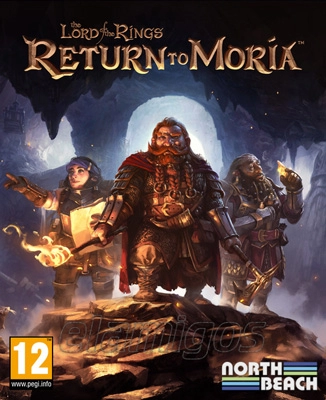
The Lord of the Rings: Return to Moria is a third-person PC survival-crafting adventure set in the Fourth Age of Middle-earth. Developed by Free Range Games and published by North Beach Games, it sends a company of Dwarves beneath the Misty Mountains to reclaim Moria, also known as Khazad-dûm or Dwarrowdelf. The current PC storefront title remains The Lord of the Rings: Return to Moria; no verified rebrand or replacement edition has superseded it.
Mining, survival, and the road through Moria
Return to Moria combines resource gathering, crafting, base building, exploration, and third-person combat. The central loop is straightforward but interconnected: mine ore, gather food and fuel, improve equipment, restore Dwarven infrastructure, and push into deeper regions where stronger enemies and more valuable materials await.
The mines are procedurally generated, so room layouts, passages, resource locations, and parts of each expedition can vary between worlds. Mining is not completely safe. The noise created by excavation can attract hostile forces, turning a resource run into an unexpected fight against Orcs, Goblins, and other dangers in the dark.
Survival is shaped by more than health and stamina. Players must manage food, sleep, temperature, light, and noise while establishing safe routes through Moria. Dynamic lighting is especially important because torches, lamps, hearths, and repaired landmarks help make underground travel more manageable.
Campaign and Sandbox modes
The game has two major structures: Campaign Mode and Sandbox Mode. Campaign is the more guided option, using a narrative progression through the Mines of Moria while introducing new areas, recipes, forges, enemies, and story objectives in a more deliberate sequence.
Sandbox Mode is built for players who want a less linear survival experience. Its world generation changes the order and arrangement of regions, making exploration more unpredictable and placing greater emphasis on self-directed building, resource planning, and adapting to the layout of each seed. It is not simply a campaign map without story missions; its structure and progression priorities are different.
Difficulty can be selected and adjusted around the chosen experience. The available settings support a more story-focused approach, a solo-oriented setup, or a harder survival challenge, with additional values that can be tuned during play. This flexibility helps both new players and experienced groups shape the pressure created by combat, resources, and hostile encounters.
Restoring a Dwarven kingdom
Progress is tied to the restoration of Moria as much as to personal equipment. Players can rebuild ancient forges, repair important Dwarven landmarks, restore mines, and create new bases inside cleared locations. Construction can begin from scratch or expand existing structures, allowing practical outposts and larger halls to grow around the underground environment.
Crafting covers weapons, armor, tools, structures, food, ale, and other survival supplies. Repaired forges unlock additional technologies and let Dwarves strengthen, repair, and enchant equipment. Magical artifacts add another layer to exploration, including weapons that warn of nearby Orcs, maps connected to rare resources, forgotten crafting plans, and amulets with useful effects.
Combat is primarily close-range, supported by ranged options such as bows. Encounters are designed around preparation and positioning rather than constant arena fights. A well-lit base, reliable equipment, food reserves, and a sensible retreat route matter when a mining expedition triggers a larger threat.
Players who enjoy the shared building, crafting, and exploration loop of cooperative survival sandboxes such as Valheim will recognize the importance of preparing a base before venturing into dangerous territory. Return to Moria is more structured around a specific setting and story, however, and its underground geography gives exploration a tighter, more enclosed character.
Base game, expansion, and optional content
The PC version is a paid base game rather than a free-to-play product. The core purchase provides the Moria survival-crafting experience, including solo play, Campaign and Sandbox structures, building, crafting, procedural exploration, and online cooperative play.
The storefront catalog also lists the Durin's Folk Expansion, which adds a story continuation and new systems connected to expeditions, NPCs, and trading. Additional optional packs include Beorn's Lodge Pack, Orc Hunter Pack, Ent-craft Pack, Rohan Pack, and the Yule-tide Pack. The catalog also separates the soundtrack and digital art exhibition from gameplay expansions.
This means the commercial structure is easy to understand: buy the base game for the main adventure, then choose the expansion or cosmetic and bonus-content packs that fit your interest. The listed add-ons do not change the base game into a subscription product.
Who should play Return to Moria?
Return to Moria is a strong fit for players who want survival crafting with a narrative spine rather than a purely open-ended building sandbox. Tolkien fans will find a setting built around Dwarven culture, Khazad-dûm, Gimli Lockbearer, Dwarven songs, ale, forges, and recognizable traces of Middle-earth lore without turning the game into a retelling of the films.
It also suits groups that enjoy dividing responsibilities. One player can gather or mine while another expands the base, cooks, repairs gear, or prepares defenses. Cross-platform multiplayer makes it practical to form a company with friends using different supported platforms.
Players who mainly want a fast, combat-first action game may find the pace too deliberate. The game repeatedly asks you to return to a hearth, improve equipment, manage supplies, and make another prepared expedition. Those who dislike procedural layouts or survival meters should approach it cautiously. For a brighter outdoor world with extensive construction and RPG exploration, survival RPGs with open-world building like Enshrouded offer a useful comparison, although Return to Moria places more of its identity in darkness, mining, and Dwarven restoration.
PC features and multiplayer ecosystem
On PC, Return to Moria is available through Steam and the Epic Games Store. The Steam version lists full controller functionality improvements, Steam Achievements, Steam Cloud, Family Sharing, single-player support, online co-op, and cross-platform multiplayer. Keyboard and mouse remain natural options for inventory management, building, and navigation.
Online sessions support up to eight players, and crossplay connects PC players with PlayStation 5 and Xbox Series X|S users. The game uses invite codes for hosted sessions, while dedicated and rentable server support is also available for groups that want a persistent multiplayer setup instead of relying only on a player's active session.
There is no direct official mod support. Third-party modifications may work at a player's own discretion, but modified files and mod-created items are not covered by normal support. This is an important distinction for PC players comparing Return to Moria with games built around an established mod ecosystem.
English includes full audio, while French, Italian, German, Spanish from Spain, Japanese, Korean, Brazilian Portuguese, and Simplified Chinese are supported through interface and subtitle localization. The game also features Dwarven vocal material, including Khuzdul references, within its English audio presentation.
Similar PC survival games
The closest comparisons are games that combine crafting, exploration, combat, and cooperative construction. Co-op survival adventures such as Grounded share the emphasis on gathering, shelter construction, hostile environments, and teamwork, though Grounded uses a miniature backyard setting and a more open outdoor layout.
Return to Moria is less focused on freeform wilderness survival than Valheim and less reliant on broad surface exploration than Enshrouded. Its differentiator is the combination of procedural underground exploration, Tolkien's Dwarven setting, restoration objectives, and a campaign that gives the survival loop a clear direction.
The Lord of the Rings: Return to Moria FAQ
Is the current PC name still The Lord of the Rings: Return to Moria?
Yes. Steam and the Epic Games Store currently list the game as The Lord of the Rings: Return to Moria. There is no verified storefront rebrand or replacement title that PC buyers need to search for instead.
Is Return to Moria a single-player or multiplayer game?
Both. You can play alone or host and join online co-op sessions with up to eight players. Crossplay supports PC, PlayStation 5, and Xbox Series X|S, and dedicated servers also support cross-platform multiplayer.
Does Return to Moria have Campaign and Sandbox modes?
Yes. Campaign provides a more guided story progression, while Sandbox creates a more nonlinear survival experience with different world layouts and a stronger emphasis on exploration and self-directed building.
What is included in the base game?
The base game includes the main Moria adventure, procedural exploration, survival systems, crafting, combat, building, character customization, Campaign Mode, Sandbox Mode, solo play, and online multiplayer. The Durin's Folk Expansion and several cosmetic or bonus-content packs are separate purchases.
Does Return to Moria support controllers on PC?
Yes. PC controller support has received multiple improvements, including clearer controller inputs, menu fixes, building adjustments, and better interaction with map and goal screens.
Does Return to Moria support mods?
There is no direct official mod support. Players who modify game files do so at their own discretion, and the developer and publisher may not be able to troubleshoot problems caused by mods or mod-created content.
System Requirements
|
Minimum:
|
Recommended:
|
| Processor: Intel® Core i5 (quad-core or better) Graphics: NVIDIA® GeForce® GTX 1060 Memory: 8 GB Disk space: Recommended to use SSD Operating system: Windows 10/11 (64-bit) |
Processor: Intel® Core™ i7 (hexa-core or better) Graphics: NVIDIA® GeForce® RTX 2060 Memory: 16 GB Disk space: Recommended to use SSD Operating system: Windows 10/11 (64-bit) |
Screenshots


Trailer/Gameplay
The Lord of the Rings: Return to Moria is a third-person PC survival-crafting adventure set in the Fourth Age of Middle-earth. Mine procedurally generated halls, rebuild Dwarven forges, craft weapons, manage light and supplies, and fight Orcs alone or with up to eight-player crossplay. It suits Tolkien fans and co-op groups who prefer structured exploration over pure sandbox survival.
Download
The Lord of the Rings Return to Moria (2023), 16.87GB
ElAmigos release, game is already cracked after installation (crack by Codex/Rune).

Updated to version 1.6.2 (18.11.2025).

1. Extract files.
2. Burn or mount the image.
3. Install the game.
4. ElAmigos release, game is already cracked after installation.
5. Play the game. If you like this game, BUY IT!
The Lord of the Rings Return to Moria Download
🔒 Premium access required
To see and use the download links, you must be logged in and have an active PREMIUM account.
* Unlock downloads via Torrent and TeraBox.
+ update 1.6.2 - 1.6.7 (12.02.2026) & crack (by Codex/Rune), 522MB
🔒 Premium access required
To see and use the download links, you must be logged in and have an active PREMIUM account.
* Unlock downloads via Torrent and TeraBox.
DLC: Durin's Folk, Beorn's Lodge Pack, Orc Hunter Pack, Ent-craft Pack, Rohan Pack, Yule-Tide Pack, Digital Art Exhibition, Soundtrack.
Torrent Download
The best torrent download speeds are with qBittorrent!