Book of Demons Hellcard
Edit date: 8-08-2025, 21:55
Reason: Updated to version 1.1.250731 (31.07.2025).
- Category:
- Release date:
- Game Genre:RPG, fantasy, turn-based, roguelike, tactical, card games, Polish, indie games, co-op
- Developer:Thing Trunk
- Release:ElAmigos
- Platform:PC
- Languages (subtitles):English, French, Italian, German, Spanish, Russian, Polish, Portuguese-Brazil, Simplified Chinese, Traditional Chinese, Japanese, Korean, Bulgarian
- Dubbing/Audio:English
- Crack:Tenoke
- Game size:1.01GB
Game Description
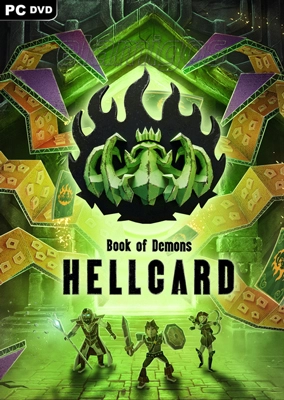
Book of Demons: Hellcard is the name many players still use for the PC spin-off now listed on Steam as HELLCARD. Developed by Thing Trunk and published by Skystone Games, it is a cooperative roguelike deckbuilder with turn-based card battles, isometric paper-dungeon presentation, and a party system built around up to three heroes.
How HELLCARD plays on PC
Each run sends your party deeper into the paper dungeons established by Book of Demons. You choose encounters, fight groups of demons, collect cards and artifacts, then adjust your build before the next battle. The route is structured as a sequence of tactical decisions rather than a traditional action-RPG campaign.
Combat is turn-based, but it is not a simple exchange of damage totals. The battlefield is divided into attack ranges and monster positions, making enemy placement one of the central systems. A monster standing near a hero may be vulnerable to melee attacks, while distant enemies can change which cards are efficient or even safe to play.
That positioning layer gives the deckbuilder a distinctly spatial identity. You are not only asking which card has the highest value; you are also deciding who should attack, which enemy must be interrupted, and how the party should arrange its actions across the turn.
Solo players can descend alone or recruit AI companions. In online multiplayer, friends or other players can join the same dungeon run, with the party working together against the Archdemon's forces.
Classes, cards, and party roles
The current game includes five playable classes: Warrior, Rogue, Mage, Tinkerer, and the DLC class Bruja. Each class has its own card pool and tactical identity, so party composition affects both the way you fight and the rewards you value.
The Warrior is built around close-range pressure, durability, and defensive play. The Rogue favors distance, precision, traps, and control. The Mage covers offensive and supportive magic, while the Tinkerer uses contraptions and area-focused effects. Bruja, the Blood Witch, introduces a more dangerous style based on exchanging health and power.
Cards generally fall into recognizable combat roles such as attacks, skills, and influences. Attacks deal damage, skills provide effects such as defense or control, and influences shape the broader behavior of a build. The important choice is not simply adding stronger cards, but keeping the deck focused enough to draw useful combinations consistently.
Artifacts provide another layer of customization. Some improve a class's opening setup, while others reward specific habits such as exhausting cards, preserving mana, blocking damage, or targeting marked enemies. These bonuses can push a run toward a specialized build instead of a collection of unrelated upgrades.
Players who enjoy tactical card combat with a stronger party identity may also find useful genre overlap in party-based roguelike deckbuilders such as Roguebook, although HELLCARD places more emphasis on shared positioning and cooperative turns.
Positioning is the defining strategy
Many deckbuilders treat combat as a menu of targets and numbers. HELLCARD makes the physical arrangement of enemies part of the puzzle. Attacks can behave differently at short and long range, and some effects become more valuable when monsters are grouped, isolated, or left within a particular hero's reach.
This creates a useful tension between individual and team play. A Warrior may want enemies close, while a Rogue benefits from space. The Mage can often bridge those gaps, and the Tinkerer can influence several targets at once. Strong turns come from coordinating these roles rather than allowing every hero to spend cards independently.
Enemy intent also matters. Certain monsters threaten direct attacks, spells, movement effects, or reinforcements, so the best card is often the one that prevents a dangerous sequence rather than the one that produces the largest immediate number.
The result is a game where card evaluation, range management, and threat prioritization are inseparable. This is the main reason HELLCARD feels closer to a cooperative tactical board game than to a conventional solo deckbuilder.
Run structure and long-term progression
A run is built around branching floor choices, combat rewards, and service locations that let you heal, remove cards, upgrade cards, find artifacts, or prepare a temporary advantage for the next battle. Choosing a safer reward can be better than chasing a rare card if the current deck is already unstable.
Failure is part of the progression loop. Repeated attempts teach you which enemies demand immediate answers, which cards work well together, and how much defensive capacity a class needs before the later floors. The game rewards learning the dungeon's patterns without turning every run into a fixed sequence.
Difficulty can be adjusted through unlockable modifiers and increasingly demanding challenges. These options give experienced players reasons to revisit familiar class combinations after they understand the basic route and card economy.
HELLCARD is therefore best understood as a mastery-focused roguelike. It does not revolve around a single linear campaign with permanent equipment replacing the run structure. Its lasting appeal comes from experimenting with classes, refining decks, coordinating companions, and solving increasingly punishing combat situations.
Base game, DLC, and modding content
The PC version is a paid standalone game. The current Steam catalog lists the base HELLCARD package alongside optional add-ons rather than presenting it as a free-to-play service.
Available add-ons include HELLCARD: Bruja, the Blood Witch, Collector's Content, the Riftbreaker's Ashley Outfit, and free Modding Tools. The Bruja expansion adds a playable class, a large collection of class-specific cards, new artifacts, cosmetic unlocks, voice lines, emotes, and a class-specific location called The Altair.
Players who do not own the Bruja add-on can still encounter Bruja as a companion in single-player mode. Ownership is required to use the class directly, while the companion remains part of the wider AI party system.
The free Modding Tools add-on is a notable PC feature. Thing Trunk provides tools for creating and publishing custom content, including cards, characters, companions, locations, monsters, outfits, and other supported assets. That gives the game more room for community experimentation than its standard card pool alone suggests.
Who should play HELLCARD?
HELLCARD is a strong fit for PC players who want a cooperative alternative to strictly solo roguelike deckbuilders. Its best moments come from discussing targets, saving a card for a teammate, and building turns around the party's combined range and abilities.
It also suits players who like readable tactical systems. The papercraft presentation is distinctive, but the combat is governed by clear card effects, enemy intent, positioning rules, and resource choices rather than hidden action-game timing.
It may be a weaker fit if you want real-time dungeon crawling, free movement, traditional loot inventories, or a large story campaign that never resets. The game is deliberately structured around repeatable runs, and its multiplayer identity is more important than cinematic progression.
Fans of the original isometric paper-themed action RPG Book of Demons will recognize the setting and visual language, but HELLCARD changes the genre completely. It is a strategic spin-off, not a second campaign using the first game's combat system.
PC features and platform details
HELLCARD is distributed through Steam and uses the platform's normal ecosystem, including Steam Cloud, achievements, leaderboards, trading cards, and Family Sharing. The current listing does not identify a separate launcher or a dedicated anti-cheat system.
The game supports full controller input with Xbox and PlayStation controller compatibility through Steam Input. A larger interface mode is available for smaller screens, and the game is marked as Steam Deck Verified on the current storefront.
Multiplayer is presented as online co-op for up to three heroes. The official PC feature list explicitly identifies online co-op rather than a local split-screen campaign, so players looking for couch co-op should not assume that the multiplayer mode supports shared-screen play.
Steam lists interface and subtitle support for English, Simplified Chinese, French, German, Polish, Russian, Latin American Spanish, Traditional Chinese, Bulgarian, Brazilian Portuguese, Spanish from Spain, Japanese, Korean, Italian, and Ukrainian. Full audio is listed for English only.
HELLCARD FAQ
Is Book of Demons: Hellcard still the official name?
No. The current Steam storefront lists the standalone game as HELLCARD. It was originally conceived as a new mode within the Book of Demons universe before Thing Trunk expanded it into a separate spin-off. Book of Demons: Hellcard remains a useful search term for players trying to identify the game.
Is HELLCARD a single-player or multiplayer game?
Both. You can play solo, recruit computer-controlled companions, or join online multiplayer sessions. The cooperative party can include up to three heroes, and the encounter design is built around coordinating their cards and positions.
Does HELLCARD have local co-op or split-screen?
The current PC storefront lists online co-op and does not list local or split-screen multiplayer as a supported feature. Treat HELLCARD as an online cooperative game rather than a couch co-op title.
What classes are available in HELLCARD?
The available classes are Warrior, Rogue, Mage, Tinkerer, and Bruja. Tinkerer is part of the base game's progression, while Bruja is tied to the optional Blood Witch content. Each class uses its own cards and supports different approaches to range, defense, control, and damage.
What does the Bruja DLC add?
Bruja, the Blood Witch adds the playable Bruja class, class-specific cards and artifacts, cosmetic unlocks, voice lines, emotes, and The Altair location. Bruja can also appear as a single-player companion for players who do not own the add-on.
Does HELLCARD support controllers and Steam Deck?
Yes. The current Steam listing includes full controller support for Xbox and PlayStation controllers through Steam Input, along with a larger interface option. The PC version is also listed as Steam Deck Verified.
Are there other PC games like HELLCARD?
For a more experimental horror take on card battles, story-driven roguelike card games such as Inscryption offer a useful comparison. HELLCARD is the better match for players who specifically want online co-op, class-based party roles, and tactical monster positioning.
System Requirements
Minimum: |
Processor: 1.7 GHz Dual Core or Greater Graphics: 512 MB DirectX 9.0c compatible graphics card Memory: 2 GB RAM Disk space: 1 GB HDD Operating system: Windows 7, 8, 8.1, 10, 11 |
Screenshots


Trailer/Gameplay
Download
Book of Demons Hellcard (2024), 1.01GB
ElAmigos release, game is already cracked after installation (crack by Tenoke).

Updated to version 1.1.250731 (31.07.2025).

1. Extract files.
2. Burn or mount the image.
3. Install the game.
4. ElAmigos release, game is already cracked after installation.
5. Play the game. If you like this game, BUY IT!
Book of Demons Hellcard Download
🔒 Premium access required
To see and use the download links, you must be logged in and have an active PREMIUM account.
* Unlock downloads via Torrent and TeraBox.
DLC: Bruja the Blood Witch, Collector's Content, RGB Glory Pack, Riftbreaker's Ashley Outfit.
Torrent Download
The best torrent download speeds are with qBittorrent!