Chinese Frontiers
- Category:
- Release date:
- Game Genre:Simulation, First-Person, Sandbox, Building, Life Simulation, Crafting, Singleplayer, Historical
- Developer:SolidGames
- Release:FitGirl
- Platform:PC
- Languages (subtitles):English, Simplified Chinese, Polish, French, German, Spanish - Spain, Japanese, Russian, Portuguese - Brazil
- Dubbing/Audio:English, Simplified Chinese
- Crack:Rune
- Game size:9.50GB
Game Description
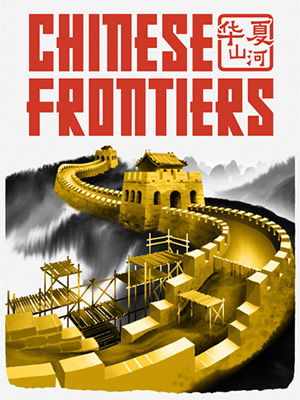
Chinese Frontiers is a first-person PC city-builder and survival simulation set in medieval China. The English storefront still uses the name Chinese Frontiers; the Simplified Chinese storefront title is 华夏山河, but no verified English rebrand or replacement edition has been identified. Developed by SolidGames and published by Big Cheese Studio, it focuses on hands-on construction, village logistics, crafting, exploration, farming, and a story-led single-player campaign.
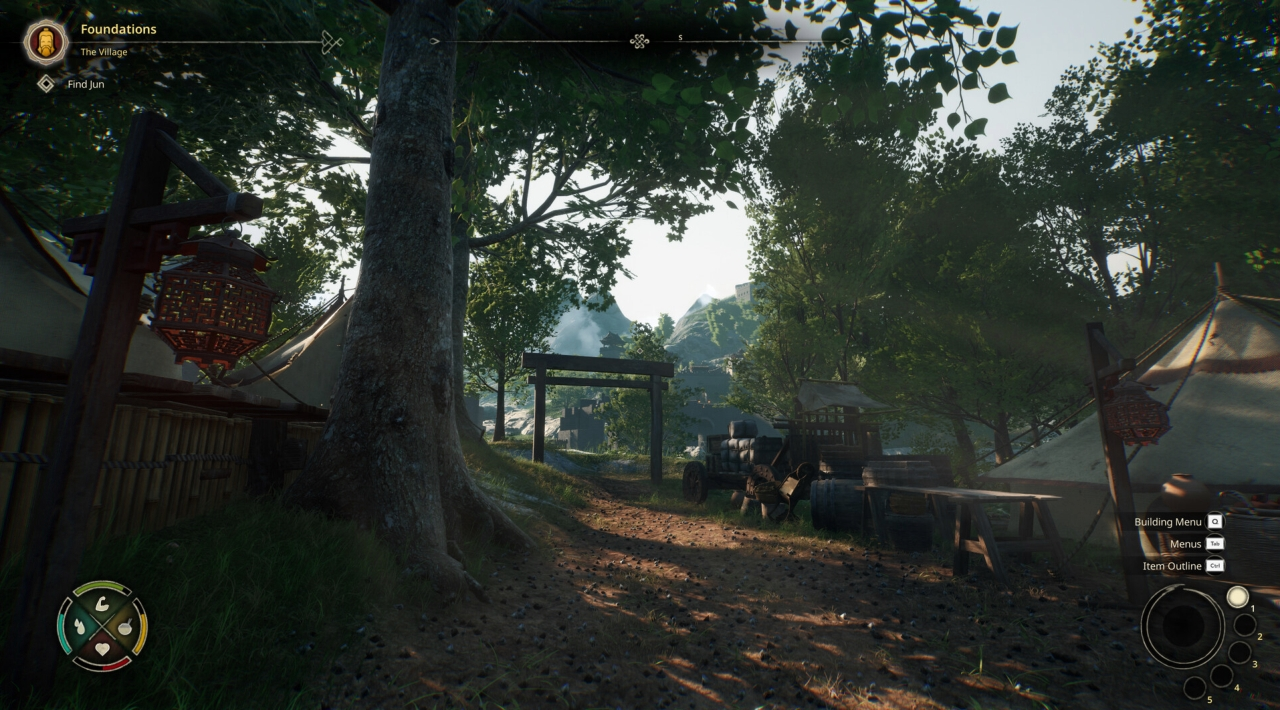
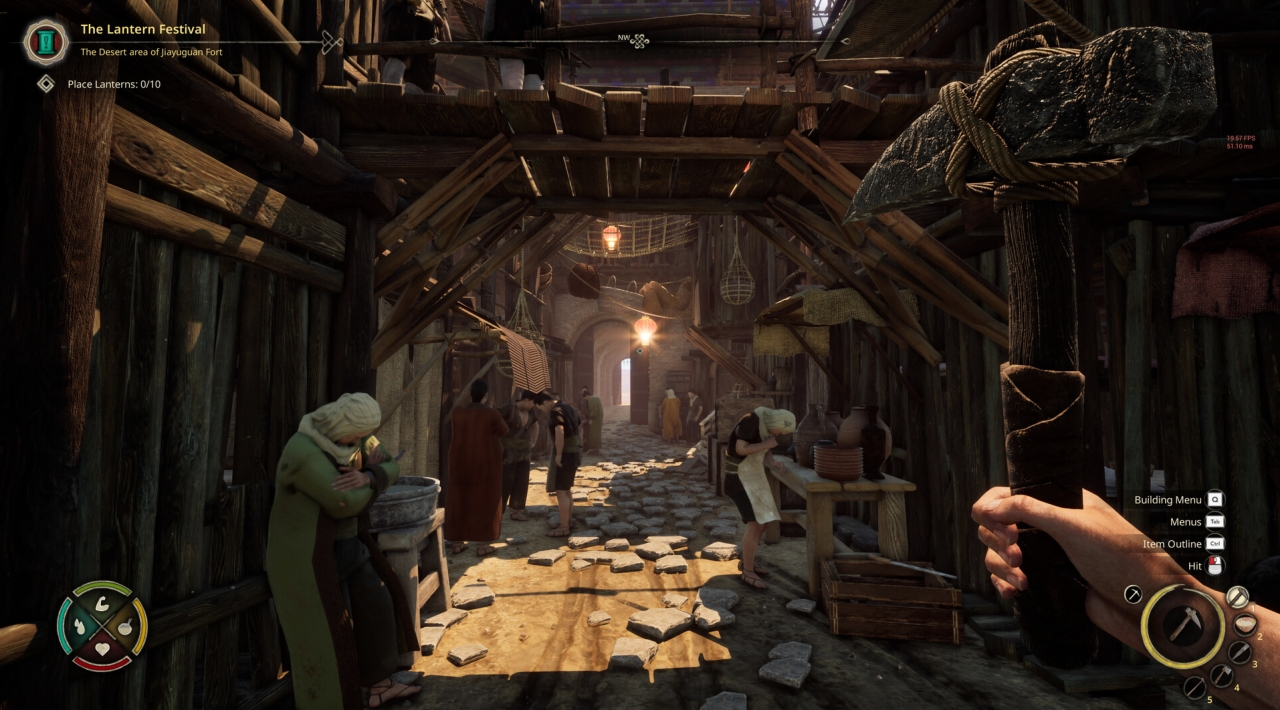
This is not a conventional top-down city-builder. You walk through the settlement, gather materials yourself, place structures from a first-person perspective, and gradually turn a small frontier community into the support network for major architectural projects.
First-person building with a clear production loop
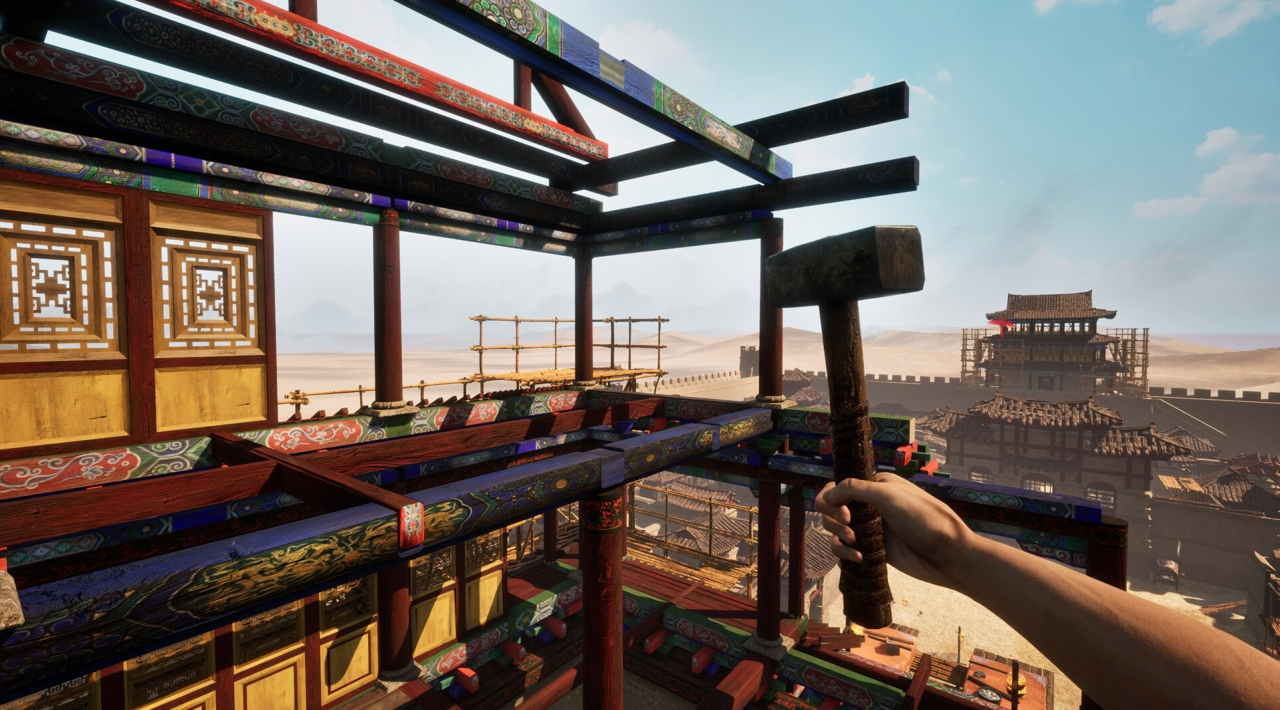
The central activity is step-by-step landmark construction. Projects are assembled through visible stages rather than appearing instantly, so the player moves between gathering, processing, transporting, and placing the materials needed to complete each section.
Progress usually begins with basic resources and simple workshops. Timber, stone, clay, bricks, metal, and other processed materials feed into increasingly demanding construction chains. The loop is deliberately practical: identify the next requirement, expand production, move the resources into position, and finish the structure by hand.
Village management supports that building loop rather than replacing it. You can recruit and direct villagers, establish workshops, improve production flows, and use logistics to reduce the amount of manual gathering required. Players who enjoy survival-focused medieval settlement builders like Farthest Frontier will recognize the importance of food, labor, storage, and settlement planning, although Chinese Frontiers presents these systems from a much closer first-person viewpoint.
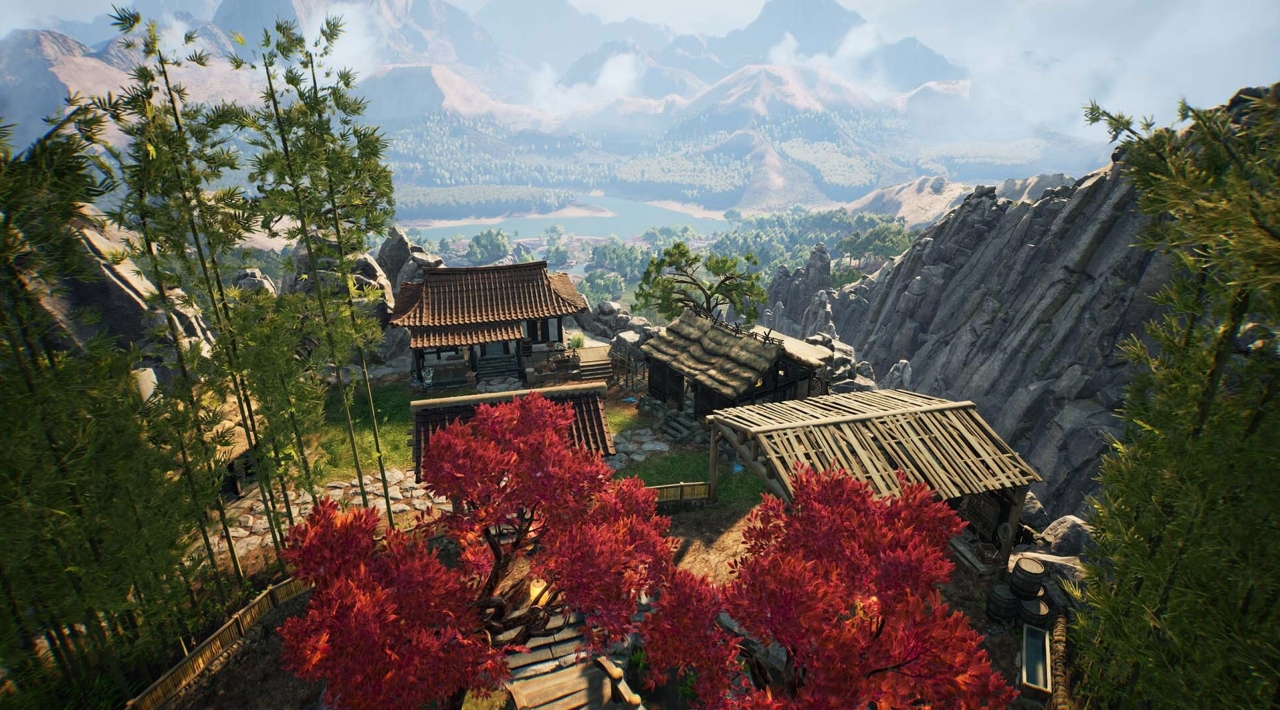
The game also includes exploration across three regions: mountain passes, desert areas, and fertile river valleys. Each environment has its own resources, hazards, and construction considerations, so location affects how efficiently a settlement can support its next major project.
Landmarks, logistics, and hands-on progression
Chinese Frontiers is built around large construction goals rather than endless abstract population growth. The campaign directs you toward traditional Chinese landmarks, including defense towers, desert fortifications, and the Jiankou Sky Stairs.
These projects give the resource economy a concrete purpose. Workshops, kilns, forges, and ornament facilities are not just decorative unlocks; they form the infrastructure required to keep large builds moving. The result is a progression loop based on production-chain optimization and visible construction milestones.
The player character is both manager and craftsman. You can assign villagers to gather or process materials, but you also remain involved in collecting resources, crafting items, placing components, and solving construction bottlenecks. That combination gives the game a more personal rhythm than a purely menu-driven management simulation.
Outside construction, the settlement supports farming, livestock, cooking, decoration, and villager well-being. These activities broaden the daily routine without changing the game's main identity: Chinese Frontiers is primarily about building a functioning community capable of completing increasingly ambitious monuments.
Story campaign and sandbox continuation
The narrative follows master Jun and his granddaughter Mei. Their story provides context for the player's work and gives the campaign more direction than a blank sandbox opening.
Quests guide the player through new techniques, regions, buildings, and construction objectives. Reputation and imperial attention are connected to progression, creating a sense that successful work has consequences beyond simply unlocking another crafting recipe.
The campaign has a defined main-story conclusion, after which players can continue developing the settlement in a more open-ended mode. This makes the game suitable for two types of builders: players who want structured goals and players who prefer to keep refining a village after the narrative has finished.
The strongest progression hook is mastery through better infrastructure. You do not simply gain power through combat or equipment. You become more capable by learning crafts, improving production, organizing villagers, and understanding how each region contributes to the next major build.
What is included on PC
The current PC edition is a paid single-player game distributed through Steam. The storefront lists Steam Cloud and Family Sharing, along with 39 Steam Achievements. No multiplayer, online co-op, or split-screen mode is listed.
Full controller support is available, including Xbox controller support. Keyboard and mouse remain natural choices for placing buildings, managing production, and navigating the game's interface, but controller users are not limited to unofficial input mapping.
The PC version includes full audio, interface text, and subtitles in English and Simplified Chinese. Polish, French, German, Spanish from Spain, Japanese, Russian, and Brazilian Portuguese are also supported through interface and subtitle localization, with English and Simplified Chinese receiving full audio.
There is no verified evidence of a separate Epic Games Store, GOG, or publisher-exclusive PC edition replacing the Steam release. The current storefront identity remains Chinese Frontiers in English, with 华夏山河 used as the Simplified Chinese title.
The store information identifies the game as using Unreal Engine, but no verified Cabinet Mode, mod browser, dedicated-server tools, or competitive anti-cheat system is listed. Those features should not be expected unless the developer adds them in a future update.
Content model and player fit
Chinese Frontiers is best understood as a complete single-player builder rather than a live-service product. The listed content centers on the campaign, three regions, settlement development, production chains, crafting, farming, cooking, exploration, decoration, and post-campaign sandbox play.
No separate season pass or large catalog of licensed expansions is identified on the current storefront. The game's value comes from its connected systems and landmark objectives, not from competitive modes or a long list of optional character classes.
This is a strong fit for players who enjoy relaxed resource management, visible construction progress, historical settings, and games that reward patience. It suits builders who want to walk through their settlement and participate in the work instead of controlling everything from a distant overhead camera.
It is less suitable for players looking for combat-heavy survival, multiplayer settlement management, deep military strategy, or a traditional city-builder with dozens of abstract policy screens. The survival elements support the settlement, but they do not define the experience as aggressively as the construction loop does.
Similar PC games and genre position
Chinese Frontiers shares some DNA with first-person dynasty and settlement simulations, particularly through gathering, villager management, crafting, farming, and village expansion. Its distinctive angle is the emphasis on monument-scale construction in a historical Chinese setting.
For players who prefer a more freeform medieval settlement layout and organic town growth, medieval city-building systems like Foundation provide a useful comparison. Foundation is more focused on broad settlement design, while Chinese Frontiers keeps the player physically involved in construction and exploration.
The closest comparison is therefore structural rather than visual: both games connect workers, resources, workshops, and settlement growth, but Chinese Frontiers places the camera inside the world and makes major buildings the primary milestones.
Chinese Frontiers FAQ
Is Chinese Frontiers still called Chinese Frontiers on PC?
Yes. The English Steam storefront continues to list Chinese Frontiers. 华夏山河 is the Simplified Chinese localized title, not a verified English rebrand or replacement PC edition.
What kind of game is Chinese Frontiers?
It is a first-person city-builder and survival simulation with crafting, exploration, farming, village management, resource logistics, decoration, and a story-driven campaign set in medieval China.
Does Chinese Frontiers have multiplayer or co-op?
No multiplayer, co-op, or split-screen mode is listed. The current PC edition is designed for single-player use.
Can you play Chinese Frontiers with a controller?
Yes. The Steam edition lists full controller support, including Xbox controllers. Keyboard and mouse are also supported for construction and settlement management.
What is the main goal in Chinese Frontiers?
The main goal is to develop a settlement, improve its production and logistics, learn new crafts, and construct major Chinese landmarks through a sequence of campaign objectives. After the main story, the settlement can continue in a more sandbox-oriented mode.
Which languages are supported?
English and Simplified Chinese include full audio, interface text, and subtitles. Additional interface and subtitle languages include Polish, French, German, Spanish from Spain, Japanese, Russian, and Brazilian Portuguese.
System Requirements
Minimum: |
Processor: Intel Core i5-8400, AMD Ryzen 5 2600 Graphics: NVIDIA GeForce GTX 1650, 4 GB or AMD Radeon RX 570, 4 GB Memory: 12 GB RAM Disk space: 30 GB available space Operating system: Windows 10 (64-bit) |
Screenshots
Trailer/Gameplay
Download
Chinese Frontiers (2025), 9.50GB

FitGirl Release

Languages: ENG/MULTI9
Original Size: 14 GB
Repack Size: 9.5 GB

Version: v2.1.1401 (2.1.2)

1. Extract files.
2. Install the game.
3. Play the game. If you like this game, BUY IT!
Chinese Frontiers Download
🔒 Premium access required
To see and use the download links, you must be logged in and have an active PREMIUM account.
* Unlock downloads via Torrent and TeraBox.
- Based on Chinese.Frontiers.v2.1.2-RUNE ISO release: rune-chinese.frontiers.v2.1.2.iso (14,978,973,696 bytes)
- Game version: v2.1.1401 (2.1.2)
- 100% Lossless & MD5 Perfect: all files are identical to originals after installation
- NOTHING ripped, NOTHING re-encoded
- Significantly smaller archive size (compressed from 14 to 9.5 GB)
- Installation takes 5-12 minutes (depending on your system)
- After-install integrity check so you could make sure that everything installed properly
- HDD space after installation: 23.6 GB
- Language can be changed in game settings
- Repack uses XTool library by Razor12911
- At least 2 GB of free RAM (inc. virtual) required for installing this repack
Torrent Download
The best torrent download speeds are with qBittorrent!