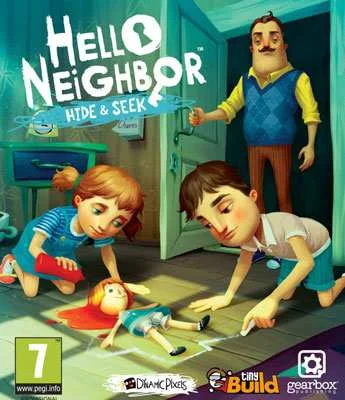
Hello Neighbor

- Category:
- Release date:
- Game Genre:Arcade, FPP, play for free, Stealth, humorous, indie games
- Developer:Dynamic Pixels Publisher: tinyBuild Games
- Release:ElAmigos
- Platform:PC
- Languages (subtitles):English, French, Italian, German, Spanish, Polish, Czech, Russian, Hungarian, Danish, Dutch, Portuguese, Portuguese-Brazil, Finnish, Swedish, Norwegian, Turkish, Arabic, Greek, Japanese, Korean, Chinese Simplified, Chinese Traditional
- Dubbing/Audio:English
- Crack:Codex
- Game size:1.18GB
Game Description
Hello Neighbor PC is a first-person stealth horror puzzle game about breaking into Theodore Peterson's house to uncover what he is hiding in the basement. The current Steam and Epic Games Store listings still use the name Hello Neighbor; no verified PC storefront rebrand or replacement edition was found. Developed by Dynamic Pixels and published by tinyBuild, it combines adaptive AI, environmental puzzles, object physics, and a cartoon horror presentation.
The premise is simple, but the execution is deliberately indirect. You are not given a conventional combat toolkit or a clear mission checklist. Instead, you study the house, test routes, collect useful objects, and work out how separate mechanisms fit together while avoiding the Neighbor.
How the House-Infiltration Loop Works
Hello Neighbor is played entirely from a first-person perspective. Movement, looking, jumping, crouching, grabbing, throwing, and using objects are central to nearly every problem. The house is treated as a physical space rather than a series of static puzzle screens, so windows, doors, furniture, switches, boxes, and household objects all contribute to navigation.
A typical attempt begins with reconnaissance. You may enter through an obvious route, watch how the Neighbor reacts, then retreat and search the surrounding area for another approach. The game rewards experimentation, but it also expects you to remember what you have learned from failed infiltrations.
The main objective is to reach the basement and uncover its secret. Progress depends on solving layered environmental puzzles, opening blocked routes, and using objects in places that are not always signposted. Some solutions are logical once understood; others rely on exploring the house thoroughly and testing unusual interactions.
Failure is part of the loop rather than a separate challenge mode. Being caught sends you back into the infiltration process, where you can try a different entrance, manipulate the environment, or rethink the purpose of an item. This makes Hello Neighbor closer to a puzzle-stealth sandbox than a traditional hide-and-seek horror game.
The Neighbor and His Countermeasures
The defining system is the Neighbor's reactive AI. The official description presents him as an opponent that learns from your actions and responds with countermeasures. If you repeatedly use a window, you may encounter a bear trap; if you favor a particular entrance, cameras or other obstacles can make that route less reliable.
This does not turn the game into a perfectly predictable stealth simulation. The Neighbor can patrol, investigate disturbances, chase you, and use shortcuts, but his behavior is designed to create pressure and surprise rather than provide a fully readable guard routine. Players looking for strict line-of-sight stealth should expect a more chaotic experience.
The house itself changes the way the AI matters. A route that works once may become dangerous after the Neighbor reacts, encouraging you to use alternate windows, rooftops, hiding places, and improvised distractions. The result is a repeated cycle of observation, trial, failure, and adaptation.
Object handling is equally important. Physics-based interaction lets you pick up, carry, throw, stack, and position items while searching for ways through the house. That freedom supports creative solutions, although it can also make the puzzle logic feel obscure when the game does not clearly communicate an object's intended use.
Puzzles, Atmosphere, and Tone
Hello Neighbor uses a bright, exaggerated visual style that contrasts with its unsettling premise. The neighborhood looks colorful and almost playful, while the Neighbor's house becomes increasingly strange and threatening as you explore deeper into it.
The horror is built more around pursuit, uncertainty, and the fear of being noticed than around sustained violence. A sudden chase can turn a quiet investigation into a scramble for cover, while the house's unusual architecture creates a sense that ordinary domestic space has become hostile.
Its puzzle design is intentionally hands-on. You are expected to inspect rooms, remember locked areas, experiment with switches, and connect clues that may be separated across different parts of the property. There is no conventional inventory-heavy adventure interface explaining every possible combination.
That design is the game's central appeal and its main risk. Players who enjoy opaque environmental puzzles and learning through experimentation may appreciate the freedom. Players who prefer clearly signposted objectives, consistent physics, or tightly authored stealth encounters may find the trial-and-error structure frustrating.
Content Model and PC Editions
The standard PC game is a paid single-player title. The Steam listing identifies Hello Neighbor as an adventure, indie, and strategy game, while its player-facing tags also place it in stealth, horror, sandbox, puzzle, first-person, and survival-horror territory.
The current Steam catalog includes the base game and a separate soundtrack add-on called Hello Neighbor's Favorite Songs. The broader franchise bundles the original game with Secret Neighbor, Hello Neighbor: Hide and Seek, and Hello Neighbor 2, but those are separate products rather than additional modes inside the original campaign.
There is no verified rebranding of the original PC game to a definitive, classic, or remastered storefront name. Searching the current official website and PC storefront listings shows the original title continuing under Hello Neighbor.
The game is structured around its house-infiltration puzzles and escalating discoveries, not a procedural campaign or an endless survival mode. Its long-term appeal comes from replaying difficult sections, finding alternative routes, completing achievements, and exploring community-made content.
Workshop Support and PC Ecosystem
PC players have access to Steam Workshop support, which expands the game beyond its original house. Community creations can add new levels, Neighbors, objects, and stories, giving the game a user-generated puzzle sandbox alongside its main content.
The official Steam listing also includes full controller support, Steam Achievements, Steam Trading Cards, Remote Play on TV, and Family Sharing. It is primarily a keyboard-and-mouse stealth puzzle game, but controller play is available for players who prefer analog movement.
The Steam version is distributed through the Steam client, while an Epic Games Store version is also listed. No verified anti-cheat requirement is listed for the PC game, which is consistent with its single-player structure and offline-oriented design.
Interface localization is broad, covering English, French, Italian, German, Spanish, Arabic, Czech, Danish, Dutch, Finnish, Greek, Hungarian, Japanese, Korean, Norwegian, Polish, Portuguese, Russian, Chinese, Swedish, and Turkish among the supported languages. The storefront listing identifies interface support rather than full voice localization, so players should not assume dubbed audio in every language.
Who Should Play Hello Neighbor?
Hello Neighbor is a good fit for players who enjoy first-person stealth horror, environmental problem-solving, sandbox experimentation, and adversaries that react to repeated habits. It also suits viewers who like games with unusual spaces, unpredictable chases, and mysteries revealed through exploration rather than constant exposition.
It is less suitable for players seeking traditional horror combat, cooperative play, or a clean puzzle flow with explicit instructions. The original game is single-player only; Steam Remote Play on TV does not turn it into online co-op or split-screen multiplayer.
The experience can also be uneven when physical interactions, AI reactions, or puzzle assumptions do not behave as expected. Treating the game as an experimental stealth puzzle box rather than a polished simulation sets more accurate expectations.
For a more linear horror puzzle adventure with a smaller character perspective and stronger platforming emphasis, atmospheric 2.5D horror games such as Little Nightmares provide a useful contrast.
Comparable PC Horror Games
Hello Neighbor shares its strongest mechanical DNA with games built around hiding, environmental interaction, and escaping a hostile pursuer. It is more open-ended than a standard linear horror adventure, but it is less systemic than a full immersive sim.
Players who prefer a contained escape-house structure can compare it with stealth escape horror games like Granny 3, where noise, pursuit, traps, and item-based progression create a more direct survival loop.
Those looking for a stronger cartoon-horror mystery and chapter-based progression may prefer first-person horror adventures such as Bendy and the Ink Machine. Hello Neighbor remains the better match for players specifically interested in an adaptive house guardian and freeform route testing.
Hello Neighbor FAQ
Is Hello Neighbor still the current PC storefront name?
Yes. The current Steam and Epic Games Store listings use Hello Neighbor. No verified rebrand or replacement title for the original PC game was found.
Is Hello Neighbor multiplayer or co-op?
No. The original game is single-player only. Secret Neighbor is the separate multiplayer spin-off in the same franchise.
Does Hello Neighbor support controllers on PC?
Yes. The Steam listing identifies full controller support, alongside standard keyboard-and-mouse controls.
Does the Neighbor really learn from the player?
The game uses reactive AI that can respond to repeated player behavior with countermeasures such as traps, cameras, and alternate pursuit routes. Its reactions are designed for pressure and unpredictability rather than perfectly deterministic stealth patterns.
Does Hello Neighbor have mod support?
Yes. Steam Workshop support allows players to access community-made levels, Neighbors, objects, and other user-created scenarios. The official ecosystem also includes a Hello Neighbor Mod Kit for creating custom content.
What languages are supported on PC?
The PC storefront listing shows interface localization across 23 languages, including English, French, German, Spanish, Italian, Japanese, Korean, Russian, Portuguese, Polish, Arabic, and Simplified and Traditional Chinese. Audio and subtitle support should not be assumed where only interface localization is listed.
System Requirements
Minimum: | Recomended: |
| Processor: Intel Core i5 Graphics: 2 GB GeForce GTX 770 Memory: 6 GB RAM Disk space: 2 GB HDD Operating system: Windows 7 64-bit | Processor: Intel Core i7 Graphics: 3 GB GeForce GTX 1060 Memory: 8 GB RAM Disk space: 2 GB HDD Operating system: Windows 10 64-bit |
Screenshots


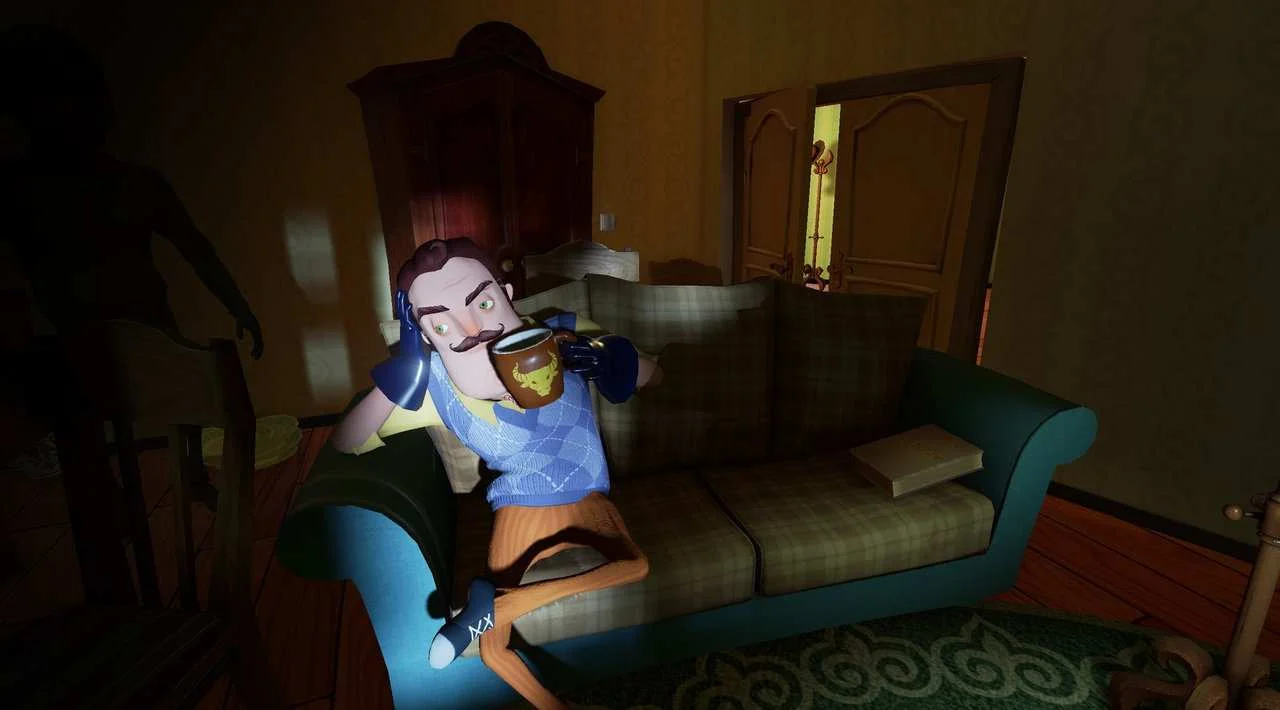
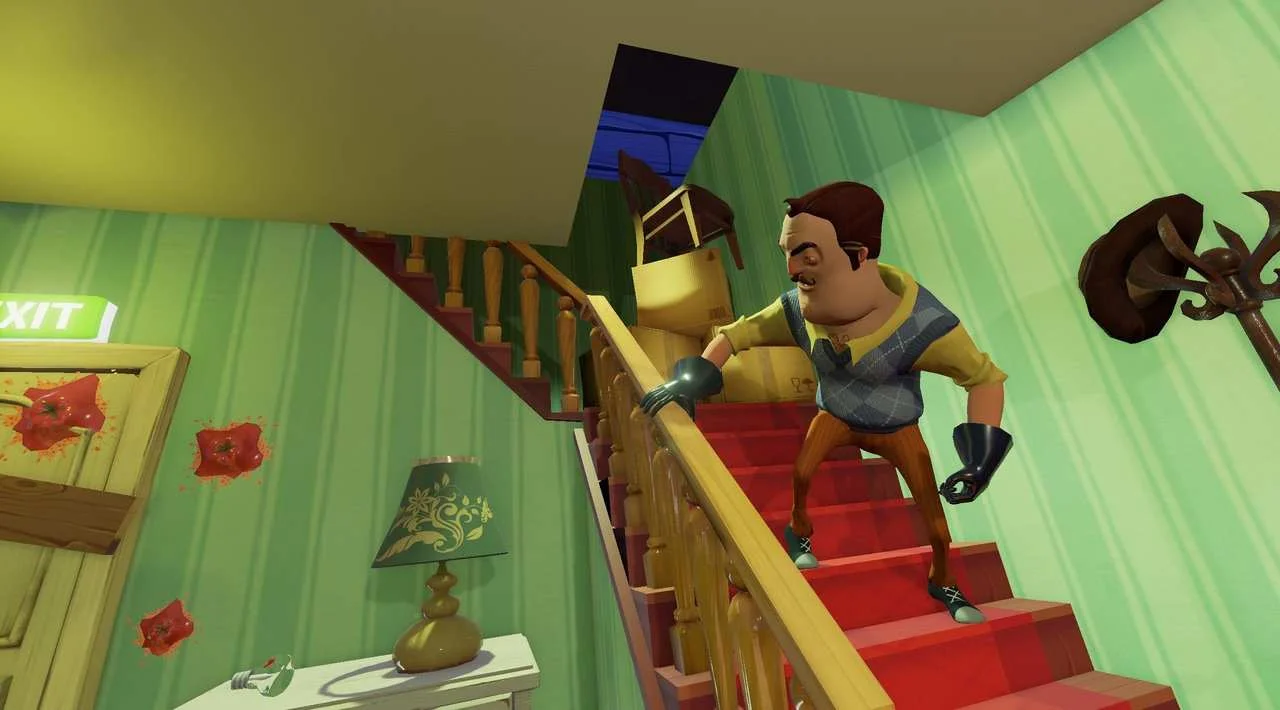
Trailer/Gameplay
Download
Hello Neighbor (2017), 1.18GB
ElAmigos release, game is already cracked after installation (crack by Codex).

Updated to version 1.3 (30.11.2018). Change language in game options.

1. Extract files.
2. Burn or mount the image.
3. Install the game.
4. ElAmigos release, game is already cracked after installation.
5. Play the game. If you like this game, BUY IT!
Hello Neighbor Download
🔒 Premium access required
To see and use the download links, you must be logged in and have an active PREMIUM account.
* Unlock downloads via Torrent and TeraBox.
Torrent Download
The best torrent download speeds are with qBittorrent!