Grand Ages: Medieval
- Category:
- Release date:
- Game Genre:Strategy, Economic, RTS, the middle ages, multiplayer
- Developer:Gaming Minds Studios Publisher: Kalypso Media
- Release:ElAmigos
- Platform:PC
- Languages (subtitles):English, French, Italian, German, Spanish, Russian, Polish, Chinese (Traditional)
- Dubbing/Audio:English, French, Italian, German, Spanish, Russian
- Crack:not necessary
- Game size:3.68GB
Game Description
Grand Ages: Medieval is a PC real-time grand strategy and economic simulation game from Gaming Minds Studios and Kalypso Media. The current Steam listing still uses the original name, with no verified storefront rebrand or replacement edition. Set in 1050 AD, it turns a small settlement into a continental power through trade, city founding, research, diplomacy, exploration, and conquest.
This is not a conventional medieval war game. Its strongest identity comes from treating economic expansion as the main route to power, while armies, diplomacy, and territorial control support the wider commercial machine.
Trade First, Conquest Second
The campaign begins with control of a modest town and gradually opens into a large-scale map covering Europe, North Africa, and parts of the Middle East. Your early decisions revolve around choosing productive locations, developing local businesses, and keeping citizens supplied with the goods they need.
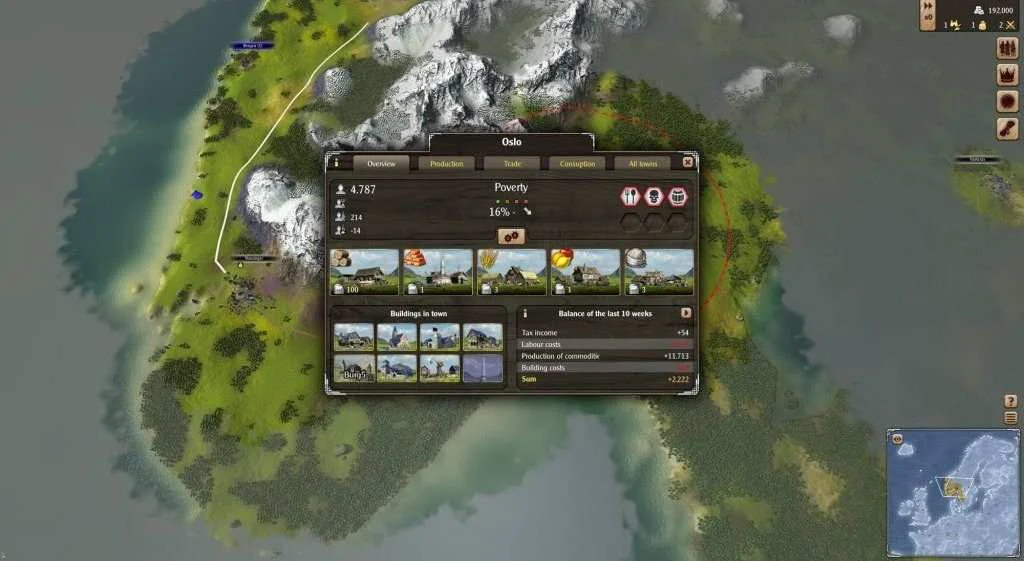
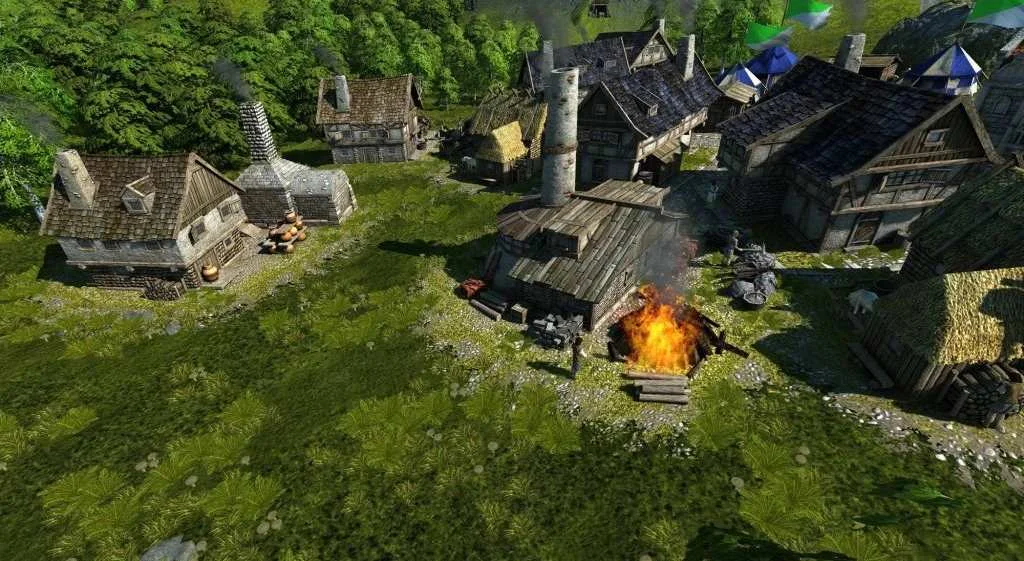
Supply and demand drive the core loop. Towns specialize in different commodities, so one settlement may provide raw materials while another turns them into more valuable manufactured goods. Establishing roads and automated trade routes lets merchants move resources between settlements and creates the financial base for further expansion.
That network is more important than simply stockpiling money. Food supports population growth, tools enable development, and military supplies help protect the routes that keep the economy moving. A poorly placed town can become a drain on the wider realm, while a carefully positioned settlement can unlock an entire regional production chain.
The perspective is a bird's-eye strategic view over the world map and settlements. Players do not control a single medieval hero directly. Instead, they manage mayors, merchants, civilian units, military forces, towns, and the larger economic system in real time.
Building Towns Across a Living Map
Founding cities is one of the most consequential choices in Grand Ages: Medieval. Each location offers different access to resources, terrain, transport connections, and nearby markets. Expansion is therefore an exercise in logistics rather than a simple race to occupy empty land.
The game supports the production and exchange of 20 different goods, including resources such as coal, fruit, and pottery. These commodities are tied to local businesses and population needs, creating a practical reason to connect distant towns instead of developing every settlement in the same way.
Research adds another layer to the economic plan. The technology tree contains 50 major advancements, including improvements associated with agriculture, textiles, and military development. Unlocking technologies such as three-field crop rotation, the low-warp loom, or the longbow can change which settlements are worth expanding and which industries become profitable.
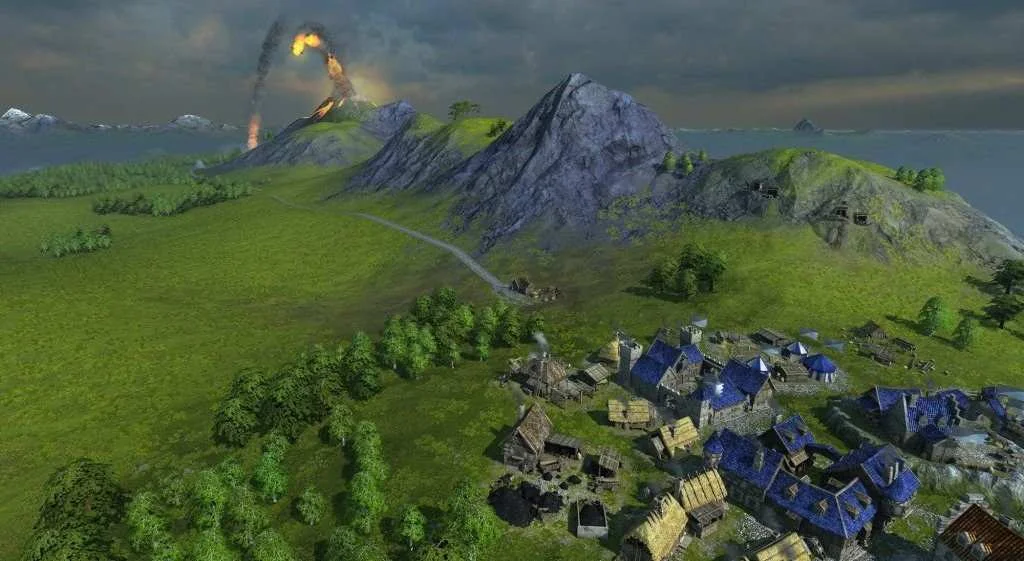
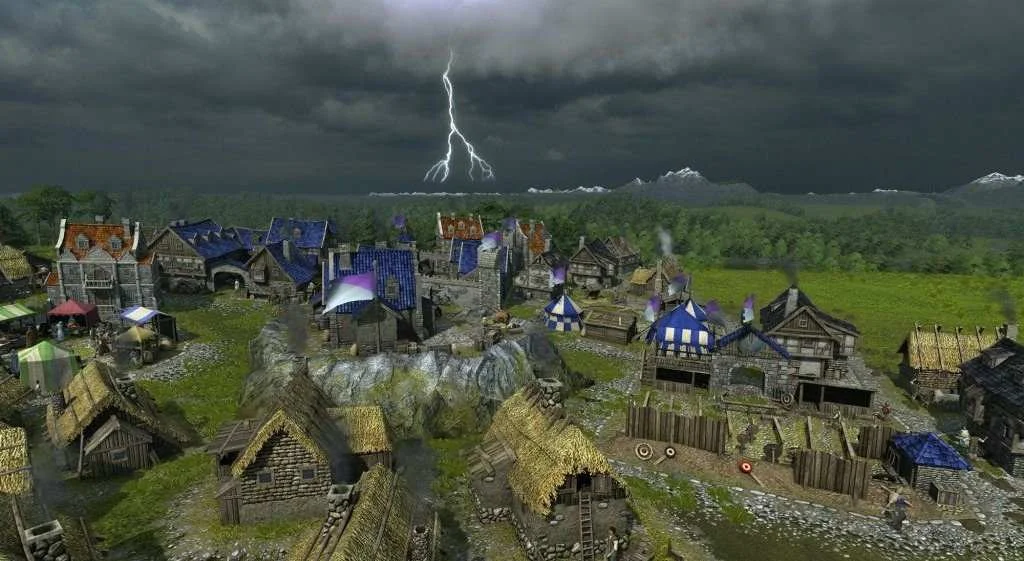
Expansion is not entirely predictable. The world can be disrupted by storms, fires, droughts, earthquakes, volcanoes, and the Black Death. These events force players to maintain reserves and reconsider plans instead of assuming that a successful trade network will remain stable forever.
Campaign, Open Game, and Multiplayer
The story campaign is built around missions and cutscenes that introduce the setting and gradually explain the major systems. It is the most structured way to learn the game, particularly for players unfamiliar with economic real-time strategy.
Open Game provides the broader sandbox experience. Players can select a starting region, configure parts of the setup, and pursue their own route toward dominance. The objective is not limited to winning battles; commercial strength, settlement growth, research, and territorial influence all contribute to the rise of an empire.
Multiplayer supports up to eight players. Matches can be configured with different victory conditions and may include computer-controlled opponents alongside human competitors. The format is best suited to players who enjoy watching several economic systems develop at once before turning trade advantages into political or military pressure.
There is no traditional co-op campaign structure presented as the main feature. Multiplayer is primarily a competitive strategic mode, so players looking for shared city management or a separate cooperative story should approach it as an online empire-building contest.
Diplomacy, Warfare, and Risk
Diplomacy gives the economy a political dimension. Agreements with neighboring rulers can support trade and reduce the need for immediate military action, but relationships are part of a broader expansion strategy rather than a deep character-driven political simulation.
When negotiation fails, armies provide another solution. The military roster includes knights, archers, and cavalry, and forces can be used to defend settlements, secure routes, or pressure rival powers. Combat exists to support the empire, not to replace the commercial game underneath it.
That distinction matters when choosing this game. Players expecting detailed battlefield tactics may find the military layer lighter than the economy. Players who prefer to win through logistics, market pressure, and territorial planning will find a more unusual strategy loop than in sword-focused medieval RTS games.
PC Edition, Controls, and Content
The PC version is distributed through Steam and lists Kalypso Launcher DRM, with account registration described as optional. Steam features include achievements, trading cards, cloud saves, statistics, Remote Play on TV, Family Sharing, and multiplayer.
Steam also lists full controller support, although keyboard and mouse remain the natural input choice for managing a large real-time map, production chains, and multiple units. The controller option is useful for players who prefer a couch setup, but the interface still reflects the information density of a traditional PC strategy game.
The storefront identifies ten supported languages: English, German, French, Italian, Spanish, Russian, Polish, Traditional Chinese, Korean, and Japanese. Full audio is available for English, German, French, Italian, Spanish, Russian, and Japanese, while Polish, Traditional Chinese, and Korean are listed with interface and subtitle support.
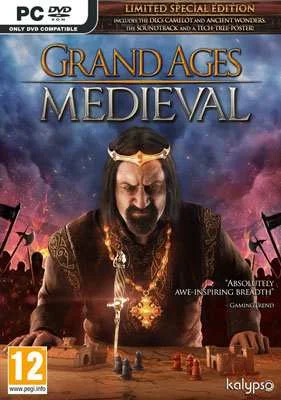
The main purchase is a paid strategy game rather than a free-to-play service. The associated PC content includes the Camelot and Ancient Wonders additions. These are supplementary content packs rather than a seasonal live-service model, and the core experience remains the campaign, open game, and multiplayer sandbox.
Who Should Play Grand Ages: Medieval?
This is a strong fit for players who enjoy seeing a settlement develop into a connected regional economy. The most rewarding decisions involve placing towns, identifying shortages, automating profitable routes, choosing research priorities, and deciding when financial power is strong enough to support expansion.
It is also a good match for fans of historical strategy who want medieval politics and commerce to matter as much as armies. Players looking for a related city-building and trading experience can compare its production chains with real-time economic strategy games such as Anno 1404 Gold Edition, though Grand Ages places more emphasis on continental empire growth.
Players who should be cautious are those seeking a character-focused medieval RPG, a highly detailed tactical war game, or a purely decorative city builder. The game asks you to read systems, track relationships between towns, and accept that the most important victories may happen through commerce rather than dramatic battles.
Comparable Medieval Strategy Games
The closest comparisons depend on which part of the game appeals to you. For settlement economics and production chains, Anno 1404 is a natural reference point. For fortress construction and direct siege warfare, the focus shifts toward castle-building RTS games like Stronghold Crusader Definitive Edition.
Those games share a medieval strategy setting but produce different priorities. Grand Ages: Medieval is about linking towns across a large map, while Stronghold emphasizes defending a compact stronghold and managing armies around it.
Players interested in historical empire management without real-time combat can also look at turn-based dynasty strategy games such as Old World. The comparison is useful because both games make research, expansion, resources, and long-term planning central, even though their pacing and historical settings differ.
Grand Ages: Medieval FAQ
Is Grand Ages: Medieval still the official PC name?
Yes. The current Steam storefront and Gaming Minds Studios page continue to use Grand Ages: Medieval. There is no verified rebrand, renamed definitive edition, or replacement storefront identity for the PC game.
What type of game is Grand Ages: Medieval?
It is a real-time strategy and economic empire simulation with city building, trading, exploration, research, diplomacy, military expansion, and sandbox play. Its central strategic emphasis is economic domination rather than constant battlefield action.
How many players can join multiplayer?
The multiplayer mode supports up to eight players. Matches can use selected victory conditions and may combine human players with AI-controlled competitors.
Does the game have a campaign?
Yes. The campaign uses structured missions and cutscenes to introduce the setting and core systems. Open Game then provides a less restricted sandbox focused on building an empire from a chosen starting position.
Does Grand Ages: Medieval support controllers on PC?
Steam lists full controller support, alongside the traditional keyboard-and-mouse interface. Mouse and keyboard are generally better suited to managing production chains, trade routes, towns, and armies across the strategic map.
What content is included beyond the base game?
The associated PC edition includes the Camelot and Ancient Wonders content additions. They supplement the main game rather than replacing its campaign, open game, or multiplayer modes.
System Requirements
Minimum: | Recomended: |
| Processor: Intel Core 2 Duo E8400 3.0 GHz Graphics: 1 GB GeForce GTS 450 Memory: 2 GB RAM Disk space: 4 GB HDD Operating system: Windows Vista/7/8/10 | Processor: Intel Core i3 3 GHz Graphics: 2 GB GeForce GTX 650Ti Memory: 4 GB RAM Disk space: 4 GB HDD Operating system: Windows 7/8/10 |
Screenshots
Trailer/Gameplay
Download
Grand Ages: Medieval (2015), 3.68GB
ElAmigos release, unprotected game (serial or crack is not necessary).

Updated to version 1.1.2 (27.01.2016)

1. Extract files.
2. Burn or mount the image.
3. Install the game.
4. Play the game. If you like this game, BUY IT!
Grand Ages: Medieval Download
 Download from TeraBox
Included DLC: Camelot, Ancient Wonders.
Torrent Download
The best torrent download speeds are with qBittorrent!