Mini Metro
Edit date: 5-01-2023, 22:14
Reason: Updated till 06.01.2020
- Category:
- Release date:
- Game Genre:Strategy, logical elements, 2D
- Developer:
- Release:ElAmigos
- Platform:PC
- Languages (subtitles):English, French, Italian, German, Spanish, Polish, Czech, Slovak, Russian, Hungarian, Danish, Dutch, Portuguese, Portuguese-Brazil, Finnish, Swedish, Norwegian, New Norwegian, Turkish, Greek, Bulgarian, Japanese, Korean, Chinese Simplified, Chinese Traditional, Gaelic, Welsh, Croatian, Serbian, Catalan, Esperanto (+ few more, 42 total)
- Dubbing/Audio:English
- Crack:not necessary
- Game size:0.17GB
Game Description
Mini Metro PC is a minimalist strategy simulation and puzzle game about designing a subway network for a city that never stops growing. The current Steam listing still uses the original name, with no verified rebrand or replacement edition. Developed and published by Dinosaur Polo Club, it focuses on route planning, passenger flow, limited resources, and score-driven replay rather than a traditional campaign.
The premise is immediately readable: connect stations, keep trains moving, and prevent waiting passengers from overwhelming the network. Its clean visual language makes the game approachable, but the pressure comes from making good decisions before a small inefficiency becomes a system-wide failure.
How the subway puzzle works
Every map begins with a small group of stations represented by simple geometric shapes. Passengers appear according to their destination shape, so a train network must move commuters between matching stations rather than merely connect every point on the map.
You draw lines between stations, assign trains to those lines, and extend or redesign routes as the city expands. The central challenge is balancing coverage, travel time, and station congestion while working with a limited supply of trains, carriages, tunnels, bridges, and metro lines.
Mini Metro is played from a top-down perspective using an abstract map inspired by real transit diagrams. There is no avatar to control and no conventional construction grid. Your main tool is the line editor, which turns a simple drag-and-connect interface into a demanding real-time planning exercise.
The game is easy to pause while you adjust routes, but the underlying problem keeps changing. New stations appear, passenger demand shifts, and previously efficient lines can become overloaded. A successful design is therefore temporary; the best play comes from recognizing when to rebuild before the network reaches a critical point.
Modes, pacing, and strategic depth
Normal mode is the main score-attack experience. The city grows at a steady pace, weekly resource choices shape your network, and the run ends when stations remain overcrowded for too long. Your score reflects how many passengers the system can serve before failure.
Endless mode removes the usual pressure of station overcrowding, making it better suited to experimentation and relaxed route design. It is not a campaign with objectives; the appeal is testing layouts, learning how demand behaves, and building a network without the standard game-over condition.
Extreme mode changes the planning problem by making line edits more restrictive. Routes and assets cannot be adjusted as freely, so early decisions carry greater weight. This mode is aimed at players who already understand the basic flow of stations and want a harsher test of network planning.
Creative mode provides the most direct sandbox experience. It lets players shape a metro layout with fewer restrictions, which is useful for exploring maps, practicing line structures, or creating a visually pleasing transit diagram without treating every decision as a race against collapse.
Maps, passenger flow, and failure states
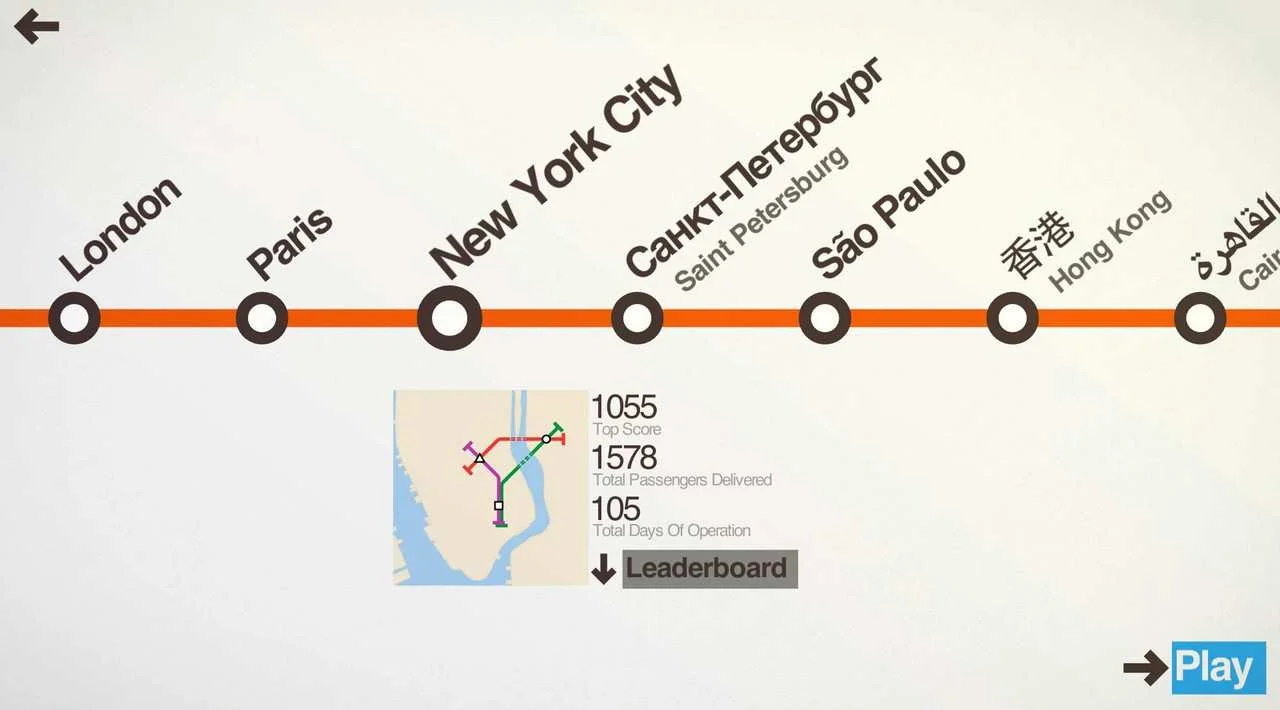
The game includes more than two dozen real-world cities, including London, Paris, New York City, Osaka, Saint Petersburg, São Paulo, Istanbul, and Auckland. These locations are not just visual backdrops: map geometry, waterways, color themes, obstacles, and growth patterns affect how easily a network can be organized.
City growth is randomized, so the same map can produce very different problems from one run to another. A strong strategy on one attempt may fail on the next because a crucial station appears on the opposite side of a river or because passenger demand concentrates on a different interchange.
Efficient networks usually depend on more than one idea. Short shuttle lines can protect busy areas, while longer routes may connect distant neighborhoods at the cost of slower service. Interchange stations are powerful because they let passengers transfer, but they can also become bottlenecks when too many lines converge on one point.
The failure state is central to the design rather than a punishment added around it. Stations have limited room for waiting passengers, and the network eventually becomes unable to clear demand quickly enough. The resulting pressure creates the game's strongest decision: whether to preserve a familiar route or make a disruptive redesign before the system breaks.
Content model and replay value
On PC, Mini Metro is presented as a paid standalone game rather than a free-to-play service. The current Steam listing does not present a season pass, recurring subscription, or catalog of paid table-sized expansions. Its content is built around the included maps, modes, procedural city growth, and repeatable score chase.
The game's replay value comes from variation and mastery instead of a long narrative. Each run asks you to solve a new arrangement of stations with the same compact set of tools, and the clean interface makes it easy to understand why a network succeeded or failed.
Steam Workshop adds a substantial community layer through player-created maps. That feature extends the experience beyond the official city selection and gives experienced players a way to explore layouts that demand different route priorities.
Players looking for a more road-focused version of the same growing-city pressure can compare it with traffic-management strategy games like Mini Motorways. The two games share Dinosaur Polo Club's minimalist presentation, but Mini Metro is more concerned with passenger transfers and line topology than road intersections.
PC features and practical fit
The PC edition is distributed through Steam and includes Steam Cloud, achievements, trading cards, leaderboards, family sharing, and Remote Play features for phone and tablet. Steam Workshop support is particularly relevant because custom maps are part of the game's long-term ecosystem.
Input is deliberately mouse-first. The storefront identifies the game as Mouse Only and Touch-Friendly, which matches the core action of drawing and reshaping lines directly on the map. Standard PC controller support is not presented as a primary storefront feature, so mouse use remains the safest expectation.
Steam Deck compatibility is listed separately, with the default controller configuration making the interface accessible on that device. On a conventional desktop, however, players who prefer a gamepad should treat controller use as a secondary configuration rather than the intended control method.
Accessibility options include colorblind mode and night mode. The presentation is intentionally sparse, with geometric station symbols, strong color coding, and a responsive soundtrack by Disasterpeace that changes with the activity of your metro system.
The Steam listing identifies interface support for 25 languages, including English, French, German, Spanish, Italian, Japanese, Korean, Polish, Russian, Simplified Chinese, Traditional Chinese, Portuguese, and several other European and Asian languages. Full audio is not listed as a separate localization category.
No dedicated external launcher or anti-cheat system is identified in the current PC storefront information. The game is single-player, and its leaderboards and Workshop features do not turn the core experience into a competitive multiplayer title.
Who should play Mini Metro?
Mini Metro is a strong fit for players who enjoy systems thinking, visual organization, and short sessions that can become unexpectedly intense. It rewards people who like watching a clean plan evolve into a complicated network, then rebuilding it when the original structure no longer works.
It is also a good choice for players who prefer games with minimal fiction and maximum feedback. Every station, passenger, and train has a functional purpose, so the strategy is easy to read even when the decisions become difficult.
Players seeking a traditional city builder, economic simulator, or detailed train-management game may find it too abstract. There are no individually modeled citizens, no large-scale industrial economy, and no campaign progression built around story missions.
For a quieter tile-placement alternative with village building and spatial planning, relaxed puzzle strategy games such as Dorfromantik offer a slower tempo. Mini Metro is less decorative and more reactive, with the network constantly demanding intervention.
Similar PC games and genre alternatives
Mini Metro occupies a narrow but effective space between puzzle game, transport simulation, and arcade score attack. Its closest comparison is Mini Motorways, while route-planning train puzzles like Train Valley 2 emphasize scheduled deliveries, production chains, and level-based objectives instead of passenger congestion.
The distinction matters when choosing what to play. Mini Metro asks, “How long can this network remain stable?” Train Valley 2 asks you to complete defined logistics challenges, while Dorfromantik focuses on placing tiles and completing landscape quests.
That focused structure is why Mini Metro remains easy to return to. A run can be understood in seconds, but improving line layouts, interchange placement, and asset choices requires repeated observation and adjustment.
Mini Metro FAQ
Is Mini Metro still called Mini Metro on PC?
Yes. The current Steam storefront continues to list the game as Mini Metro. No verified PC rebrand, replacement title, or definitive-edition name is shown in the current official storefront information.
Is Mini Metro a multiplayer game?
No. The PC version is listed as single-player. Steam leaderboards and Workshop maps add community comparison and user content, but there is no advertised local co-op, online co-op, or competitive multiplayer mode.
Does Mini Metro have a campaign?
It does not use a conventional story campaign. Progress is based on playing maps, surviving longer, improving passenger throughput, exploring game modes, and chasing higher scores across different city layouts.
What is included in the PC version?
The paid PC game includes the official city maps, Normal, Endless, Extreme, and Creative modes, randomized city growth, accessibility options, Steam Workshop support, and the standard Steam ecosystem features. The current listing does not advertise a season pass or separate DLC catalog.
Can Mini Metro be played with a controller?
The intended PC input is mouse, and the storefront highlights Mouse Only and Touch-Friendly controls rather than native gamepad support. Steam Deck has a default controller configuration, but desktop players should plan around mouse control for the most precise experience.
What makes Mini Metro difficult?
The difficulty comes from limited resources, unpredictable station placement, passenger demand, and overcrowding. A route can be technically connected yet still inefficient, forcing you to manage transfer points, line length, train capacity, and future growth at the same time.
System Requirements
Minimum: |
Processor: Pentium 4 2.0 GHz Graphics: ShaderModel 2.0 Memory: 512 MB RAM Disk space: 200 MB HDD Operating system: Windows XP/Vista/7/8 |
Screenshots



Trailer/Gameplay
Download
Mini Metro (2015), 0.17GB
ElAmigos release, unprotected game (crack is not necessary).

Updated till 06.01.2020.

1. Extract files.
2. Burn or mount the image.
3. Install the game.
4. ElAmigos release, game is already cracked after installation.
5. Play the game. If you like this game, BUY IT!
Mini Metro Download
🔒 Premium access required
To see and use the download links, you must be logged in and have an active PREMIUM account.
* Unlock downloads via Torrent and TeraBox.
Torrent Download
The best torrent download speeds are with qBittorrent!