Lost: Via Domus

- Category:
- Release date:
- Game Genre:Adventure, TV series, action adventure
- Developer:
- Release:ElAmigos
- Platform:PC
- Languages (subtitles):English, French, Italian, German, Spanish, Polish, Czech, Hungarian, Portuguese-Brazil (unofficial)
- Dubbing/Audio:English, French, Italian, German, Spanish
- Crack:not necessary
- Game size:2.04GB
Game Description
Lost: Via Domus is a third-person mystery adventure for PC set in the world of ABC's Lost. It follows Elliott Maslow, an amnesiac photojournalist and previously unseen survivor of Oceanic Flight 815, as he searches the island for answers about his identity. The game is also known in Europe as Lost: The Video Game; this is a regional name, not a verified modern rebrand. Current storefront research found no active official Steam purchase page, and no current Epic Games Store or GOG listing was verified.
That availability issue matters because many search results still describe Via Domus as a normal digital PC release. Steam retains legacy app metadata under the name Lost: Via Domus, but its product link currently redirects to the general Steam storefront rather than a live product page. The game is therefore best understood as an older, single-player PC catalog title that players may encounter through physical copies or archival collections.
Island exploration and the mystery loop
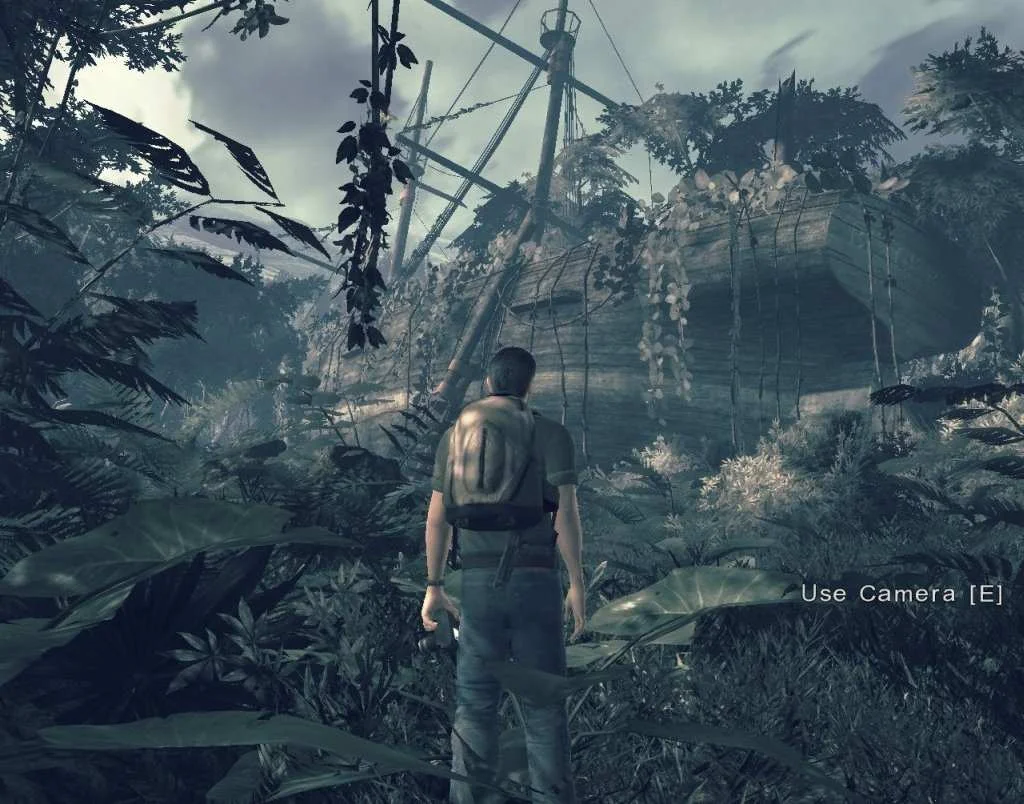
Via Domus is built around linear episode progression, not open-world survival. Elliott moves between familiar Lost locations such as the beach camp, jungle paths, caves, Dharma stations, and wreckage from Flight 815. Progress depends on speaking with survivors, finding useful objects, following environmental clues, and completing objectives recorded in the notebook.
The camera sits behind Elliott during ordinary exploration, giving the game a conventional third-person perspective. Movement is handled with keyboard controls on PC, while the mouse controls the camera and interaction focus. A separate observation or beacon view helps identify routes through areas where the island's paths can otherwise be difficult to read.
Most objectives are practical rather than combat-focused. You may need to recover a camera, locate a battery, gather light sources, repair equipment, or persuade another castaway to trade. The island works as a sequence of connected problem spaces where dialogue and item collection open the next route.
Players looking for a modern sandbox will find the structure restrictive. The appeal is closer to a compact licensed adventure: recognizable locations, familiar characters, environmental puzzles, and a new protagonist whose personal mystery runs alongside the show's mythology.
Flashbacks, photography, and investigation
Elliott's amnesia gives Via Domus its clearest original mechanic. Conversations, locations, and story events trigger playable flashbacks that begin as fragmented, blurred scenes. The player must use the camera to adjust zoom and focus, frame important elements, and capture the correct image.
Once a memory is reconstructed, the flashback becomes an explorable scene. Elliott can inspect objects, read documents, speak with characters, and uncover details that explain his past. The camera is therefore more than a collectible tool: it is the central device connecting the island's present to the protagonist's personal investigation.
Photography also appears outside the memory sequences. Certain events and unusual findings must be photographed at the right moment, with framing and focus indicators confirming whether the shot is properly aligned. These sections reward observation and timing rather than fast reflexes.
The photography system is a genuine point of difference, but it is also the mechanic most likely to divide players. It is precise and deliberate, while the surrounding adventure design can provide limited guidance about what the game expects you to capture. Players searching for camera puzzles on PC will find a clear answer here, but not a freeform photography sandbox.
Puzzles, resources, and island threats
Via Domus includes electrical fuse puzzles and simple computer challenges. Fuse panels require the player to place and rotate different fuse types, understand the direction of power flow, and provide enough power to the required outputs. These puzzles are tied directly to progression, including access to locked rooms and equipment.
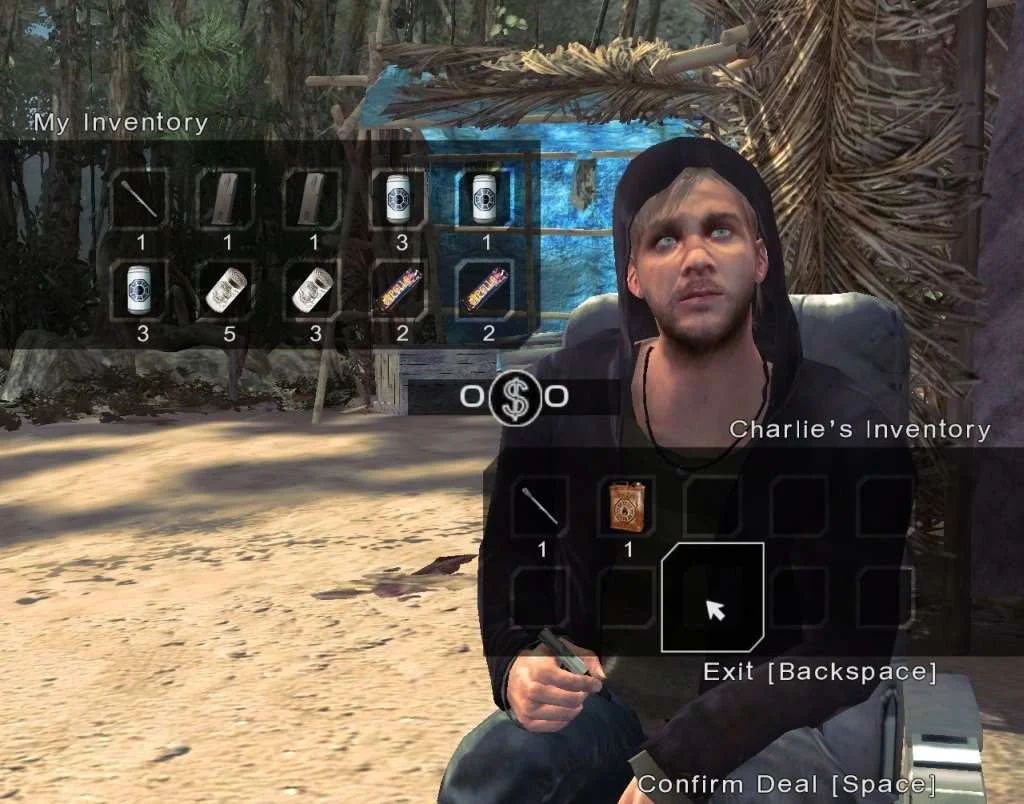
The inventory uses dedicated slots for equipment such as the camera, torch, and gun, alongside backpack space for objects acquired through exploration or trading. The castaways' barter system gives food, drinks, and other supplies a practical role. Items are not part of a crafting tree or character-build system; they are tools for solving immediate problems.
Navigation challenges add pressure to otherwise quiet exploration. Darkness requires a working light source, while chase sequences demand quick movement through dangerous routes. The Black Smoke is the most distinctive threat, forcing Elliott to keep moving or find cover when it closes in.
There is also limited gunplay, but Via Domus is not a conventional third-person shooter. Ammunition is a constrained resource, enemies and targets are highly contextual, and combat appears as punctuation within a story-led adventure. The main loop remains exploration, conversation, clue gathering, and puzzle solving.
Story, characters, and canon expectations
The protagonist is Elliott Maslow, a photojournalist whose amnesia prevents him from understanding his own history. The game places him among major Lost characters including Jack Shephard, Kate Austen, John Locke, Hugo Reyes, Sayid Jarrah, James Sawyer Ford, Benjamin Linus, and Juliet Burke.
These characters are not simply background cameos. Dialogue with the survivors determines which objectives become available, who will trade with Elliott, and when a new memory sequence begins. Sawyer functions as a key trader, while Locke, Kate, Jack, Sayid, and others connect Elliott's personal investigation to recognizable events and places from the television series.
Players should approach the narrative as a side story within the Lost setting, not as a definitive explanation of the show's mysteries. Elliott and his flashback storyline are original to the game, and the plot is commonly treated as non-canon or semi-canonical by fan reference sources. Its value is in revisiting the island's atmosphere and locations from a new viewpoint.
The game also includes unlockable extras and episode replay options. Replaying an episode can help locate missed objects, hidden extras, or additional memory details, but there is no branching role-playing system, relationship meter, or campaign-ending choice structure.
PC edition and current content status
The PC version is a single-player adventure with no verified co-op, split-screen, competitive multiplayer, or online mode. Its original control documentation lists keyboard and mouse input, along with support for a Windows-compatible gamepad or joystick.
Keyboard and mouse are the clearest officially documented option. The PC control scheme uses W, A, S, and D for movement, the mouse for camera control, contextual actions for interaction, and dedicated inputs for the notebook, inventory, running, camera aiming, and gun aiming.
Localization metadata associated with the legacy Steam entry lists interface support for English, French, German, Italian, and Spanish. The same metadata does not list separate full-audio languages, so players should not assume that every language option includes dubbed dialogue. The original PC manual also documents subtitle toggling in the options menu.
The legacy PC release used disc-based copy-protection technology, and the manual warns that this protection could conflict with some disc or virtual-drive configurations. Because there is no currently verified live storefront product page, the exact activation and launcher behavior depends on the physical or archival edition a player owns.
No separate season pass, expansion campaign, or modern live-service content model was verified for Via Domus. The game is a self-contained story package built around its episode sequence, flashbacks, puzzles, exploration, and limited combat.
Who should play Lost: Via Domus?
Via Domus is aimed first at dedicated Lost fans who want to walk through the beach camp, Dharma facilities, caves, and other recognizable island locations. It is also a fit for players who enjoy short, linear mystery adventures where dialogue, object inspection, and story clues matter more than character progression.
It is less suitable for players expecting deep survival mechanics, free exploration, modern stealth systems, or a large arsenal. The game does not offer crafting, skill trees, open-ended faction choices, or a persistent survival simulation. Its challenges are compact and authored rather than systemic.
Players who want a more traditional survival-horror structure with resource pressure, fixed-camera tension, and mansion-based puzzle exploration may find stronger mechanical depth in classic third-person survival horror such as Resident Evil HD. That comparison also makes Via Domus's lighter combat and stronger television tie-in easier to place.
Related PC experiences
The closest comparison for the photography mechanic is third-person horror built around camera-based investigation like Fatal Frame II Crimson Butterfly Remake. The two games use photography in very different ways: Via Domus uses framing and focus to restore memories and document events, while Fatal Frame centers photography on supernatural confrontation.
For a broader adventure comparison, Via Domus sits between a licensed television mystery and a light survival-horror game. Its island setting, inventory, threats, and puzzles provide genre structure, but the episodic story and recognizable cast remain the main reason to play.
Lost: Via Domus FAQ
Is Lost: Via Domus the same game as Lost: The Video Game?
Yes. Lost: The Video Game is the regional European name used for Lost: Via Domus. Research did not verify a modern replacement edition or a current rebrand on Steam, Epic, GOG, or publisher storefronts.
Is Lost: Via Domus currently available on Steam?
Steam still retains legacy metadata for the game, but the known product URL currently redirects to the general Steam storefront instead of an active purchase page. No current official Steam sales page was verified.
What kind of game is Lost: Via Domus on PC?
It is a third-person, single-player mystery adventure with island exploration, survivor conversations, trading, environmental objectives, electrical and computer puzzles, camera-based flashbacks, navigation challenges, and limited gunplay.
Does Lost: Via Domus have multiplayer or co-op?
No. The PC edition is designed for solo play and does not provide a verified cooperative, split-screen, competitive, or online multiplayer mode.
How does the camera mechanic work?
In flashbacks, the player adjusts zoom and focus to reconstruct blurred memories and capture required subjects or objects. Elsewhere, photographs document important events and discoveries, sometimes requiring a precisely timed shot.
What languages does the PC version support?
Legacy storefront metadata lists English, French, German, Italian, and Spanish interface support. The original PC documentation includes subtitle controls, but it does not establish full dubbed audio for every listed language.
Is Via Domus an open-world survival game?
No. The island is divided into authored areas connected by episode objectives. Exploration is purposeful and mostly linear, with progress driven by conversations, items, puzzles, flashbacks, and scripted threats rather than unrestricted survival simulation.
System Requirements
Minimum: |
Processor: Pentium 4 3.5 GHz Graphics: 256 MB VRAM Memory: 2 GB RAM Disk space: 3 GB HDD Operating system: Windows XP SP2/Vista |
Screenshots


Trailer/Gameplay
Download
Lost: Via Domus / Lost: The Video Game (2008), 2.04GB
ElAmigos release, unprotected game (serial or crack is not necessary).

1. Extract files.
2. Burn or mount the image.
3. Install the game.
4. Play the game. If you like this game, BUY IT!
Lost: Via Domus / Lost: The Video Game Download
🔒 Premium access required
To see and use the download links, you must be logged in and have an active PREMIUM account.
* Unlock downloads via Torrent and TeraBox.
Torrent Download
The best torrent download speeds are with qBittorrent!