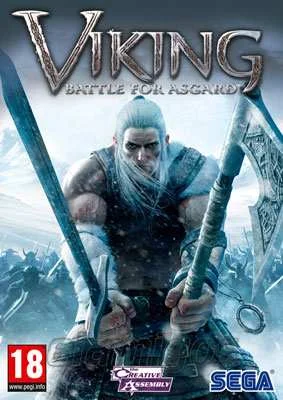
Viking: Battle for Asgard
- Category:
- Release date:
- Game Genre:Action, TPP, Norse mythology
- Developer:Creative Assembly Publisher: SEGA
- Release:ElAmigos
- Platform:PC
- Languages (subtitles):English, French, Italian, German, Spanish, Russian, Polish
- Dubbing/Audio:English, French, Italian, Spanish
- Crack:Reloaded
- Game size:3.33GB
Game Description
Viking: Battle for Asgard is a third-person action-adventure and hack-and-slash game for PC, developed by Creative Assembly with the PC port handled by Hardlight and published by SEGA. The current Steam listing still uses the original title, with no verified rebrand, remaster name, definitive edition, or replacement storefront identity. Its focus is straightforward: fight through Norse armies, free captured Vikings, and turn liberated forces into a weapon against Hel.
The game is a paid, single-player release built around direct melee combat and large battlefield set pieces. It is not a co-op Viking RPG, a strategy game in the Total War mold, or a loot-driven action RPG. The appeal comes from its combination of open-area exploration, brutal close-quarters fighting, stealth objectives, and army-led assaults.
Combat across a war-torn Midgard
You play as Skarin, a Viking warrior chosen by Freya to oppose Hel, the goddess whose undead forces are spreading through Midgard. The campaign moves through broad island environments rather than a single seamless kingdom, giving each region a mixture of combat zones, enemy camps, settlements, caves, and travel routes.
The moment-to-moment loop is built around scouting an area, locating objectives, defeating enemy groups, and freeing imprisoned allies. Captured soldiers are not just background story elements. Rescuing them increases the strength of the Viking forces available for the larger assaults that follow.
Skarin's weapon work centers on light and heavy attacks, blocks, dodges, counters, and context-sensitive finishing moves. Combat is deliberately physical, with enemies reacting to impacts and vulnerable foes open to dismemberment executions. The system is accessible, but survival still depends on reading attacks and avoiding being surrounded.
The game also includes rage-powered attacks and elemental abilities that give Skarin stronger options against tougher opponents. Fire, ice, and lightning effects add variety to the basic sword fighting, while collected souls and combat rewards support the use of these supernatural powers.
Liberation, infiltration, and army assaults
Viking: Battle for Asgard is structured around the gradual collapse of Hel's control over each island. Objectives include freeing prisoners, disrupting enemy infrastructure, attacking fortified positions, and helping settlements return to the Viking side. Completing enough objectives eventually opens a major assault against an enemy stronghold.
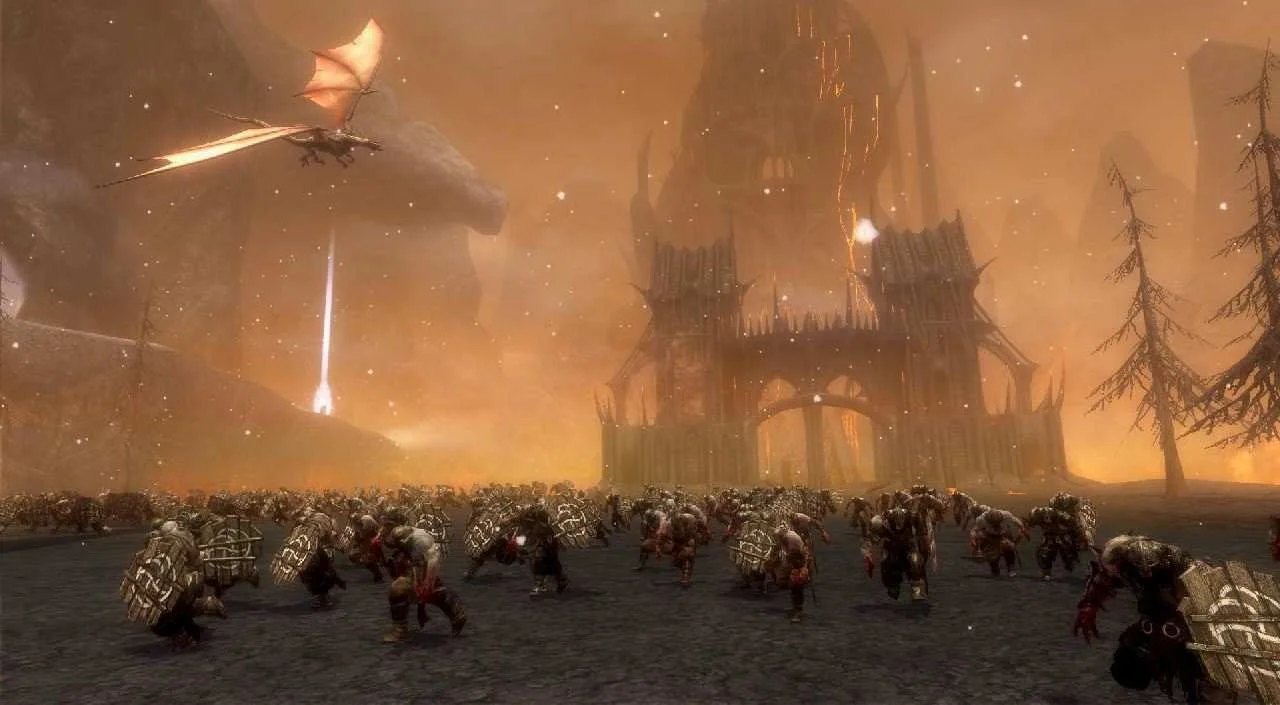
These assaults are the game's defining feature. Instead of fighting a small encounter alone, Skarin enters a large-scale Viking battle where allied warriors clash with Hel's forces across a fortress or battlefield. The player remains an active combatant while also helping the wider army push through resistance.
Dragons add another layer to the set pieces. Skarin can command dragons to attack strategic targets, including enemy positions that would be difficult to overcome through ordinary melee combat. This makes the assaults feel distinct from the regular camp-clearing missions, even though both rely on the same basic combat controls.
Stealth appears in selected infiltration missions and enemy-base objectives. It is not a full stealth sandbox with a deep detection system, so players should treat it as a situational change of pace rather than the game's central identity. The strongest parts of the campaign remain the open combat encounters and the transition from liberation work to fortress assault.
Progression without modern loot systems
The campaign does not use the equipment treadmill or randomized loot structure associated with contemporary action RPGs. Skarin's growth is tied more closely to story progress, combat abilities, magical powers, and the resources earned while fighting through occupied territory.
That structure keeps the emphasis on mastering encounters rather than comparing constant gear drops. You improve by learning attack timing, using elemental powers at the right moment, exploiting enemy weaknesses, and understanding when to disengage from a crowded fight.
Travel gates, also referred to as leystones, provide a practical way to move around previously visited areas. They reduce unnecessary trekking between objectives and make it easier to return to regions where prisoners, resources, or unfinished tasks remain.
Players looking for a more traditional fantasy action-adventure with weapon upgrades, dungeon puzzles, and ability-based exploration may find a useful comparison in third-person hack-and-slash adventures such as Darksiders Warmastered Edition. Viking is more focused on army warfare and Norse mythology, while Darksiders places greater weight on puzzle-driven progression.
Content structure and commercial scope
The PC package is a standalone campaign rather than a live-service product. The Steam listing does not present a season pass, online progression system, or collection of licensed expansion packs. Players should approach it as a self-contained action game whose main content is the story campaign and its liberation-to-assault progression.
Its content is divided between ordinary exploration, enemy camps, rescue objectives, short mission variations, and the climactic assaults that conclude each major island arc. The campaign repeatedly returns to this structure, so the game is best suited to players who enjoy a clear mechanical rhythm rather than constant reinvention.
There is no character creator, class selection, party management, or deep crafting economy. Skarin is a fixed protagonist, and the progression design supports a focused heroic power curve instead of a customizable build system.
Who should play Viking: Battle for Asgard?
This PC version is a good fit for players who want third-person melee combat, Norse mythology, violent finishing moves, and battles where individual swordplay contributes to a broader military objective. It also suits players interested in games that sit between a conventional action adventure and a small-scale battlefield spectacle.
Fans of historical-fantasy settings may appreciate the contrast between ordinary Viking settlements and the supernatural forces serving Hel. The game is not a documentary interpretation of Norse history. Gods, dragons, undead warriors, and prophetic conflict place it firmly in dark fantasy.
It is less suitable for players expecting online multiplayer, cooperative raids, extensive character builds, or a modern stealth system. The campaign is designed for one player, and its repetition between island objectives can be noticeable if you prefer tightly varied mission design.
For a Norse-themed game with a stronger action-RPG foundation and cooperative play, isometric Viking hack-and-slash games such as Vikings: Wolves of Midgard offer a different direction. That comparison is useful because Viking: Battle for Asgard is more cinematic and third-person, while Wolves of Midgard concentrates on character builds, loot, and co-op combat.
PC controls, storefront status, and languages
The Steam edition supports gamepad play as well as keyboard and mouse controls. The PC release also provides remappable keyboard-and-mouse controls, and a controller is a natural option for players who prefer the console-style combat layout.
The current PC storefront identity remains Viking: Battle for Asgard. There is no verified current name change to a Classic, Definitive, Remastered, or Complete edition. The game is delivered through Steam, and its platform identity is tied to the Steam version rather than a separate publisher launcher.
Steam lists interface support for English, German, French, Italian, Spanish, Russian, and Polish. Full voice support is listed for English, French, Italian, and Spanish, while the remaining supported languages are presented as interface and subtitle options. Players who need a specific localization should confirm the language labels attached to their regional Steam listing.
The PC version is strictly single-player. There is no verified online multiplayer, local co-op, split-screen mode, or competitive mode. Its replay value comes from completing objectives, improving combat execution, exploring the islands, and revisiting the campaign rather than from a persistent online ecosystem.
Similar PC action adventures
Viking: Battle for Asgard occupies a narrow space between character-focused hack-and-slash combat and army-scale action. Its closest comparisons are games that combine a third-person perspective with melee encounters, fantasy settings, or structured exploration.
Players who prefer acrobatic movement and weapon-focused melee may also enjoy dark third-person action adventures like Prince of Persia: Warrior Within, although that game puts much more emphasis on traversal, environmental puzzles, and time manipulation.
Players seeking another Norse setting should remember that Vikings: Wolves of Midgard is an isometric action RPG rather than a direct equivalent. Its co-op and loot systems differ substantially from Skarin's fixed-character campaign.
The comparison gap is important: few PC games combine liberation objectives, direct hack-and-slash combat, dragon commands, and fortress assaults in one package. That unusual structure remains the main reason to seek out Viking: Battle for Asgard today.
Viking: Battle for Asgard FAQ
Is Viking: Battle for Asgard still the current PC name?
Yes. The current Steam listing uses Viking: Battle for Asgard. No verified storefront rebrand, remaster title, or definitive replacement edition has been identified.
What kind of game is Viking: Battle for Asgard?
It is a third-person action-adventure and hack-and-slash game with open-area exploration, melee combat, stealth objectives, Norse mythology, and large fortress assaults supported by allied Viking forces.
Does the PC version include multiplayer or co-op?
No. Viking: Battle for Asgard is a single-player game without online multiplayer, local co-op, or split-screen support.
Can PC players use a controller?
Yes. The Steam version supports gamepads and also includes remappable keyboard-and-mouse controls.
Does the game have a deep RPG or loot system?
No. Progression focuses on Skarin's combat abilities, magical powers, story advancement, and campaign resources rather than randomized loot, classes, or extensive build crafting.
What makes the campaign different from a normal hack-and-slash game?
The central distinction is the connection between freeing Viking prisoners and launching army-led fortress assaults. Regular combat prepares the wider battlefield, while dragons and allied troops become part of the larger attack sequence.
System Requirements
Minimum: |
Processor: Core 2 Duo 2.6 GHz Graphics: 512 MB VRAM Memory: 2 GB RAM Disk space: 4 GB HDD Operating system: Windows XP/Vista/7 |
Screenshots


Trailer/Gameplay
Download
Viking: Battle for Asgard (2012), 3.33GB
ElAmigos release, game is already cracked after installation (crack by Reloaded).

Updated to the latest version (25.04.2013).

1. Extract files.
2. Burn or mount the image.
3. Install the game.
4. ElAmigos release, game is already cracked after installation.
5. Play the game. If you like this game, BUY IT!
Viking: Battle for Asgard Download
 Download from TeraBox
Torrent Download
The best torrent download speeds are with qBittorrent!