King's Bounty: The Legend
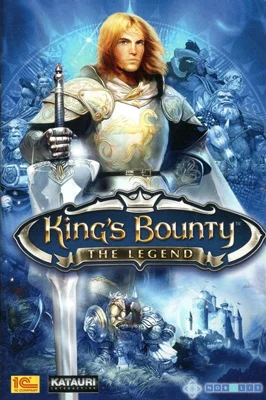
- Category:
- Release date:
- Game Genre:Strategy, fantasy, turn-based, RPG elements, multiplayer
- Developer:Katauri Interactive, Publisher: 1C / Cenega
- Release:GOG
- Platform:PC
- Languages (subtitles):English, Polish, German, Spanish, French, Italian, Hungarian, Czech, Russian, Chinese (Simplified), Japanese
- Crack:not necessary
- Game size:3.52GB
Game Description
King's Bounty: The Legend PC is a single-player fantasy RPG and turn-based strategy hybrid built around real-time exploration, army management, quests, and tactical battles on hex-based arenas. The game is still listed under its original name on current Steam and GOG storefront pages. There is no verified rebrand, replacement edition, or free-to-play transition.
Exploration Before the Battle
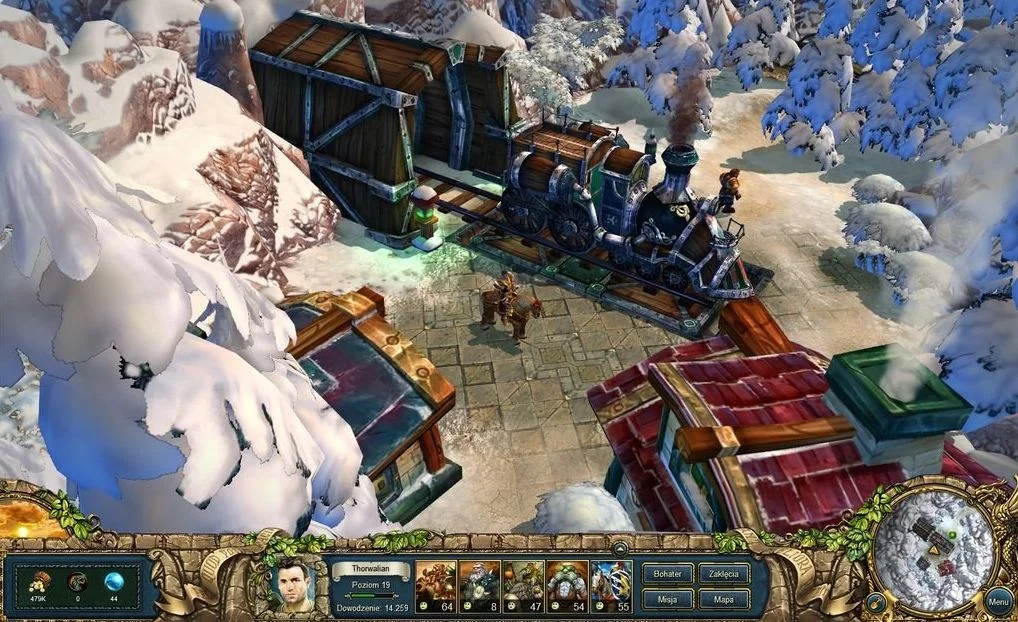
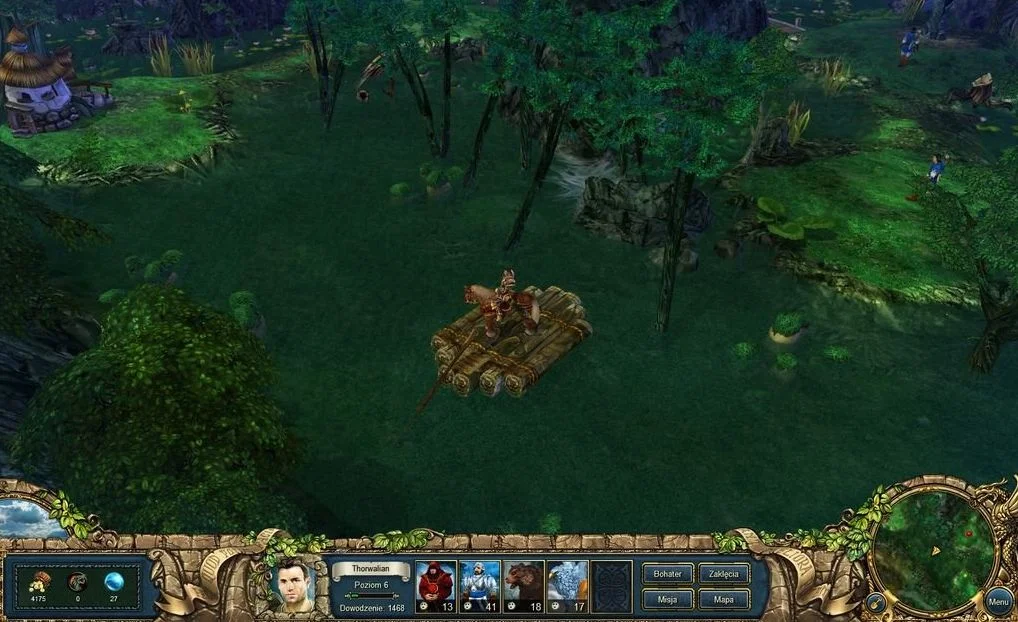
The adventure takes place across Endoria, where the hero travels between towns, wilderness areas, castles, caves, and dungeons while working for King Mark of Darion. Movement across the world is continuous rather than divided into traditional strategy turns, giving the game a more direct adventure-game rhythm.
Exploration is not just travel between fights. The map contains quests, treasure, recruitable creatures, interactive objects, enemy commanders, and hidden rewards. Decisions made during quests can affect the rewards received, while some objectives send the hero across multiple regions before they are complete.
The result is a compact but flexible campaign loop: explore a new area, inspect available armies, recruit suitable troops, complete quests, collect equipment, and decide which encounters are worth taking. There is no kingdom-building layer comparable to a traditional 4X strategy game. Your attention stays on one hero, one army, and the next tactical problem.
Players looking for a modern fantasy strategy game with stronger settlement management may prefer turn-based kingdom builders such as Songs of Conquest, but King's Bounty: The Legend is more focused on character progression and individual battles.
Three Heroes, Three Progression Paths
At the beginning, players choose between the Warrior, Paladin, and Mage. These are not cosmetic choices. Each class changes how quickly the hero develops different skill groups and how the army is supported during combat.
The Warrior is the strongest commander for players who want high Leadership, larger forces, and greater access to Rage abilities. The class develops Might skills quickly and is better suited to direct army enhancement, although its Mana growth is comparatively limited.
The Paladin occupies the middle ground between martial strength and magic. It develops Mind skills, receives balanced combat and magical growth, and has access to utility abilities such as enemy information, improved rewards, reserve troops, and Diplomacy.
The Mage relies more heavily on the Spell Book than on troop strength. It gains Magic Runes, higher Mana growth, and better spell development, but has lower Leadership and Rage growth. This makes the class powerful when the player understands spell timing and battlefield control.
Hero development uses three skill groups: Might, Mind, and Magic. Runes earned through leveling and quest progression unlock these skills, allowing players to specialize in army bonuses, scouting, trade, diplomacy, necromancy, spell improvement, or Rage management.
Why Combat Is the Real Progression System
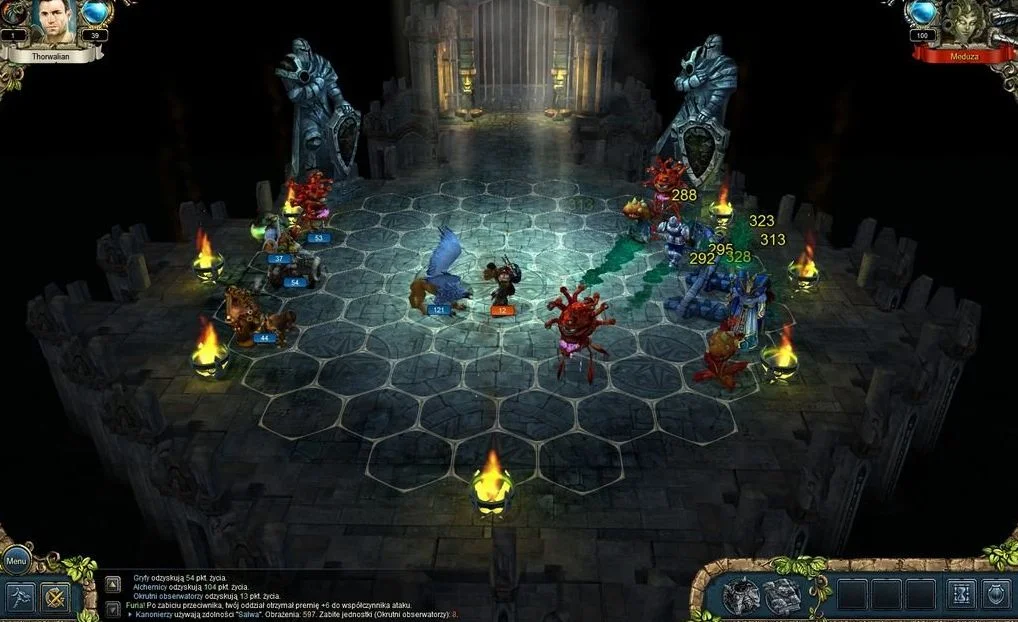
When an encounter begins, the game switches from exploration to turn-based tactical combat. The hero does not fight as a normal battlefield unit. Instead, the player commands up to five troop stacks while supporting them with spells, passive bonuses, and special Rage abilities.
Every troop stack has its own statistics, movement rules, abilities, talents, and racial interactions. Units can include ordinary soldiers, archers, undead, demons, dragons, griffins, dwarves, and other fantasy creatures. The number of units in a stack directly affects its health and damage, so losing soldiers before a crucial engagement can have lasting consequences.
Leadership limits which creatures can join the army and how many of them can be commanded. This turns recruitment into a strategic decision rather than a simple shopping list. A powerful unit may be unsuitable if it consumes too much Leadership, while a weaker troop with useful abilities can remain valuable in the right formation.
Morale also matters. The races in the army influence one another, and incompatible combinations can reduce effectiveness. Building an army is therefore about more than choosing the highest-rated creatures. Players must consider morale, unit abilities, battlefield position, enemy composition, and the hero's class skills.
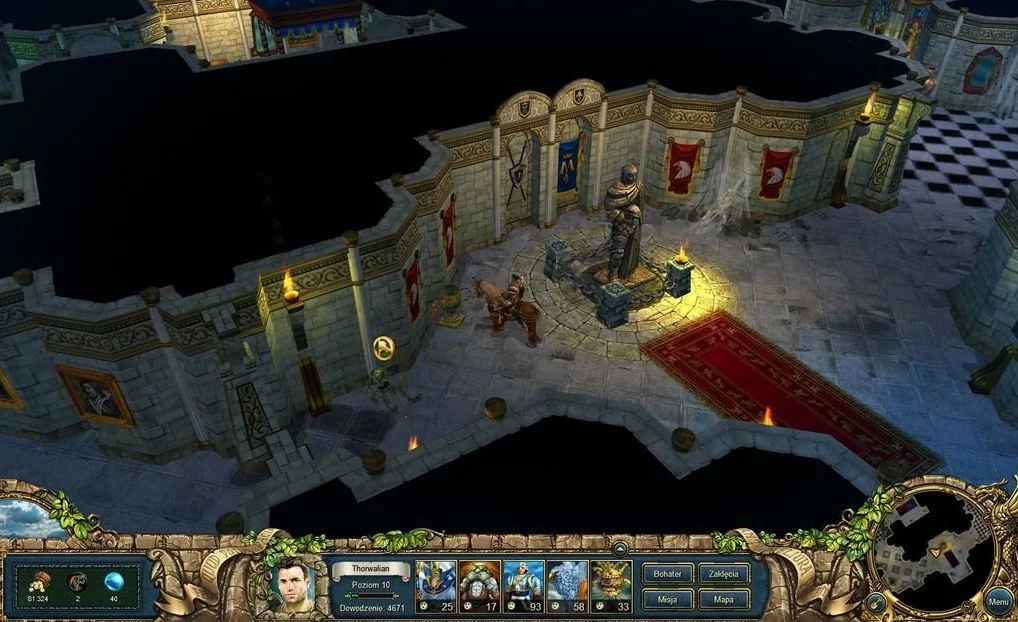
Arenas change according to their location. Forests, castle walls, ship decks, cemeteries, lava fields, and other environments create different tactical conditions. Obstacles restrict movement, illumination affects certain creatures, and some enemies gain situational advantages from the terrain.
Combat rewards preparation more than reflexes. Initiative, positioning, retaliation rules, movement range, spell selection, and limited-use talents can determine the result of a battle before the first attack is made. The most reliable approach is to inspect enemy forces, save before major encounters, and avoid assuming that every visible fight is immediately winnable.
Spells, Rage, and Living Equipment
The hero can influence battles through a broad spell system divided into Order, Distortion, and Chaos magic. Spells consume Mana and can damage enemies, protect troops, alter positioning, restore units, or create opportunities that a conventional army could not achieve alone.
Rage is generated during combat and powers the Rage Box. After progressing through the early assignments, the player gains access to four Spirits of Rage: Zerock, Sleem, Lina, and Reaper. Each Spirit has its own quest, skills, experience progression, and combat role.
Rage abilities are not unlimited emergency buttons. Strong attacks require more Rage and can place a Spirit into a recovery period. Choosing when to spend Rage is part of the battle plan, especially in long fights or encounters against powerful enemy commanders.
One of the game's most unusual systems is its collection of living items. These artifacts have their own Morale and preferences, reacting to the player's behavior. A living item can improve when its Morale rises, but it may stop providing bonuses or rebel when its Morale falls too low.
Living items can be upgraded by defeating their Keepers in special battles populated by Gremlins and supporting troops. This gives equipment its own progression loop and makes artifact management more involved than simply replacing an old sword with a stronger one.
The hero can also acquire a wife and children. Different wives provide different bonuses and equipment slots, while children occupy those slots and add further statistical benefits. It is a secondary system, but it reinforces the game's preference for unusual character-building choices over a purely linear loot ladder.
Content, Editions, and Commercial Model
The current standalone product is a paid base game for Windows. It is not structured as a seasonal service, free-to-play title, or multiplayer platform. The campaign, classes, creatures, spells, artifacts, quests, and tactical systems belong to the core release.
Steam currently lists the game with achievements, trading cards, Steam Workshop, Steam Cloud, Family Sharing, and single-player support. The store page also lists free music and art companion content rather than a paid DLC program for the standalone title.
Steam bundles such as King's Bounty: Platinum and the Collector's Pack combine The Legend with later King's Bounty games. These bundles should not be confused with a renamed edition of The Legend itself. The game's storefront identity remains King's Bounty: The Legend.
GOG lists the game as a Windows single-player release with optional cloud functionality and a DRM-free distribution model. GOG Galaxy is not required for installation or offline play, which makes that version the clearest choice for players who want a standalone launcher-independent copy.
Who Should Play It
King's Bounty: The Legend is a strong fit for players who enjoy single-player tactical RPGs, army composition, difficult encounters, fantasy exploration, and progression systems with several viable approaches.
It is particularly suitable for players who like studying enemy formations, rebuilding an army after a setback, experimenting with spell combinations, and solving battles through positioning rather than fast inputs. The campaign structure also works well for players who prefer side quests and exploration over a strictly linear mission path.
It is less suitable for anyone expecting traditional city construction, competitive multiplayer, cooperative play, or a conventional party-based RPG in which the hero personally swings a sword during every battle. The hero is a commander and support character, while the recruited troops do the direct fighting.
The game can also be demanding when players attack enemies without enough Leadership, enter a battle with poor morale, or use a troop composition that does not answer the opponent's abilities. That difficulty is central to the design rather than a temporary obstacle on the way to a simpler power fantasy.
PC Features and Practical Details
The PC presentation uses an angled overhead view for exploration and separate tactical arenas for combat. Keyboard and mouse input are documented in the game's manual, including direct hotkeys for the map, quest log, hero window, spell book, quick save, and combat commands.
Steam provides Workshop access for community modifications, alongside achievements and cloud saves. GOG provides a DRM-free option with an offline installer, while the Steam release is tied to the Steam client and its platform services.
The current Steam listing identifies eleven interface and subtitle languages, including English, Russian, French, Italian, German, Spanish, Czech, Japanese, Hungarian, Polish, and Simplified Chinese. Full audio is not listed as a separate supported category on the storefront.
There is no multiplayer campaign, co-op mode, split-screen option, or competitive mode listed for the current PC versions. This is an offline-friendly solo strategy RPG first, with Workshop content on Steam as its main ongoing community feature.
Similar Fantasy Strategy Games
Players who want a closer connection to classic hero-led fantasy strategy can compare it with fantasy turn-based campaigns like Might & Magic Heroes VI. That series places more emphasis on kingdoms, resources, and broader strategic management, while The Legend keeps the focus on one adventurer and his recruited forces.
Those who prefer a tactical RPG with modern squad combat and a stronger mission structure may also look toward games such as Fort Triumph, but its combat framework is closer to cover-based tactical battles than The Legend's stack-based fantasy warfare.
The most important distinction is the balance between exploration and combat. King's Bounty: The Legend is neither a pure Heroes-style kingdom simulator nor a traditional action RPG. Its identity comes from joining an adventure map, hero progression, and carefully prepared hex-grid battles into one continuous campaign.
King's Bounty: The Legend FAQ
Has King's Bounty: The Legend been renamed?
No verified rebrand is currently shown on the Steam or GOG storefronts checked for this guide. The game remains listed as King's Bounty: The Legend.
Is King's Bounty: The Legend multiplayer?
No. The current PC storefront listings identify it as a single-player game. There is no listed online co-op, competitive multiplayer, or split-screen mode.
What classes can you choose?
You can choose the Warrior, Paladin, or Mage. The Warrior favors Leadership and Rage, the Paladin combines martial and magical utility, and the Mage specializes in Mana and spell development.
How does combat work?
Exploration occurs in real time, but battles are turn-based. You command up to five troop stacks on tactical arenas while using hero spells, class skills, equipment effects, and Spirits of Rage.
What are living items?
Living items are artifacts with Morale and individual preferences. Their bonuses can improve when their Morale rises, while low Morale can disable their effects or cause them to resist the player.
Is the GOG version DRM-free?
Yes. GOG lists the game as DRM-free and provides an optional offline installer. GOG Galaxy is not required to install or play the game offline.
Does the game support mods?
The Steam version currently lists Steam Workshop support. That gives PC players access to community-created modifications, although the exact availability and compatibility of individual projects can vary.
System Requirements
Minimum: |
Processor: Pentium 4 3 GHz Graphics: 256 MB Memory: 1 GB RAM Disk space: 4 GB HDD Operating system: Windows XP/Vista |
Screenshots
Trailer/Gameplay
Download
King's Bounty: The Legend (2008) GOG, 3.52 GB

Version 1.7.35.398 (39945)

Included bonus content: Artworks, Avatars, manual, Wallpapers.

1. Extract files.
2. Install the game.
3. Play the game. If you like this game, BUY IT!
King's Bounty: The Legend Download
🔒 Premium access required
To see and use the download links, you must be logged in and have an active PREMIUM account.
* Unlock downloads via Torrent and TeraBox.
Torrent Download
The best torrent download speeds are with qBittorrent!