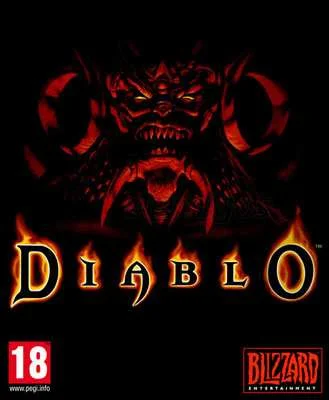
Diablo (1996)
- Category:
- Release date:
- Game Genre:RPG, fantasy, hack'and'slash, Isometric view, co-op, action RPG
- Developer:
- Release:ElAmigos
- Platform:PC
- Languages (subtitles):English, French, Italian, German, Spanish, Polish, Portuguese-Brazil
- Dubbing/Audio:English
- Crack:not necessary
- Game size:0.77GB
Game Description
Diablo on PC is a dark fantasy action RPG dungeon crawler built around descending through a randomized labyrinth beneath Tristram. The current storefront naming is straightforward rather than a full rebrand: Blizzard lists the game as Diablo, while the GOG package is named Diablo + Hellfire and includes the non-canonical expansion as a free add-on. The original game was developed by Blizzard North and published by Blizzard Entertainment.
This is the compact, foundational version of the series: one town, one escalating descent, three core classes, and a deliberately focused loop of exploration, combat, identification, shopping, and risk management. It remains a strong fit for PC players who prefer atmosphere and meaningful discoveries over sprawling quest logs.
How the dungeon-crawling loop works
Each run begins in Tristram, where survivors provide services, rumors, quests, healing, and equipment. From there, you descend through the cathedral and into deeper regions, fighting demons in real time from an isometric perspective. Movement, attacks, item pickup, and interaction are primarily handled with the mouse, giving the game a direct point-and-click rhythm.
The central loop is simple but demanding: enter a floor, reveal its layout, defeat monsters, manage your health and mana, collect gold and equipment, then return to town before your resources or escape options disappear. Randomized dungeon layouts change the arrangement of rooms, corridors, monsters, objects, and stairways, so repeated characters do not follow exactly the same route.
Diablo is not built around a modern live-service endgame. Its replayability comes from starting new characters, trying different classes, learning enemy behavior, finding unusual equipment, and making better decisions on each descent. The campaign structure is a concentrated climb through 16 dungeon levels toward Diablo rather than a large open-world adventure.
Classes, stats, spells, and equipment
The base game offers three playable classes: Warrior, Rogue, and Sorcerer. The Warrior favors close combat, durability, and heavy equipment. The Rogue combines ranged attacks with strong Dexterity and can handle bows more naturally. The Sorcerer starts physically fragile but gains access to the widest magical potential.
Character growth uses attributes, experience levels, spells, weapons, armor, and magical item modifiers rather than modern skill trees. Class identity matters, but equipment can push a character into unexpected directions. A Warrior may rely on resistances and a carefully chosen weapon, while a Sorcerer may spend much of a run managing spellbooks, mana, and distance.
Identification scrolls, town services, limited inventory space, and equipment durability make every haul a series of decisions. You cannot keep everything. Returning to town is part of the strategy, especially when a promising item competes with potions, scrolls, gold, or a weapon you already understand.
Combat rewards positioning and timing more than ability rotation. Doors, corners, narrow corridors, ranged enemies, and monster groups can determine whether a fight is manageable. The game also expects players to experiment with spell effects, resistances, weapon reach, and enemy weaknesses instead of relying on a single universal build.
Atmosphere and story delivery
Diablo’s narrative is delivered through Tristram’s surviving residents, quest encounters, books, scripted conversations, and the changing condition of the town. The premise is direct: an ancient evil has taken root beneath the cathedral, and the player must descend through increasingly hostile environments to confront it.
The four major dungeon environments, from the cathedral to the caves and Hell, create a clear sense of descent. Gothic horror atmosphere, restrained exposition, unsettling sound design, and deliberately sparse settlements give the game a stronger identity than its compact structure might suggest.
Optional quests and discoveries are important because they make each playthrough feel less like a checklist. Some objectives reveal lore, others introduce distinctive encounters or rewards, and some can be missed entirely. That uncertainty supports the game’s central mood: Tristram is a place where information is incomplete and every dark doorway may matter.
Diablo + Hellfire: what the current package adds
The GOG storefront package is called Diablo + Hellfire. Hellfire was developed by Synergistic Software and was not an official Blizzard product, but Blizzard approved its inclusion with GOG purchases. It adds a non-canonical single-player storyline centered on Na-Krul.
Hellfire expands the original formula with the Monk class, additional weapons, items, spells, quests, locations, dungeons, and enemies. It is best treated as an optional companion campaign rather than a replacement for the original Diablo experience.
The content model is therefore unusually clear. The base package contains the original game and Hellfire, with no modern season system, rotating shop, or paid DLC catalogue. Players choosing the GOG edition receive both campaigns in one purchase, while the original Diablo experience remains the main reference point for the franchise’s early design.
Multiplayer and PC edition differences
Diablo supports single-player and multiplayer play. The classic build can connect through Blizzard’s classic Battle.net service, while multiplayer can also involve LAN or direct peer-to-peer connections depending on the version and setup.
The GOG release presents two important builds. The original-style version preserves compatibility with classic Battle.net matchmaking. The GOG-enhanced version adds compatibility fixes, resolution upscaling, refresh-rate controls, and other modern-PC adjustments, but it does not connect to Battle.net and instead uses LAN and peer-to-peer multiplayer options.
That distinction is one of the most important buying facts for PC players. If Battle.net access is the priority, use the classic-compatible build. If offline access, modern Windows compatibility, and easier display scaling matter more, the enhanced GOG build is the more practical choice.
GOG describes the package as DRM-free, and Galaxy is optional. The game can be installed and played without requiring the Galaxy client. The official language listing is English only, and the original interface is designed around keyboard-and-mouse input rather than native controller support.
Who should play Diablo on PC?
Diablo is a good match for players who want a focused old-school action RPG with randomized exploration, class-based combat, scarce inventory space, and a strong horror atmosphere. It also suits players interested in seeing how later loot-driven dungeon crawlers established their core vocabulary.
Players who enjoy the broader, loot-heavy structure of isometric hack-and-slash RPGs such as Diablo II Complete Edition will recognize the lineage, but the first Diablo is much narrower. It has fewer classes, less geographic variety, and a more compressed progression model.
It is less suitable for anyone expecting modern convenience features, extensive build respec systems, expansive outdoor zones, voice-heavy storytelling, or seamless online services. The interface and combat are intentionally dated, and the game asks you to learn its rules through experimentation rather than constant explanation.
Comparable PC games and genre context
The closest comparisons are other loot-driven, isometric dungeon crawlers. Torchlight II’s randomized dungeons and cooperative action RPG structure show how the formula later expanded into larger worlds, more classes, and a more generous equipment loop.
Diablo itself is more austere. Its town is small, its campaign is compact, and its atmosphere is oppressive rather than colorful. That narrower scope is also its advantage: every descent reinforces the same horror premise, and every item decision has a visible cost.
For modern players, the most useful comparison is not content volume but design emphasis. Diablo prioritizes readable combat, randomized floors, class identity, and tension created by limited resources. It is a historical action RPG, but it remains playable as a tightly structured dungeon crawl rather than only as a museum piece.
Diablo PC FAQ
Is Diablo currently rebranded as Diablo + Hellfire?
No full rebrand is indicated. The game is still listed as Diablo in Blizzard’s storefront context, while GOG uses the package name Diablo + Hellfire because the Hellfire expansion is included with that edition.
Does the GOG version include Hellfire?
Yes. The GOG package includes Hellfire as a free add-on with Diablo. Hellfire provides a separate, non-canonical single-player storyline, the Monk class, and additional content.
Does Diablo support multiplayer on PC?
Yes, but the available connection method depends on the build. The classic-compatible version supports classic Battle.net matchmaking, while the GOG-enhanced version supports LAN and peer-to-peer multiplayer rather than Battle.net.
Does Diablo have native controller support?
The original PC design is built around mouse-and-keyboard input, and the current GOG listing does not present native controller support as a feature. A controller may require external remapping rather than working as a built-in gamepad option.
Is Diablo available in languages other than English?
The current official storefront information lists English for the game’s text and audio. Do not assume that later Diablo localization options apply to this original PC release.
Is Diablo a campaign game or an endless loot game?
It is primarily a compact campaign dungeon crawl. Replayability comes from randomized layouts, class experimentation, equipment discoveries, optional quests, and replaying the descent with different characters rather than from a separate endgame activity.
Which PC edition is better for offline play?
The GOG-enhanced build is the most convenient choice for offline-focused players because it is DRM-free, does not require GOG Galaxy, and includes modern compatibility improvements. Choose the classic-compatible build instead if access to classic Battle.net multiplayer is the deciding factor.
System Requirements
Minimum: |
Processor: Pentium 166MHz Graphics: 32 MB VRAM Memory: 32MB RAM Disk space: 800 MB HDD Operating system: Windows |
Screenshots
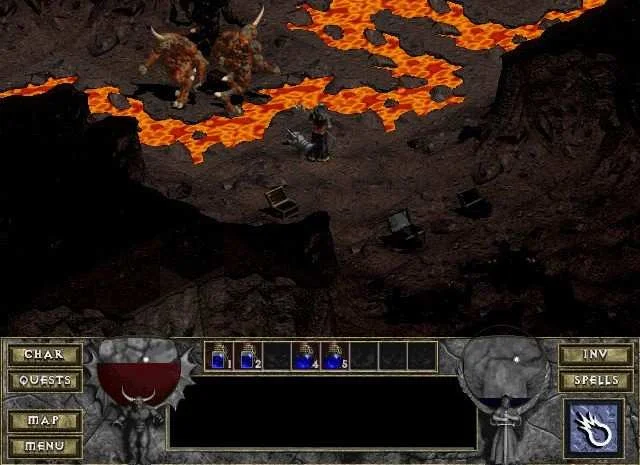
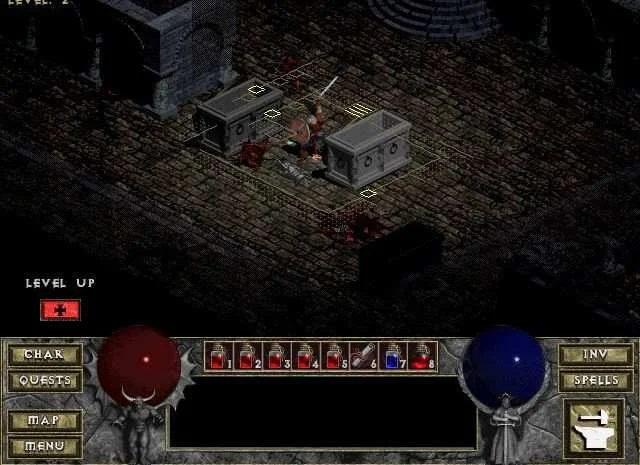
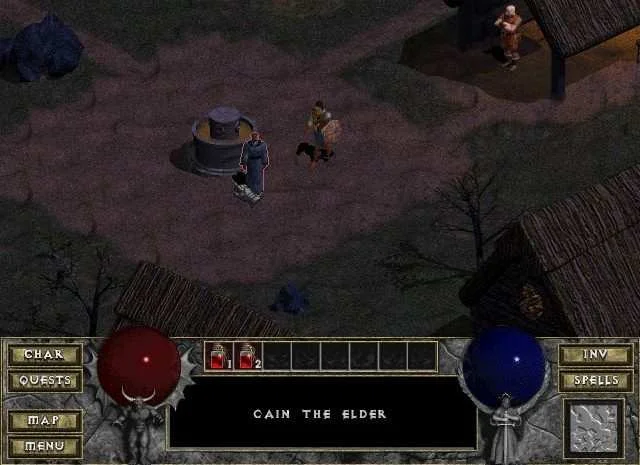
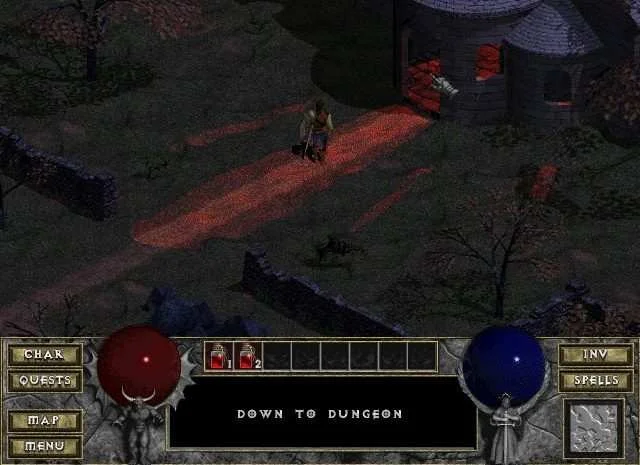
Trailer/Gameplay
Download
Diablo (1996), 0.77GB
ElAmigos release, unprotected game (serial or crack is not necessary).
Updated to version 1.09b.

1. Extract files.
2. Burn or mount the image.
3. Install the game.
4. ElAmigos release, game is already cracked after installation.
5. Play the game. If you like this game, BUY IT!
Diablo (1996) Download
🔒 Premium access required
To see and use the download links, you must be logged in and have an active PREMIUM account.
* Unlock downloads via Torrent and TeraBox.
HD Mod and Hellfire addon are included as setup options. All translations except English are unofficial and they work in Diablo Classic mode or with Diablo HD Mod. Included bonus content: Soundtrack (FLAC/Lossless).
Torrent Download
The best torrent download speeds are with qBittorrent!