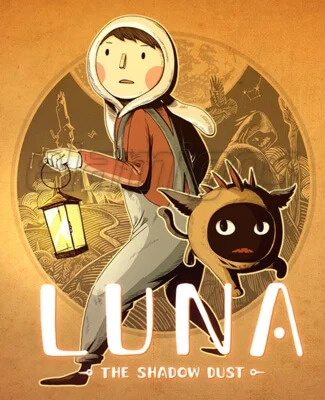
LUNA The Shadow Dust
- Category:
- Release date:
- Game Genre:Adventure, point-and-click, logical elements, 2D, crowdfunding, indie games
- Developer:Lantern Studio Publisher: Application Systems Heidelberg
- Release:ElAmigos
- Platform:PC
- Languages (subtitles):English, French, Italian, German, Spanish, Polish, Czech, Russian, Hungarian, Danish, Dutch, Portuguese, Portuguese-Brazil, Finnish, Swedish, Norwegian, Turkish, Ukrainian, Romanian, Japanese, Korean, Chinese Simplified, Chinese Traditional, Bulgarian, Thai, Vietnamese
- Dubbing/Audio:N/A
- Crack:Codex
- Game size:0.83GB
Game Description
LUNA The Shadow Dust on PC is a hand-animated point-and-click puzzle adventure set inside a mysterious tower at the edge of the world. The current Steam and GOG listings retain this original title, with no verified storefront rebrand or renamed definitive edition. Lantern Studio developed the game, while Coconut Island Games and Application Systems Heidelberg handled publishing. Its defining traits are wordless storytelling, atmospheric 2D artwork, and puzzles built around two playable companions.
This is a focused single-player adventure rather than an open-ended exploration game. The tower provides a linear route through carefully staged rooms, each designed around a specific visual idea, interaction pattern, or environmental puzzle.
A two-character puzzle loop
The central mechanic is dual-character control. You guide a young boy and his cat-like companion, switching between them whenever their different positions or abilities are needed. The boy can reach some areas, while the smaller companion can slip through spaces, climb to ledges, and interact with parts of a room that remain inaccessible to the human character.
Most rooms function as self-contained puzzles. You examine the scene, identify relationships between objects, and perform actions in the correct sequence. The game does not rely on a traditional inventory, hidden-item hunt, or large collection of combinable objects, so progress usually depends on understanding the room itself rather than carrying clues between distant locations.
Light and shadow are more than visual motifs. Several challenges use shadow manipulation, including sequences where the companion enters a shadowy realm and uses the silhouettes created by objects in the physical environment. Other puzzles involve symbols, paintings, mechanisms, seasonal changes, music, and unusual transformations that alter how the space can be crossed.
The puzzle logic is intentionally visual and sometimes indirect. Environmental murals, repeated symbols, object placement, and animated reactions often provide the information needed to continue. Players who prefer explicit quest markers or constant hints may find the deduction demanding, while fans of classic adventure design will appreciate the emphasis on observation.
Silent storytelling inside the tower
LUNA The Shadow Dust communicates without conventional dialogue. Instead of relying on spoken conversations or long text sequences, it uses hand-animated cinematics, expressions, music, environmental details, and recurring visual symbols to reveal the relationship between the boy and his companion.
The absence of dialogue makes the setting broadly accessible, but it also leaves parts of the lore open to interpretation. The tower feels like a place with a history that must be reconstructed from murals, scenes, and visual callbacks rather than explained through exposition.
Lantern Studio built the presentation around frame-by-frame animation. The result is closer to an interactive illustrated storybook than a conventional 3D adventure, with each room arranged as a composed scene. The artwork is not merely decorative; it frequently supplies the clues that connect a puzzle solution to the surrounding world.
The soundtrack carries unusual narrative weight because there is no voiced script. Musical changes help establish mood, signal transitions, and support the emotional beats of the journey. Players looking for a quiet, visually led adventure will find that the sound design and animation work together as part of the storytelling system.
Content, extras, and ownership options
The base game is a paid single-player adventure with a contained puzzle campaign. It is not structured around repeatable runs, character builds, combat progression, or open-world side activities. The primary loop is solving rooms, advancing through the tower, and interpreting the story revealed between puzzle sequences.
Current storefront content listings identify two optional extras: The Art Book and the Official Game Soundtrack. These are supplementary products rather than gameplay expansions, so the core adventure is not divided into a season pass or a series of content packs.
The art book focuses on the project’s visual development, including finished artwork and sketches. The soundtrack is presented as a separate music release built around the compositions used to support the game’s silent narrative. Players interested only in the playable experience can treat both as optional additions.
Steam lists 24 achievements, giving completion-focused players a secondary reason to inspect rooms carefully and revisit missed objectives. The game itself remains linear, however, so achievements supplement the puzzle journey rather than turning it into a branching campaign.
Who should play it?
LUNA The Shadow Dust suits PC players who enjoy atmospheric point-and-click adventures, visual storytelling, and compact puzzle campaigns. It is particularly well matched to people who prefer examining a scene and forming their own hypothesis instead of following waypoint instructions.
The strongest audience overlap is with players who value art direction as much as mechanical complexity. The boy-and-companion structure gives the puzzles a clear identity, while the silent presentation makes the experience approachable for players who do not want a dialogue-heavy adventure.
It is less suitable for anyone seeking combat, inventory management, branching decisions, or a large world to explore at their own pace. The adventure is deliberately linear, and its challenge comes from interpreting visual logic rather than from reflexes or resource management.
Puzzle difficulty varies from straightforward interactions to more ambiguous sequences. The game generally expects patience and close observation, so it rewards players willing to test ideas and read the room visually instead of clicking every object at random.
PC features and storefront differences
The Steam edition is listed as single-player and includes Steam Achievements, Steam Cloud, and Family Sharing. It does not advertise multiplayer, co-op, split-screen, or online functionality, and there is no verified multiplayer mode in the game.
Steam lists 29 interface languages, including English, French, German, Spanish, Portuguese, Italian, Russian, Polish, Japanese, Korean, Simplified Chinese, Traditional Chinese, and several additional European and Asian languages. Because the story is wordless, there is no conventional voiced dialogue campaign to localize.
The GOG edition is listed as DRM-free and can be installed without requiring GOG Galaxy. Galaxy remains optional for features such as synchronization, while the standalone installer supports an offline-oriented ownership model.
Neither current storefront listing prominently advertises native controller support. For PC players, mouse-and-keyboard control should be treated as the dependable input method, especially because the game’s interaction model is built around pointing, selecting, and examining objects.
Comparable point-and-click adventures
The closest comparisons are games that combine hand-crafted scenes, environmental logic, and storytelling with little or no conventional dialogue. Players looking for another atmospheric PC adventure built around visual clues may enjoy hand-drawn point-and-click puzzles like Machinarium Definitive Edition, although its robot protagonist and world of mechanical contraptions give it a different tone.
Fans of strange creatures, unusual interactions, and compact fantasy worlds may also appreciate surreal point-and-click exploration in Samorost 3. It shares LUNA’s preference for visual discovery and eccentric puzzle logic, while offering a broader sequence of locations rather than one central tower.
Atmospheric 2D puzzle adventures such as Creaks are another useful comparison for players who enjoy mysterious environments and minimal exposition. Creaks adds stealth-like movement and hazards, whereas LUNA keeps the focus on room-by-room observation and cooperation between its two playable characters.
LUNA The Shadow Dust FAQ
Is LUNA The Shadow Dust still sold under the same name?
Yes. The current Steam and GOG listings use LUNA The Shadow Dust. No verified rebrand, renamed edition, or storefront transition has been identified.
What type of game is LUNA The Shadow Dust?
It is a linear point-and-click puzzle adventure with hand-drawn 2D environments, wordless cinematics, environmental interactions, and two playable companions.
Is LUNA The Shadow Dust multiplayer or co-op?
No. It is designed as a single-player experience. The two-character system means switching between characters yourself, not controlling them through local or online co-op.
Does the game have an inventory system?
The puzzles are designed around the current room and do not depend on a conventional inventory or extensive backtracking. Progress usually comes from examining objects, recognizing visual relationships, and coordinating the boy with his companion.
Which PC version is DRM-free?
The GOG edition is listed as DRM-free and does not require GOG Galaxy. The Steam edition provides Steam-specific services such as cloud saves, achievements, and Family Sharing.
Does LUNA The Shadow Dust support controllers?
Controller support is not advertised in the current Steam feature list. Players should plan around mouse-and-keyboard input for the most dependable PC experience.
System Requirements
Minimum: |
Processor: Intel Core i5-2557M 1.7 GHz Graphics: 1 GB GeForce GT 440 / Radeon HD 5570 Memory: 4 GB RAM Disk space: 1 GB HDD Operating system: Windows 7/8/8.1/10 |
Screenshots


Trailer/Gameplay
Download
LUNA The Shadow Dust (2020), 0.83GB
ElAmigos release, game is already cracked after installation (crack by Codex).

Included bonus content: Soundtrack (mp3), Artbook.

1. Extract files.
2. Burn or mount the image.
3. Install the game.
4. ElAmigos release, game is already cracked after installation.
5. Play the game. If you like this game, BUY IT!
LUNA The Shadow Dust Download
🔒 Premium access required
To see and use the download links, you must be logged in and have an active PREMIUM account.
* Unlock downloads via Torrent and TeraBox.
Torrent Download
The best torrent download speeds are with qBittorrent!