Darkest Dungeon
Edit date: 20-08-2026, 20:00
Reason: Updated to version 27760 (18.08.2026).
- Category:
- Release date:
- Game Genre:RPG, fantasy, turn-based, roguelike, horror, 2D, dungeon-crawler, indie games, classic RPG
- Developer:
- Release:ElAmigos
- Platform:PC
- Languages (subtitles):English, French, Italian, German, Spanish, Russian, Polish, Czech, Portuguese-Brazil, Simplified Chinese, Japanese, Korean
- Dubbing/Audio:English
- Crack:Codex/Rune
- Game size:2.70GB
Game Description
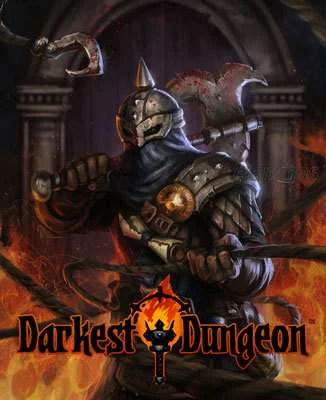
Darkest Dungeon on PC is a gothic turn-based roguelike RPG built around party formation, psychological pressure, and expeditions that can leave even a successful roster badly damaged. The Steam, Epic Games Store, and GOG versions still use the original Darkest Dungeon name; there is no verified storefront rebrand. Red Hook Studios remains both developer and publisher, and the current PC ecosystem includes the original campaign, multiple expansions, Steam Workshop mod support, and the newer The Fire's Edge DLC.
Party tactics under constant pressure
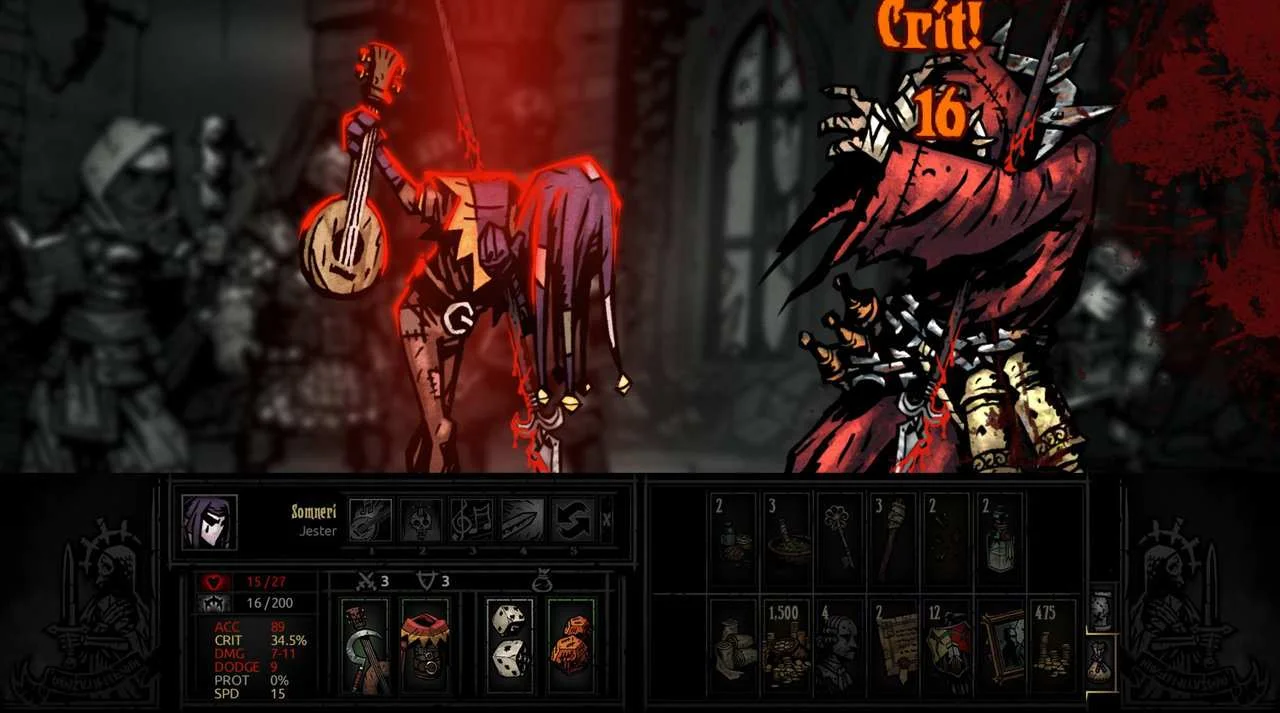
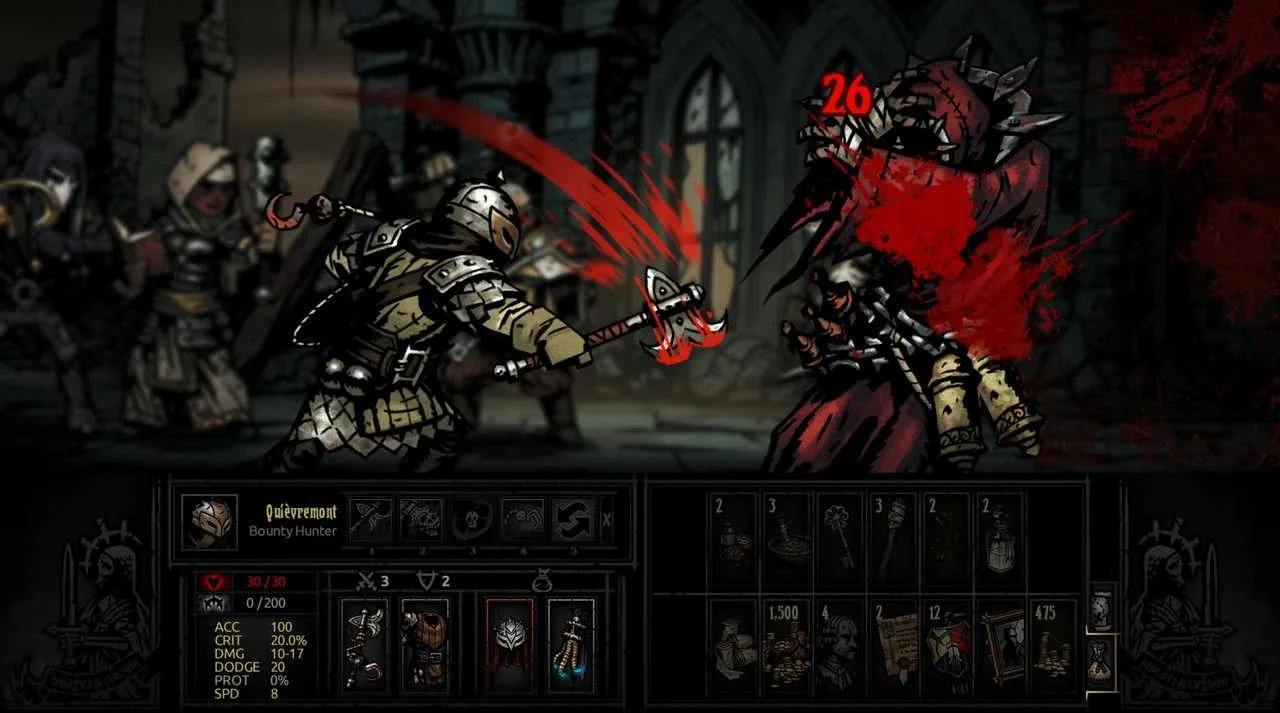
Each expedition begins with a four-hero party assembled from a larger roster. Position matters because combat skills are tied to specific ranks, so moving a hero, stunning a front-line enemy, or pulling a back-row threat forward can completely change the battle. The best team is not simply the one with the highest damage; it is the group whose skills, resistances, healing, and rank coverage match the area and mission.
Combat is deliberately attritional. Heroes can suffer bleed, blight, stun, debuffs, disease, and accumulating stress while enemies exploit gaps in your formation. A hero reduced to zero health enters Death's Door rather than dying immediately, but further damage can cause a deathblow. This creates narrow recovery windows without removing the threat of permanent loss.
Outside battle, every expedition is a resource decision. Torches influence visibility and risk, while food, shovels, keys, bandages, medicinal herbs, and other provisions occupy limited inventory space. Hunger checks, traps, curios, ambushes, and failed retreats can all turn a profitable mission into a costly withdrawal.
The stress system is the real enemy
Darkest Dungeon's defining mechanic is its stress system. Heroes gain stress from combat, darkness, hunger, traps, enemy abilities, and witnessing companions reach Death's Door or die. At high stress, a hero receives an Affliction or, less often, a Virtue. Afflicted characters may refuse commands, move themselves, pass turns, attack allies, or increase party stress, while Virtuous heroes can provide useful combat benefits.
Stress does not simply disappear when a quest ends. The Hamlet becomes a management layer where heroes can recover at the Abbey or Tavern, while the Sanitarium treats diseases and negative quirks. Gold is therefore spent not only on weapons and armor, but also on keeping valuable survivors functional enough to return to the road.
The result is a campaign about managing a roster rather than protecting one fixed squad. Heroes gain Resolve levels, equipment upgrades, quirks, diseases, and personal histories, but death is mostly permanent. A failed expedition can still provide experience and heirlooms, yet losing a trained specialist may force you to rebuild the party around whoever arrives at the Stage Coach next.
Hamlet progression and expedition structure
The Hamlet is the campaign's strategic hub. Buildings such as the Stage Coach, Guild, Blacksmith, Survivalist, Sanitarium, Abbey, Tavern, and Nomad Wagon support recruitment, training, stress relief, camping skills, equipment upgrades, and trinket management. Improving the right facility at the right time is often more important than buying one stronger weapon.
Regular missions take place across distinct regions including the Ruins, Warrens, Weald, and Cove, with specialized enemy groups, curios, hazards, and bosses. The Courtyard from The Crimson Court operates as a parallel campaign with its own enemies and pressures, while the Farmstead content from The Color of Madness offers a more focused endurance challenge.
Camping is available during longer missions and turns provisions into tactical preparation. Heroes can heal, reduce stress, remove disease, prevent nighttime ambushes, or apply combat buffs, but camp skills consume limited respite points. Choosing recovery over offense may save the next fight, while overcommitting to buffs can leave a party exposed.
Modes, classes, and current DLC
The main campaign supports Radiant, Darkest, and Stygian difficulty modes. Radiant reduces some of the campaign's grinding and progression friction without removing the game's core stress and permadeath systems. Darkest is the standard experience, while Stygian adds harsher rules and campaign failure conditions for players who already understand the systems.
The roster now spans 20 playable classes across the base game and character DLC. The core lineup includes recognizable roles such as the Vestal, Highwayman, Plague Doctor, Hellion, Leper, Man-at-Arms, Occultist, and Houndmaster, while expansions add specialists such as the Shieldbreaker, Flagellant, Musketeer, Runaway, and Duelist.
The commercial structure is straightforward but not all-inclusive. The base game is a paid single-player title. Paid content includes The Crimson Court, The Color of Madness, The Shieldbreaker, and The Fire's Edge; The Butcher's Circus and The Musketeer are listed as free additions on the Steam content panel. The current Ancestral Edition bundle groups the base game with its major DLC and soundtrack, but individual purchases remain available.
Who should play Darkest Dungeon?
Darkest Dungeon suits players who enjoy turn-based party tactics, difficult resource decisions, procedural missions, and campaigns where failure creates new problems instead of simply resetting a checkpoint. It is especially strong for players who like learning enemy behavior, refining formations, and treating roster management as part of the strategy rather than as menu administration.
It is a poor match for anyone seeking a forgiving power fantasy, a traditional party with permanent companions, or a fast route to mastery. The game frequently asks you to retreat, dismiss or replace wounded heroes, accept an imperfect outcome, and spend resources fixing damage from the previous mission.
Players who want a more action-focused dungeon loop can compare its procedural exploration DNA with top-down roguelike dungeon crawlers such as UnderMine, but Darkest Dungeon is much more concerned with formation, stress, and long-term roster consequences than reflex combat.
PC features and ecosystem
The Steam version is a single-player game with Steam Achievements, Trading Cards, Steam Cloud, Family Sharing, Remote Play on Tablet, and access to the Steam Workshop. Workshop support is a major part of the PC experience, with custom heroes, classes, trinkets, enemies, skins, balance changes, and total-conversion-style projects extending the campaign well beyond its default content.
The current Fire's Edge update was designed additively so that it would not interfere with existing mods, and Red Hook has announced work on an improved mod loader. That makes the PC version particularly attractive to players who want to customize difficulty, expand the class roster, or experiment with alternate campaign rules.
Gamepad play is supported, although the store feature list does not label Darkest Dungeon with Steam's Full Controller Support badge. Keyboard and mouse remain the safest choice for inventory management, menus, and precise party control. The storefront lists interface and subtitle support in English, French, German, Spanish, Czech, Polish, Brazilian Portuguese, Russian, Italian, Simplified Chinese, Korean, and Japanese; English is the only listed full-audio language.
The Steam build launches through Steam and requires agreement to a third-party EULA. No separate anti-cheat system is identified in the current storefront information, and the game is fundamentally a solo campaign rather than an online service.
Similar PC games
There is no exact substitute for Darkest Dungeon's combination of stress, formation tactics, and estate management. Rhythm-driven roguelike dungeon games like Crypt of the NecroDancer share procedural runs and escalating mastery, but replace party planning with beat-based movement.
Story-rich action roguelikes such as Hades offer a more fluid combat loop and stronger moment-to-moment mobility, while Darkest Dungeon emphasizes deliberate turns, rank control, and the consequences of bringing exhausted heroes back into danger.
These comparisons are useful because they clarify what makes Red Hook's game unusual: its central progression is not simply becoming stronger. It is learning when to push forward, when to spend money on recovery, and when a damaged expedition should be abandoned.
Darkest Dungeon FAQ
Has Darkest Dungeon been renamed on PC?
No verified rebrand has replaced the original name. Current Steam, Epic Games Store, GOG, and publisher references continue to identify the game as Darkest Dungeon. Darkest Dungeon II is a separate sequel, not a renamed edition of the first game.
Is Darkest Dungeon single-player or multiplayer?
The main game is single-player. The free Butcher's Circus add-on provides a separate competitive mode using modified hero skills, but it does not turn the main campaign into cooperative play.
What is included in the base game?
The base game includes the Hamlet management layer, the main regions, procedural expeditions, the core hero roster, stress and Affliction mechanics, camping, bosses, trinkets, and the main Darkest Dungeon campaign. The Crimson Court, Color of Madness, Shieldbreaker, and Fire's Edge are separate paid additions.
Which Darkest Dungeon DLC is the most substantial?
The Crimson Court is the major parallel campaign expansion, adding a new area, enemies, bosses, progression pressures, and a continuing narrative thread. The Color of Madness adds the Farmstead endurance content, while Fire's Edge adds the Runaway, Duelist, Burn mechanics, new trinkets, town events, and three Hamlet Districts.
Does Darkest Dungeon support mods on PC?
Yes. The Steam version supports Steam Workshop content, and the official game has an established modding ecosystem. Mods can add heroes, enemies, trinkets, skins, quests, balance changes, and broader rule-set adjustments.
Is a controller required?
No. Darkest Dungeon is fully playable with keyboard and mouse, and controller support is available for PC players who prefer gamepad input. Because the game contains dense menus and frequent inventory decisions, keyboard and mouse are usually the more practical option.
System Requirements
Minimum: | Recomended: |
| Processor: Dual Core 2.5 GHz Graphics: 512 MB GeForce 8800 Memory: 2 GB RAM Disk space: 3 GB HDD Operating system: Windows 7 | Processor: Dual Core 2.5 GHz Graphics: 512 MB GeForce 8800 Memory: 4 GB RAM Disk space: 3 GB HDD Operating system: Windows 7 |
Screenshots


Trailer/Gameplay
Download
Darkest Dungeon (2016), 2.70GB
ElAmigos release, game is already cracked after installation (crack by Codex/Rune).

Updated to version 27760 (18.08.2026).

1. Extract files.
2. Burn or mount the image.
3. Install the game.
4. ElAmigos release, game is already cracked after installation.
5. Play the game. If you like this game, BUY IT!
Darkest Dungeon Download
🔒 Premium access required
To see and use the download links, you must be logged in and have an active PREMIUM account.
* Unlock downloads via Torrent and TeraBox.
DLC: The Fire's Edge, The Butcher's Circus, The Color of Madness, The Shieldbreaker, The Crimson Court, The Musketeer, Soundtrack.
Torrent Download
The best torrent download speeds are with qBittorrent!