Getting Over It with Bennett Foddy
Edit date: 1-02-2023, 11:37
Reason: Updated to version 1.7 (06.01.2022)

- Category:
- Release date:
- Game Genre:Arcade, indie games, climbing
- Developer:
- Release:ElAmigos
- Platform:PC
- Languages (subtitles):English, Japanese, Russian, Korean, Simplified Chinese
- Dubbing/Audio:English
- Crack:Codex
- Game size:0.57GB
Game Description
Getting Over It with Bennett Foddy is a physics-based climbing game for PC, built around one unusual premise: guide a man trapped in a metal pot up an enormous mountain using only a hammer. The current Steam listing still uses the original title, with no verified PC rebrand or replacement edition. It remains a standalone single-player challenge developed and published by Bennett Foddy.
This is not a conventional platformer with checkpoints, combat, collectibles, or a forgiving recovery loop. Progress depends on learning the exact relationship between mouse movement, hammer placement, momentum, and the environment. One mistake can erase a long climb, making every successful landing feel earned.
One hammer, one mountain, no safety net
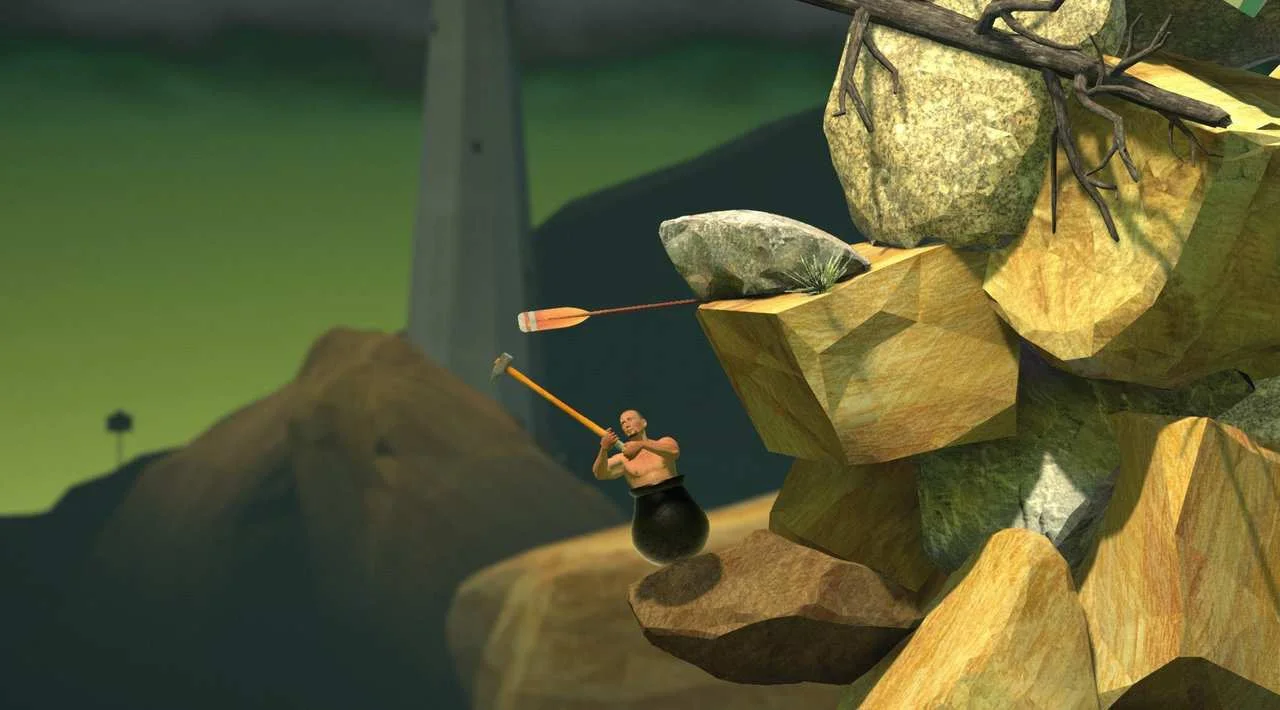
The entire game revolves around hammer-based locomotion. Your character cannot walk or jump normally. Instead, you swing the hammer around the pot, use its head to catch surfaces, and push or pull yourself through the obstacle course.
Small movements let you make controlled adjustments around rocks, branches, furniture, and other pieces of the mountain. Larger swings can launch you upward or across a gap, but they also create more risk. The physics are consistent enough to reward practice, yet demanding enough that familiar obstacles can still punish careless input.
The camera uses a close third-person perspective, keeping the pot and hammer at the center of the screen while revealing the route ahead. Because the hammer is both your tool and your only meaningful form of movement, positioning the cursor becomes a constant exercise in angle control, momentum management, and precision recovery.
There is no combat system and no conventional puzzle inventory. The challenge comes from reading the terrain, choosing where to plant the hammer, and committing to movements that can either advance the climb or send you sliding back toward earlier sections.
Why the controls become the progression system
Getting Over It replaces character upgrades with player mastery. Your pot does not become stronger, faster, or more durable. You become better at understanding how the hammer interacts with different surfaces.
Early attempts are often spent discovering basic techniques: hooking around a ledge, pushing off a slope, stabilizing after a launch, and using the hammer beneath the pot to gain vertical height. Later progress depends on chaining these actions without losing control.
The game is difficult because failure has structural consequences. A slip is not simply a failed jump followed by a nearby respawn. You may lose a substantial amount of progress and need to rebuild your route from a lower position. That progress-loss loop is central to the experience rather than an occasional penalty.
Bennett Foddy’s spoken commentary adds another layer to the climb. His observations discuss frustration, failure, game design, and the emotional response to difficult tasks. The commentary can be funny, philosophical, or deliberately uncomfortable, and it reacts to the player’s situation without turning the game into a story-driven adventure.
The mountain also functions as a memory test. Once you understand a difficult section, you can approach it more efficiently on future attempts. This makes the game suitable for repeated runs, personal bests, and speed-oriented practice even though the main structure is a single continuous ascent.
A compact challenge designed for repeated attempts
Getting Over It has a focused content model. There is one main climb, one core movement system, and a small set of achievements tied to progress and completion. The appeal comes from replaying the route with greater control rather than unlocking a large campaign or collecting extensive gear.
The commercial structure is equally direct. The PC version is sold as a standalone paid game on Steam, and the storefront does not present a season pass, table-style content packs, character classes, or a separate multiplayer edition. Players are buying the complete central challenge rather than a live-service framework.
That compact design makes the game easy to understand but hard to exhaust. A first successful ascent is a major goal. Afterward, some players return to reduce mistakes, improve consistency, test different movement techniques, or pursue faster runs.
Players who enjoy unforgiving vertical platforming may also want to compare it with precision climbing platformers such as Jump King. The games use different movement systems, but both turn lost height into the main consequence of failure.
Who should play Getting Over It?
This game is a strong fit for players who enjoy masocore challenges, physics experimentation, and mastery loops that do not soften failure. It is especially suitable for people who find satisfaction in repeating the same section until a difficult motion becomes automatic.
It also works well as a short-session game. You can make a serious attempt in a limited sitting, stop after a frustrating fall, and return later without having to remember a complex plot or manage a long quest log.
However, the design is intentionally hostile to players who expect regular checkpoints, adjustable accessibility options, combat variety, or steady narrative rewards. The game does not gradually broaden its mechanics to keep the experience comfortable. Its central idea remains the same from the opening climb to the final ascent.
Players looking for a more conventional platformer with defined rooms, frequent checkpoints, and a wider range of movement abilities may prefer precision platform adventures like Celeste. The two games share an interest in difficult movement, but their approaches to recovery and progression are very different.
PC controls and platform features
The intended PC input is the mouse. The hammer follows the cursor, so sensitivity, desk space, and the ability to make smooth circular motions can influence how comfortable the game feels. Precision matters more than rapid button presses.
Bennett Foddy also confirmed gamepad support in the Steam community, although he noted that mouse control is generally the better fit. On a controller, the hammer is handled through the analog sticks, creating a viable alternative for players who prefer gamepad input but a different precision challenge.
The Steam listing identifies single-player support, commentary, Remote Play on Phone, Remote Play on Tablet, and Family Sharing. It does not list online multiplayer, local co-op, split-screen, dedicated servers, mod tools, or competitive matchmaking.
PC players should also note the localization scope. The Steam listing provides interface and subtitle support in English, Japanese, Russian, Korean, and Simplified Chinese. English includes full audio, matching the importance of Bennett Foddy’s spoken commentary.
The game is distributed through Steam on PC. No separate launcher, anti-cheat system, or DRM technology is prominently identified on the public storefront page beyond the Steam distribution environment, so those should not be treated as independent gameplay features.
Similar games and genre context
Getting Over It is often grouped with rage games and difficult platformers, but its defining feature is more specific: physics-driven climbing with a single tool. The player is not simply timing jumps. Every movement is generated through the hammer’s contact with the world.
Jump King is a useful comparison for its emphasis on vertical progress and catastrophic falls, while Celeste offers a contrasting model built around precise platforming rooms and frequent resets. Neither reproduces Getting Over It’s cursor-controlled hammer physics.
Another nearby comparison is vertical obstacle games such as Only Up!, which also make upward movement and lost height central to the player’s tension. The difference is that Getting Over It is far more mechanically concentrated, with nearly every meaningful action emerging from the hammer and pot.
The term Foddian is also used for games inspired by Bennett Foddy’s approach to difficult traversal, especially designs where a single mistake can cause major setbacks. The label describes a family resemblance, not an official game mode or separate platform category.
Getting Over It with Bennett Foddy FAQ
Is Getting Over It with Bennett Foddy still the current PC name?
Yes. The current Steam storefront listing retains the exact name Getting Over It with Bennett Foddy. No verified PC rebrand, renamed Steam edition, or replacement title was identified during the storefront check.
What kind of game is Getting Over It?
It is a single-player physics-based climbing and platforming game. The core loop is climbing a continuous mountain with a hammer, recovering from mistakes, and gradually improving your control over the pot and hammer.
Does the game have checkpoints?
No conventional checkpoint system is listed. Falling can send you back to a lower part of the mountain, so preserving progress and recovering safely are fundamental parts of the design.
Can you play Getting Over It with a controller?
Yes. The developer confirmed that gamepad support exists, with both analog sticks used for hammer control. The mouse remains the intended primary input and is generally the more precise option for PC play.
Does Getting Over It have multiplayer or co-op?
No. The Steam feature list identifies the game as single-player and does not list online multiplayer, local co-op, or split-screen support. Remote Play on Phone and Remote Play on Tablet are listed as Steam platform features, not cooperative modes.
What languages are supported on PC?
The Steam listing supports English, Japanese, Russian, Korean, and Simplified Chinese for the interface and subtitles. English also includes full audio for the commentary.
Is there DLC or a season pass?
The PC release is presented as a standalone paid game. No DLC packs, expansion structure, or season pass is listed as part of the current storefront offering.
System Requirements
Minimum: | Recomended: |
| Processor: Intel Core i3 2x2 GHz Graphics: 512 MB Intel HD 4000 Memory: 2 GB RAM Disk space: 1 GB HDD Operating system: Windows Vista | Processor: Intel Core i3 2x2.5 GHz Graphics: 2 GB GeForce GTX 970 / Radeon RX 470 Memory: 4 GB RAM Disk space: 1 GB HDD Operating system: Windows 10 |
Screenshots


Trailer/Gameplay
Download
Getting Over It with Bennett Foddy (2017), 0.57GB
ElAmigos release, game is already cracked after installation (crack by Codex).

Updated to version 1.7 (06.01.2022).

1. Extract files.
2. Burn or mount the image.
3. Install the game.
4. ElAmigos release, game is already cracked after installation.
5. Play the game. If you like this game, BUY IT!
Getting Over It with Bennett Foddy Download
🔒 Premium access required
To see and use the download links, you must be logged in and have an active PREMIUM account.
* Unlock downloads via Torrent and TeraBox.
Torrent Download
The best torrent download speeds are with qBittorrent!